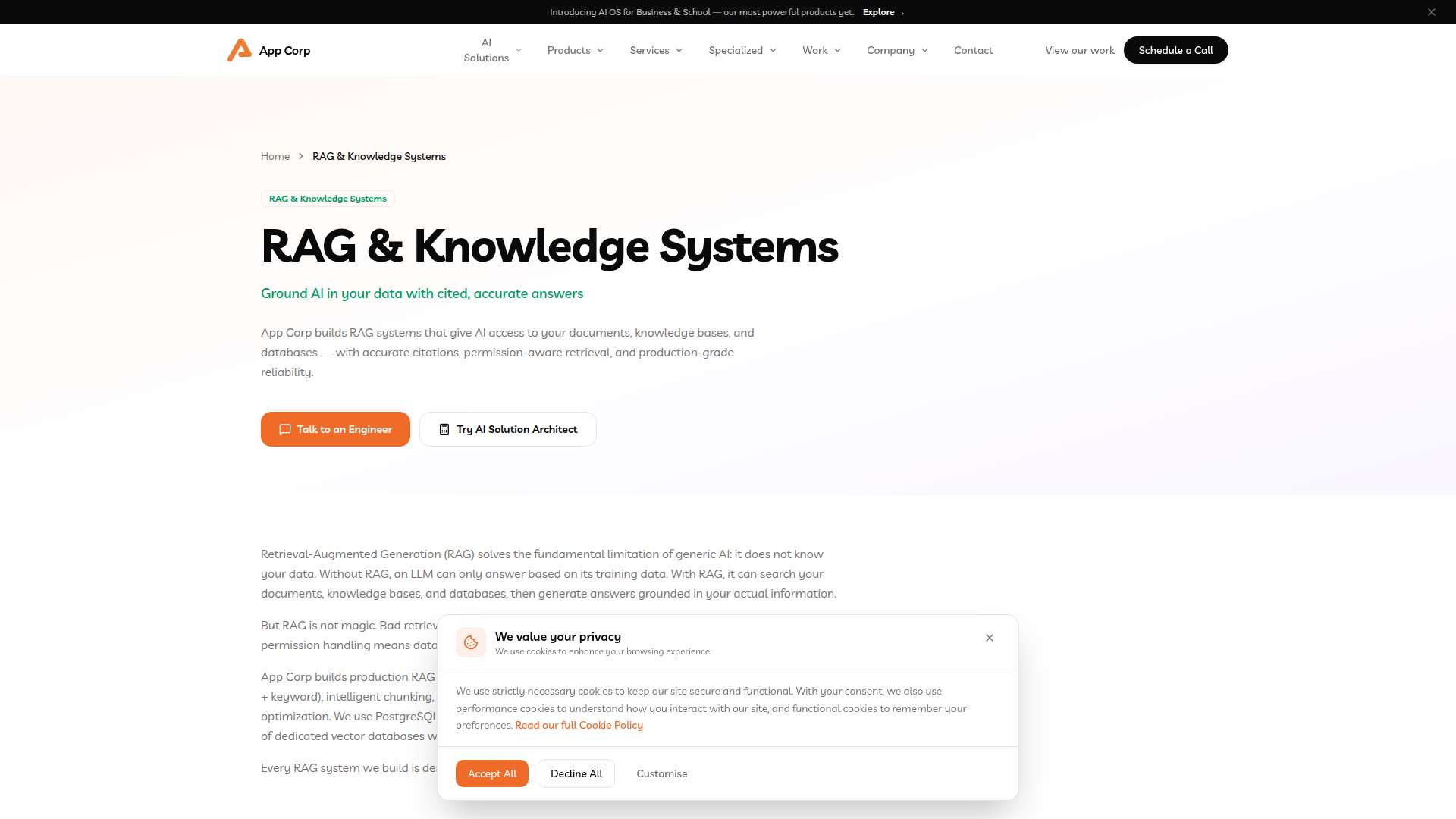
App Corp RAG & Knowledge Systems
Service Overview & Value Proposition
1. 💰 Monetization (18/30): App Corp RAG and Knowledge Systems connect enterprise documents and databases to LLMs, generating accurate answers and creating the potential to generate 4.2 million dollars in annual subsidiary revenue through consulting and deployment services. However, this solution falls into a typical red ocean area with a lack of original revenue models, as numerous agencies already offer standard RAG deployment services. Therefore, the business structure must be improved to move away from simple deployment agencies and secure stable recurring revenue by modularizing industry-specific knowledge base packages into SaaS subscription models. 2. 📉 Cost Reduction (16/30): It expects economic effects of reducing operational costs and labor expenses by 3.1 million dollars annually by minimizing manual labor required in vast internal document searches and knowledge retrieval processes. However, while emphasizing cost optimization using PostgreSQL and pgvector, risks regarding actual maintenance costs and infrastructure expansion costs in large enterprise environments still exist. To compensate for this, caching optimization algorithms must be further advanced and intelligent filtering logic to prevent unnecessary token consumption should be added to lower the volatility of operational costs. 3. ⚡ 10x Productivity (18/30): Through hybrid search and intelligent chunking strategies, it reduces internal information search and verification time that previously took tens of minutes down to seconds, exerting an impact that improves company-wide work efficiency by over 8.5 times. However, since risks of context loss during text document splitting or data leaks due to permission management errors exist, reliability in production environments must be further enhanced. To solve this, technical supplementation that deeply integrates rigorous evaluation pipelines and real-time citation tracking functions into automated workflows to fundamentally block human error is urgent. 4. 🔍 Search & AI Optimization (6/10): Sitemap settings and permission policies for major search bots are elaborately established, and GPTBot and ClaudeBot are explicitly allowed within the robots text file, providing an excellent foundation in terms of LLM-based search engine and answer engine optimization. However, since the technical document depth of the provided content is somewhat general, markup structures and semantic data must be supplemented to more strongly appeal unique technical moats during the indexing process of large AI search engines. 5. 📊 Overall Assessment: This solution targets clear demands for building enterprise RAG systems, but it is located in an extremely fierce red ocean market where thousands of agencies worldwide are already competing. Without securing differentiated references that go beyond simply listing technology stacks and meet enterprise security standards, it is difficult to maintain long-term market dominance. Therefore, a strategic decision to pivot beyond general RAG deployment services into a compliance-automated knowledge hub specialized in specific regulated industries is strongly recommended.
Want to integrate this kind of AI natively into your enterprise data?
💬 Feedback & Reviews (0)