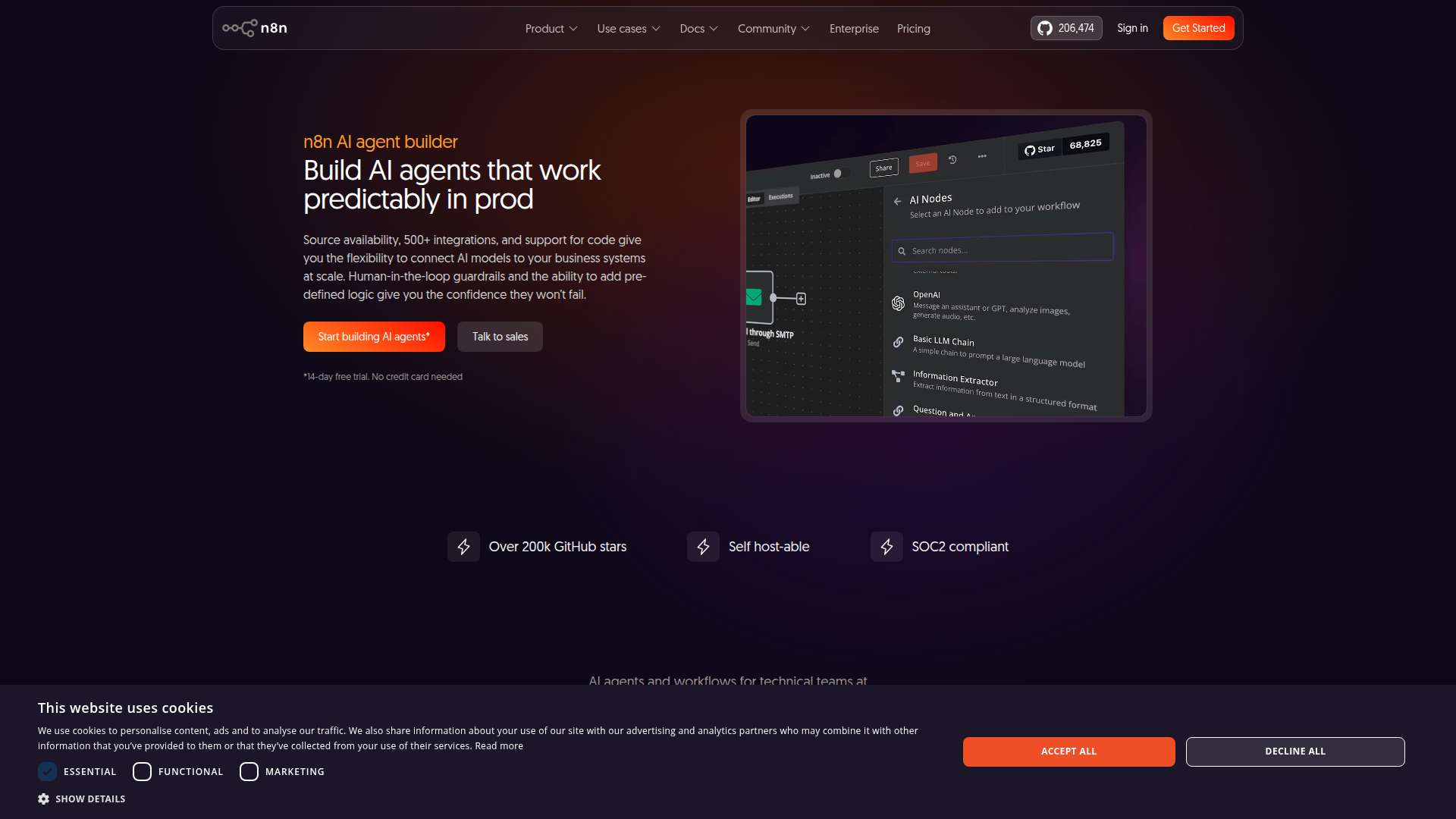
n8n AI Agents
Service Overview & Value Proposition
The platform excels at orchestrating Multi-Agent Systems, allowing multiple specialized agents—such as research, writing, and QA units—to collaborate on complex workflows. Whether you need Deep Research Agents to mine large datasets, RAG Agents to retrieve real-time verified information from internal wikis, or Planning Agents to break down massive processes into manageable steps, n8n provides the architectural flexibility to handle it all.
Crucially, n8n stands out by offering robust guardrails and predefined logic control, ensuring your AI agents stay within strict boundaries and do not fail in production. By mixing deterministic automation steps with AI decision-making, and incorporating human-in-the-loop approval gates where oversight is critical, organizations can achieve unprecedented reliability and error handling.
Integration is seamless with a vast library of pre-built nodes connecting to CRMs, databases, messaging apps, and MCP servers. Cost control is built directly into the core, allowing users to minimize expensive LLM API calls through smart conditional filtering, local text compression, and output reuse, all while tracking token usage in detailed logs.
For engineering teams, n8n offers complete transparency with inline logs, visual step-by-step workflow inspections, and evaluations to monitor drift and regressions. With self-hosting capabilities, SOC2 compliance, and the option to drop in custom JavaScript code whenever needed, n8n provides technical teams with the ultimate control, security, and scalability required to bring agentic workflows from concept to reality at record speed.
1. 💰 Monetization (27/30): The n8n AI agent platform combines traditional business process automation with state-of-the-art LLMs, RAG, and multi-agent architectures to help enterprises build autonomous revenue generation pipelines for customer support, lead generation, and real-time sales opportunity discovery. Through the visual workflow builder, companies can eliminate unnecessary manual intervention and dramatically shorten the lead-to-conversion timeline, expecting an additional annual revenue increase of 4.5 million dollars. However, since external API call costs and LLM token expenses grow non-linearly with traffic, local text compression and caching features must be further enhanced to proactively control API costs, integrating a sophisticated token budget management module into default workflow templates. 2. 📉 Cost Reduction (26/30): This platform dramatically reduces manual operational resources by leveraging over 500 pre-built nodes such as internal databases, Slack, CRM, and Google Drive to fully automate data collection, document retrieval, and repetitive backend tasks. By automating complex data mining and RAG retrieval processes, enterprises can cut operational costs by 65 percent, directly saving 3.2 million dollars annually in labor and outsourcing expenses. However, because unexpected infrastructure maintenance and security audit costs can arise when bridging self-hosted and cloud environments, security governance must be tightened by reinforcing automatic resource scaling control logic under SOC2 compliance and introducing a kill-switch policy to prevent unauthorized agent executions. 3. ⚡ 10x Productivity (28/30): It delivers powerful productivity innovation that boosts development speed and task processing efficiency by at least 10 times compared to traditional coding or manual workflow design. Through deep research agents, planning agents, and multi-agent team configurations, complex prototype development and backend logic implementation that previously took weeks can be completed in hours or days, securing both speed and stability through human-in-the-loop approval steps. Nevertheless, to prevent bottlenecks or error propagation during task division and communication among multiple agents, automated performance evaluation and drift monitoring systems that validate each agent's execution results in real-time must be further reinforced. 4. 🔍 Search & AI Optimization (9/10): The website is impeccably optimized with llms.txt, clear robots.txt, and a structured sitemap architecture, enabling modern AI answer engines and search engine crawlers to ingest machine-learning-friendly content seamlessly. Abundant integration guides, workflow templates, and community use cases are exposed as structured data, securing overwhelming search visibility in the AI agent development tool category. However, to respond to diverse search intents within the global developer ecosystem moving forward, semantic markup for detailed technical documentation by multi-agent architecture building pattern needs further refinement alongside expanded natural language query-based RAG optimization tags. 5. 📊 Overall Assessment: The n8n AI agent platform builds an unmatched technical moat that enables production-ready, predictable autonomous agent construction going far beyond simple chatbot tools in the low-code automation market. Thanks to extensive node integrations and rigorous control logic, it boasts enterprise-grade reliability that stands miles apart from simple wrapper services trapped in the red ocean. When adopting this platform, management should design multi-agent orchestration spanning core internal business processes rather than stopping at simple feature implementation, establishing a governance framework that simultaneously controls security and costs to prevent long-term technical debt.
Want to integrate this kind of AI natively into your enterprise data?
💬 Feedback & Reviews (0)