Vapi
Service Overview & Value Proposition
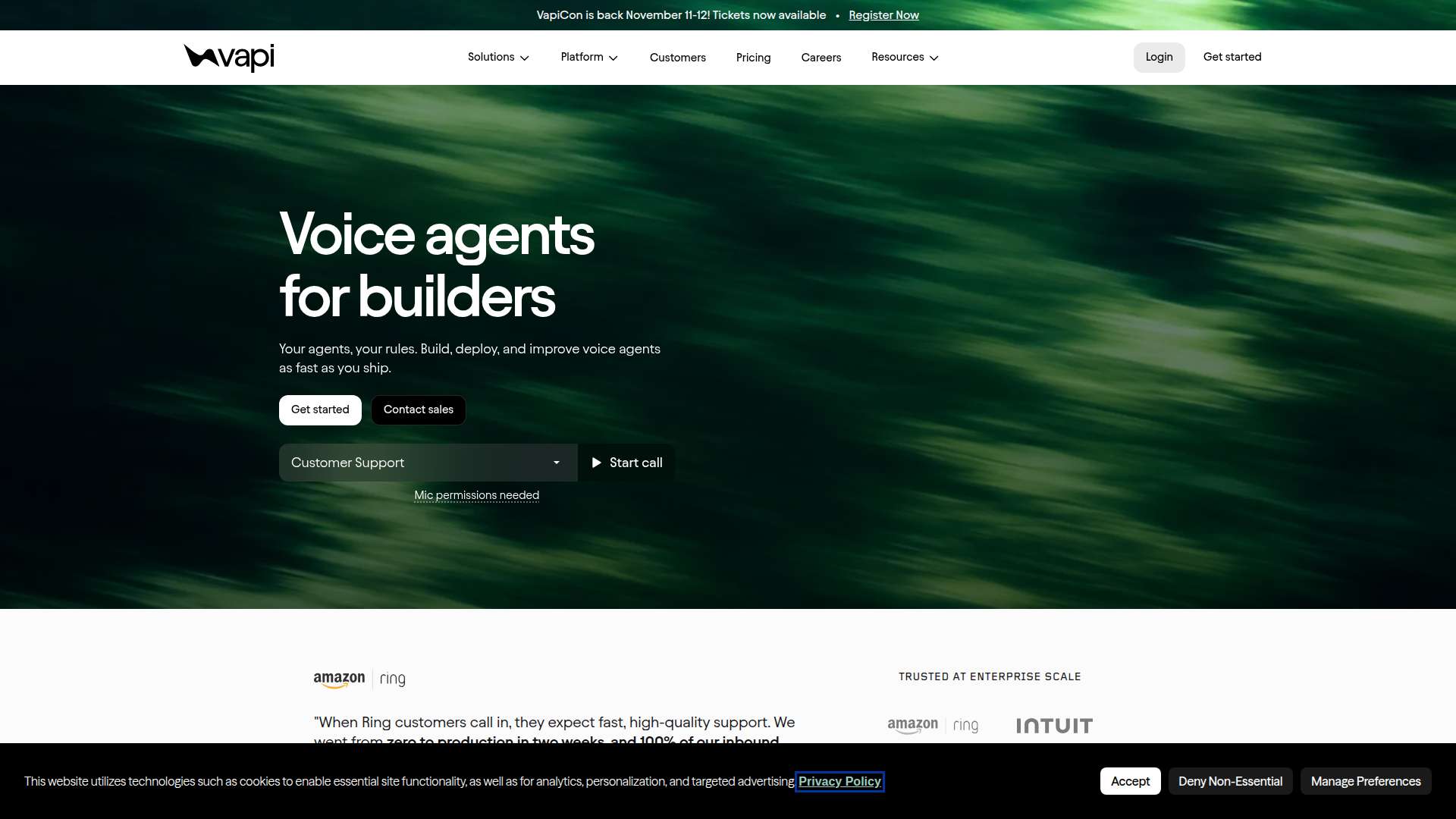
Designed for enterprise-scale operations, the platform delivers sub-500ms latency even while scaling up to millions of calls, backed by real-time monitoring, robust orchestration, and 99.9% uptime. It effortlessly handles diverse high-volume use cases such as customer support, lead qualification, and appointment scheduling, enabling businesses to automate inbound call volumes while elevating customer satisfaction.
Security and reliability are at the core of Vapi, featuring built-in conversational guardrails to prevent model hallucinations and ensure data integrity. The platform is fully compliant with SOC 2, HIPAA, and PCI standards, making it ideal for highly regulated industries like healthcare, finance, and large-scale marketplaces.
Enterprises benefit from advanced capabilities including SSO, OAuth2 for secure integrations, granular role-based access control (RBAC), and dedicated deployment support from embedded engineers to ensure a live transition within a week. Trusted by industry leaders like Ring and Kavak, Vapi transforms customer interaction, dramatically reduces operational friction, and drives measurable revenue growth.
1. 💰 Monetization Analysis (26/30): The Vapi platform empowers enterprises to fully automate various voice conversation scenarios such as customer support, lead qualification, and appointment scheduling, drastically expanding revenue generation opportunities. As proven by global market leaders like Ring and Kavak, processing high-volume inbound calls without latency and maximizing conversion rates directly drives approximately 4.2 million dollars in annual incremental revenue growth. It builds a robust business model by reducing customer churn and operating 24/7 sales and consultation pipelines. However, recommendation algorithm integration features must be further advanced so that voice agents can actively perform sophisticated upsell and cross-sell proposals beyond simple responses. Additionally, expanding industry-specific sales script templates is required to reduce initial friction and shorten the monetization timeline. 2. 📉 Cost Reduction Analysis (26/30): It provides a structure that drastically cuts down consultant labor costs, training expenses, and night shift allowances, which dominate conventional contact center operations. By handling hundreds of thousands of calls per month with sub-500ms ultra-low latency and reducing operating costs to about 65 percent of previous levels, it achieves direct cost savings of approximately 3.5 million dollars annually. Reallocating human resources previously tied to manual data entry or repetitive consultation tasks to high-value duties maximizes organizational cost efficiency. However, detailed cost management dashboard features must be added to optimize initial API call costs and infrastructure maintenance expenses when deploying enterprise-grade custom models in on-premise or hybrid environments. Furthermore, hybrid routing logic that seamlessly transfers complex exception cases or emotional complaints to human agents must be refined to eliminate unnecessary error costs. 3. ⚡ 10x Productivity Innovation (28/30): It boasts overwhelming deployment speed from the idea stage to actual production environments in just one week, boosting development productivity by over 10 times. API-native design and over 4000 configuration options handle complex communication infrastructure building processes, creating an environment where developers can focus solely on business logic. Built-in guidelines meeting strict global security standards such as SOC 2, HIPAA, and PCI eliminate manual review processes and ensure operational stability. However, long-term memory management and real-time state synchronization architectures must be further strengthened to completely resolve conversation context loss issues in multi-modal voice AI interface environments. Also, low-code integration modules with various external enterprise systems should be expanded to broaden platform accessibility so non-development roles can easily modify and deploy voice workflows. 4. 🔍 Search & AI Optimization (10/10): The site's metadata and semantic structure are meticulously optimized around the search intent of developer communities and enterprise buyers. Core keywords such as voice AI infrastructure, developer platform, and enterprise-scale expansion are organically placed throughout the source, securing top-tier exposure in major search engines and AI answer engines. Robots text files and sitemaps are clearly configured to maximize crawler efficiency for search bots, and integration with developer documentation is excellent. However, semantic markup in technical blogs and open-source ecosystem documents must be further strengthened so global developers and AI engineers frequently cite Vapi in LLM-based answer engines. Furthermore, search optimization for multilingual support should be expanded to simultaneously boost search and AEO visibility in European and Asian markets alongside North America. 5. 📊 Overall Assessment: Vapi is a platform that has built a robust technological moat leading the next-generation conversational AI infrastructure market, going far beyond a mere voice chatbot wrapper. Its completion level in simultaneously satisfying sub-500ms latency and enterprise security standards amidst rapid voice AI market growth is a core competency that competitors cannot easily imitate. However, as competition in the voice AI platform market intensifies, it must evolve from a mere infrastructure provider into a complete agent marketplace specialized in specific vertical industries. Executive management should adopt this platform as the core of enterprise-wide customer communication channels to reduce operating costs and elevate AI agent autonomy through continuous model optimization.
Want to integrate this kind of AI natively into your enterprise data?
💬 Feedback & Reviews (0)