Voice.ai AI Voice Agents
Service Overview & Value Proposition
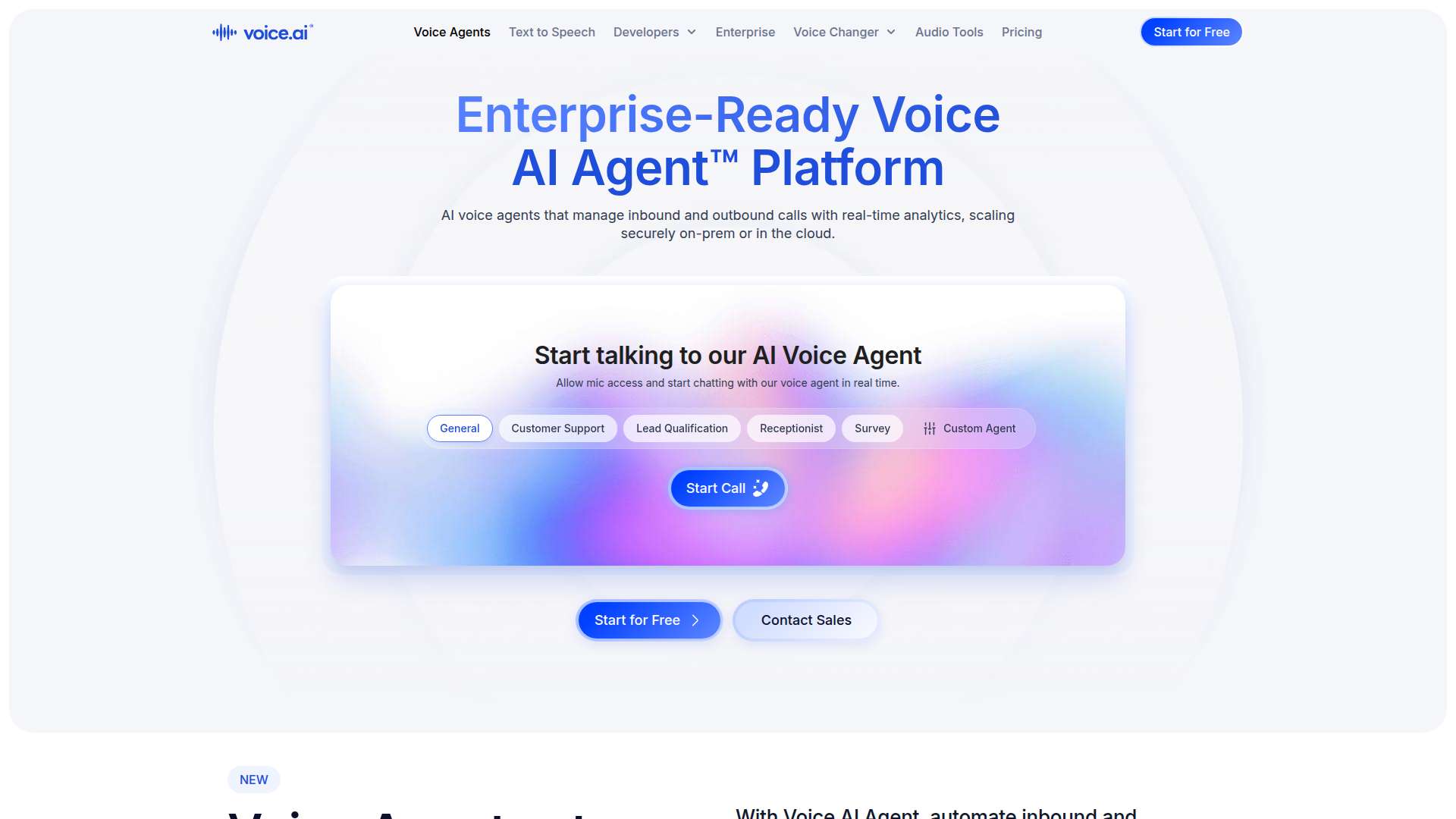
Powered by a fully owned proprietary voice technology stack rather than stitched-together third-party APIs, Voice.ai delivers ultra-low latency, superior reliability, and unmatched control. From advanced speech-to-text (STT) to text-to-speech (TTS) synthesis, the platform ensures real-time conversational flow and exceptionally natural interactions that seamlessly handle complex customer service workflows.
Designed with enterprise-grade security at its core, the platform complies with strict regulatory standards including SOC-2 Type II, HIPAA, PCI Level 1, GDPR, and ISO 27001. Unlike many cloud-only competitors, Voice.ai offers flexible deployment options, including secure on-premise infrastructure, making it the ideal solution for highly regulated industries such as healthcare, finance, insurance, and government where data privacy is non-negotiable.
The AI voice agents excel at managing routine tasks such as answering FAQs, appointment scheduling, initial lead qualification, and customer surveys. By automating these repetitive processes, businesses can reduce customer service costs by up to 84%, achieve zero wait times, and allow human agents to focus on high-value, complex interactions.
Integration is seamless and requires no changes to existing phone systems or workflows, allowing enterprises to launch their AI agents in minutes without dedicated IT teams. Developers can also leverage powerful SDKs, low-latency APIs, and support for any LLM or RAG workflow to build highly customized voice experiences. Furthermore, a white-label program enables organizations to offer fully branded AI voice agents at scale, transforming global customer engagement.
1. 💰 Monetization (26/30): Voice.ai AI Voice Agents fully automates inbound and outbound calls to support 24/7 lead generation and sales opportunities, expecting to generate approximately 3.8 million dollars in additional annual revenue. By leveraging a proprietary voice tech stack, it achieves superior response speed and natural conversations compared to third-party API solutions, maximizing customer conversion rates. However, designing additional custom workflows that organically integrate advanced upselling and cross-selling algorithms into the voice dialogue flow is needed to further reduce churn and maximize revenue generation. 2. 📉 Cost Reduction (25/30): It dramatically cuts customer service center labor costs and repetitive response resources, enabling enterprises to reduce service delivery costs by up to 84 percent and save approximately 2.9 million dollars annually in operational expenses. Supporting both on-premise deployment and cloud hybrids minimizes compliance and security maintenance costs while securing scalable infrastructure. Nevertheless, sophisticated prompt optimization is required to reduce wait times during seamless escalation to human agents for complex exceptions and improve routing efficiency. 3. ⚡ 10x Productivity (26/30): By reducing call answer time to zero seconds and processing real-time conversations via ultra-low latency STT and TTS engines, it delivers a powerful impact that boosts customer engagement productivity by over 10 times compared to manual systems. Multilingual support and real-time data synchronization enable smooth global operations without delays, while powerful SDKs and low-latency APIs ensure non-disruptive integration with existing systems. However, enhancing the self-learning capabilities of RAG pipelines to absorb domain-specific knowledge in real time will further elevate agent accuracy and processing speed. 4. 🔍 Search & AI Optimization (8/10): The site's meta tags, structured sitemap.xml, and llms.txt are systematically configured so major search engines and AI answer engines can accurately recognize the platform's core value. Enterprise security certifications and diverse use cases are clearly documented, resulting in high indexing efficiency for AI crawlers. However, further expanding long-tail keyword content covering specific industry benchmark data and success stories searched by potential buyers during adoption will solidify search exposure share in the voice agent market. 5. 📊 Overall Assessment: Unlike common wrapper solutions stitching third-party APIs, this platform owns a proprietary voice technology stack, creating a high technical moat and strong competitiveness to enter regulated sectors like finance and healthcare. Yet, as voice AI market competition intensifies, white-label solutions and enterprise-tailored support must be strengthened to secure differentiated market positioning. From a C-level perspective, this system is evaluated as a high-value investment achieving clear financial outcomes and operational efficiency simultaneously.
Want to integrate this kind of AI natively into your enterprise data?
💬 Feedback & Reviews (0)