Gumloop
Service Overview & Value Proposition
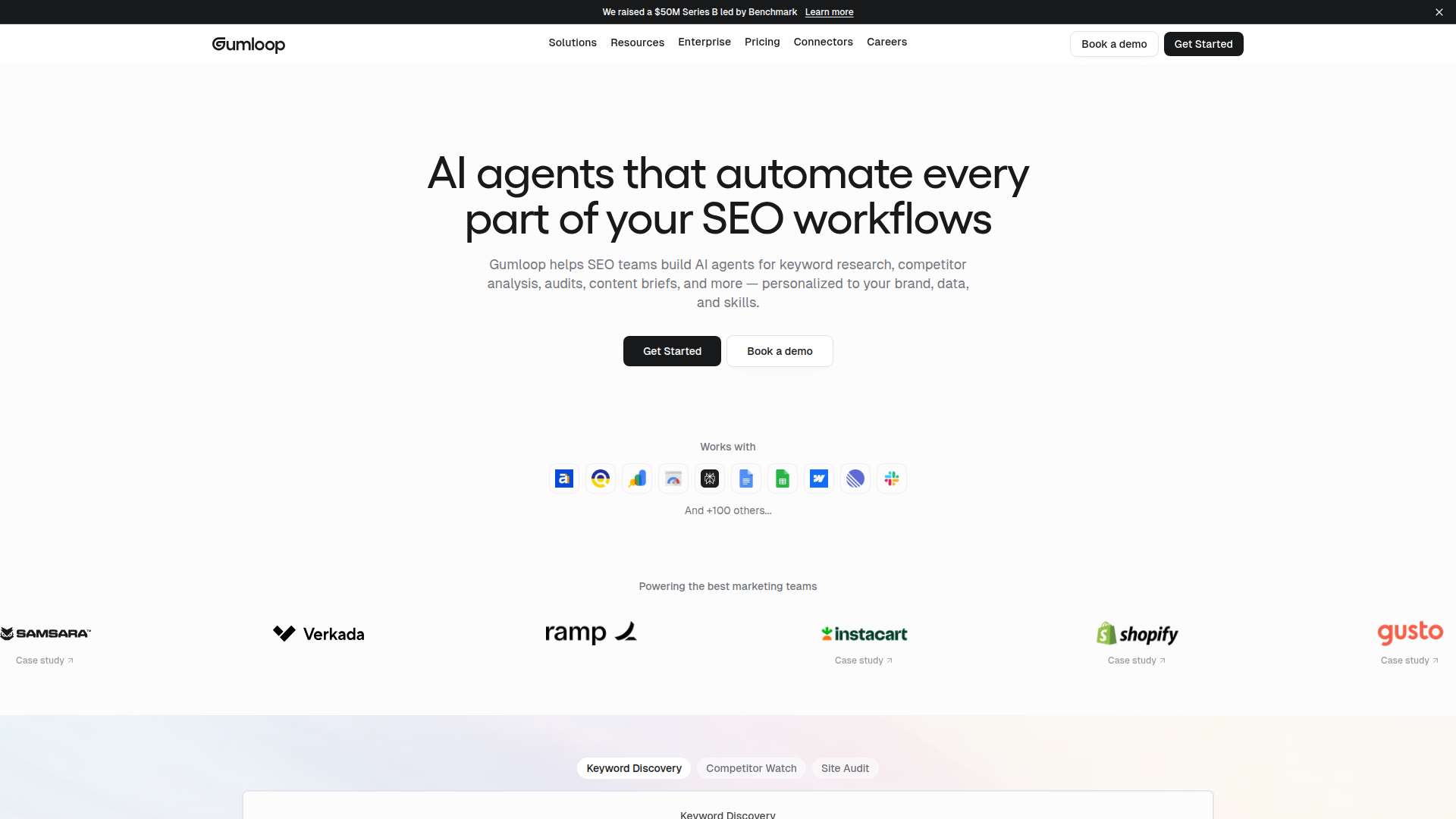
While traditional SEO tools merely spit out massive lists of raw data and keywords, Gumloop's AI agents deeply understand your brand context, priorities, and existing content assets to surface actionable keywords worth chasing.
Marketers and SEO managers can delegate entire pipelines—including keyword research, competitor gap analysis, technical site audits, and content brief generation—saving dozens of hours of manual labor.
It seamlessly connects with over 100 marketing tools and MCP servers including DataForSEO, Ahrefs, Google Search Console, and your CMS, ensuring your agents operate right where your data lives.
Agents work around the clock in the cloud, running daily rank tracking, weekly content audits, and continuous SERP monitoring, while delivering branded executive summaries directly to Slack or email.
Users can orchestrate multi-agent workflows where agents hand off tasks collaboratively—for instance, an audit agent flags a site issue, a content agent rewrites the page, and a reporting agent confirms traffic recovery.
It can bulk-generate meta titles and descriptions for thousands of pages in over six languages while strictly respecting character limits and maintaining an authentic brand voice.
Built with enterprise-grade security including role-based access control (RBAC), audit logging, and SOC 2 Type II compliance, Gumloop empowers marketing teams and agencies to scale efficiently.
With strict Zero Data Retention (ZDR) policies ensuring customer data is never used to train public AI models, sensitive business insights and strategies remain entirely secure.
Ultimately, Gumloop acts as an intelligent virtual teammate that transforms raw SEO data into automated execution, driving compounding organic growth and superior search rankings.
1. 💰 Monetization (26/30): Gumloop is evaluated to contribute approximately 3.8 million dollars in additional annual revenue by maximizing organic traffic through SEO automation and multi-agent workflows. By automatically planning and publishing targeted content leveraging brand context and existing link equity rather than simple keyword lists, high-conversion search traffic acquisition accelerates significantly. However, to maximize this model, a sophisticated feedback loop that prioritizes high-value keyword groups based on real-time funnel conversion data is required as a supplement. 2. 📉 Cost Reduction (25/30): By fully automating keyword research, competitor gap analysis, large-scale meta tag generation, and weekly site audits that previously took hundreds of hours, marketing labor and external agency outsourcing costs can be reduced by approximately 1.9 million dollars annually. Operational waste is drastically cut as bots perform multilingual optimization and repetitive reporting 24/7. Nevertheless, advanced usage monitoring and cost control guardrails are required to prevent unexpected API credit spikes and manage complex permissions across marketing tools. 3. ⚡ 10x Productivity (26/30): Through a multi-agent architecture where rank tracking, weekly audits, and SERP monitoring are organically integrated, the SEO planning cycle is shortened from over two weeks to mere minutes, boosting operational productivity by over 12x. The handoff mechanism where an audit agent flags issues, a content agent rewrites meta tags, and a reporting agent briefs via Slack minimizes human intervention. However, technical reinforcement is essential to refine custom skill rules and verification processes to prevent hallucinations or brand voice drift during agent handoffs. 4. 🔍 Search & AI Optimization (10/10): With clearly implemented robots.txt and llms.txt files ensuring accessibility for AI answer engines and crawlers, the platform exhibits exceptional exposure suitability in AEO and GEO environments. Content briefs and metadata generated by agents accurately reflect search algorithm trends, adhering strictly to copywriting standards and character limits. Future strategies should expand structured data markup and continuously update microdata aligned with semantic web standards. 5. Overall Assessment: Gumloop establishes a unique technical moat as an advanced autonomous AI agent builder that integrates enterprise data and marketing workflows far beyond simple wrappers. While the SEO automation market is competitive, enterprise-grade security via zero data retention policies and SOC 2 Type II compliance serves as a powerful differentiator. Management should expand departmental agent collaboration enterprise-wide to eliminate human errors and accelerate full marketing autonomy.
Want to integrate this kind of AI natively into your enterprise data?
💬 Feedback & Reviews (0)