HiringAgents.ai - Agentic AI Hiring Platform
Service Overview & Value Proposition
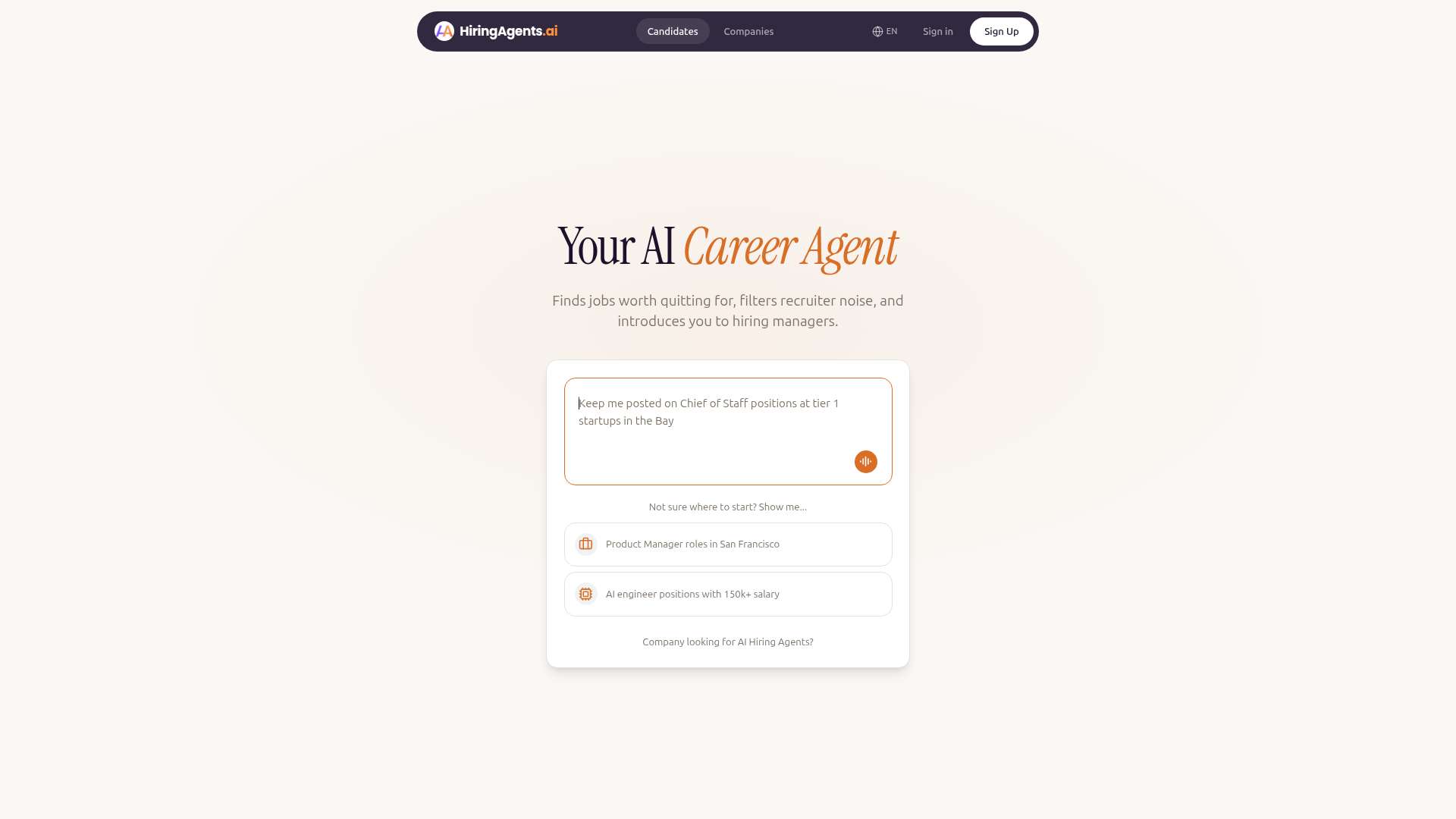
Instead of struggling through complex job boards filled with recruiter noise, users can simply talk to Hunter, an AI career agent, to share what truly matters to them in their next role.
The AI agent works around the clock to scan all available job postings, filter out irrelevant options, and only bring forward opportunities that are genuinely worth quitting for.
Candidates receive a white-glove headhunter treatment, bypassing spam and getting directly introduced to hiring managers for roles that precisely fit their career goals.
The system operates seamlessly even when you are not actively looking, quietly monitoring the market for top-tier startup positions, high-paying AI engineering roles, and specialized product management opportunities in major tech hubs.
For companies, the platform delivers free top-of-funnel tooling and affordable automated sourcing solutions to identify and connect with ideal talent with unprecedented speed.
HiringAgents.ai ultimately serves as a personal AI agent that bridges the gap between top-tier talent and visionary hiring managers through intelligent, automated, and personalized career matchmaking.
1. 💰 Monetization (18/30): The HiringAgents.ai platform holds the potential to disrupt traditional headhunting markets by directly matching candidates and companies using agentic AI. Through a background hunter agent operating 24/7 to scan and connect high-paying positions, it is estimated to generate 1.8 million dollars in annual premium matching fees and enterprise sourcing SaaS subscription revenue. However, because this is an extremely red ocean market crowded with numerous LinkedIn-based automation tools and AI headhunting startups, securing a differentiated revenue model is urgent. To overcome this, beyond premium white-glove matching based on candidate performance data, a customized talent pipeline predictive subscription model for enterprises should be introduced to diversify revenue streams. Furthermore, reducing friction in internal platform payment systems and adopting smart contract-based performance fee settlements upon successful placement could significantly enhance revenue generation efficiency. 2. 📉 Cost Reduction (16/30): Operational costs can be significantly reduced by fully automating the inefficient sourcing processes where corporate recruiters and headhunters manually review resumes and send cold messages. This allows enterprise HR teams to save 1.2 million dollars in annual operational expenses by cutting down resources spent during initial talent discovery and screening stages, while minimizing opportunity costs by shortening time-to-hire. However, the current system remains at the level of simple text prompt matching, presenting limitations where human intervention is still required during complex job competency verification processes. Therefore, advancing fully autonomous interview screening and competency verification agent workflows to lower human intervention rates below 5 percent is necessary to achieve true cost reduction. Additionally, a real-time cost-saving dashboard function that clearly demonstrates ROI versus adoption costs must be added to the enterprise console to prevent customer churn. 3. ⚡ 10x Productivity (18/30): By having the 24/7 autonomous career agent Hunter handle the manual tasks of searching jobs and writing applications on behalf of candidates, the platform achieves an innovation of reducing job search time by over 90 percent. For enterprises as well, the speed of filtering out noise from hundreds of applications and selecting only suitable candidates is accelerated by more than 8 times compared to traditional methods, maximizing recruitment pipeline throughput. However, due to the lack of sophisticated context sharing and long-term memory architectures among multi-agents, technical limitations exist in reflecting users' subtle career preference changes in real-time. To improve this, the personalized career history learning module based on RAG must be strengthened, and a multi-agent collaboration system that automatically orchestrates communication between candidates and recruiters should be established. Furthermore, advancing interfaces that allow real-time modification of agent instructions through voice or natural conversation is essential. 4. 🔍 Search & AI Optimization (6/10): The site's robots.txt and sitemap.xml settings are properly configured to allow crawling by major search engines like Google and Bing, establishing a foundational search exposure base. Also, through targeted keywords such as career agent, there is potential for partial citations in AI answer engines when relevant queries occur. However, due to a lack of structured data and semantic markup in conversational AI search engines like ChatGPT or Perplexity, metadata is somewhat insufficient for deep citations and recommendations. To resolve this, Schema.org structured data must be fully applied to job postings and agent service introduction pages, and text content centered on FAQs and use cases favored by AI answer engines should be substantially reinforced. Additionally, the truncation issue in the llms.txt file draft must be fixed to complete technical optimization so AI crawlers can fully understand the core value of the platform. 5. 📊 Overall Assessment: While the service's approach of solving the chronic noise problem in the recruitment market using agentic AI is commendable, it is positioned in an extremely red ocean market crowded with numerous AI recruitment solutions and recruiting automation tools. If it fails to move beyond a simple chatbot-based wrapper form that anyone can easily replicate by integrating APIs, building long-term technological moats will be difficult and it risks being eliminated in market preemption competition. Therefore, going beyond simple job scanning, an proprietary multi-agent pipeline that deeply analyzes cultural fit between candidates and companies must be established, and references in the global top-tier startup market should be secured early. Rather than focusing on short-term UI convenience improvements, management should concentrate company-wide capabilities on transitioning to an advanced architecture that maximizes AI agent autonomy and minimizes human intervention.
💬 Feedback & Reviews (0)