ContentBot.ai
Service Overview & Value Proposition
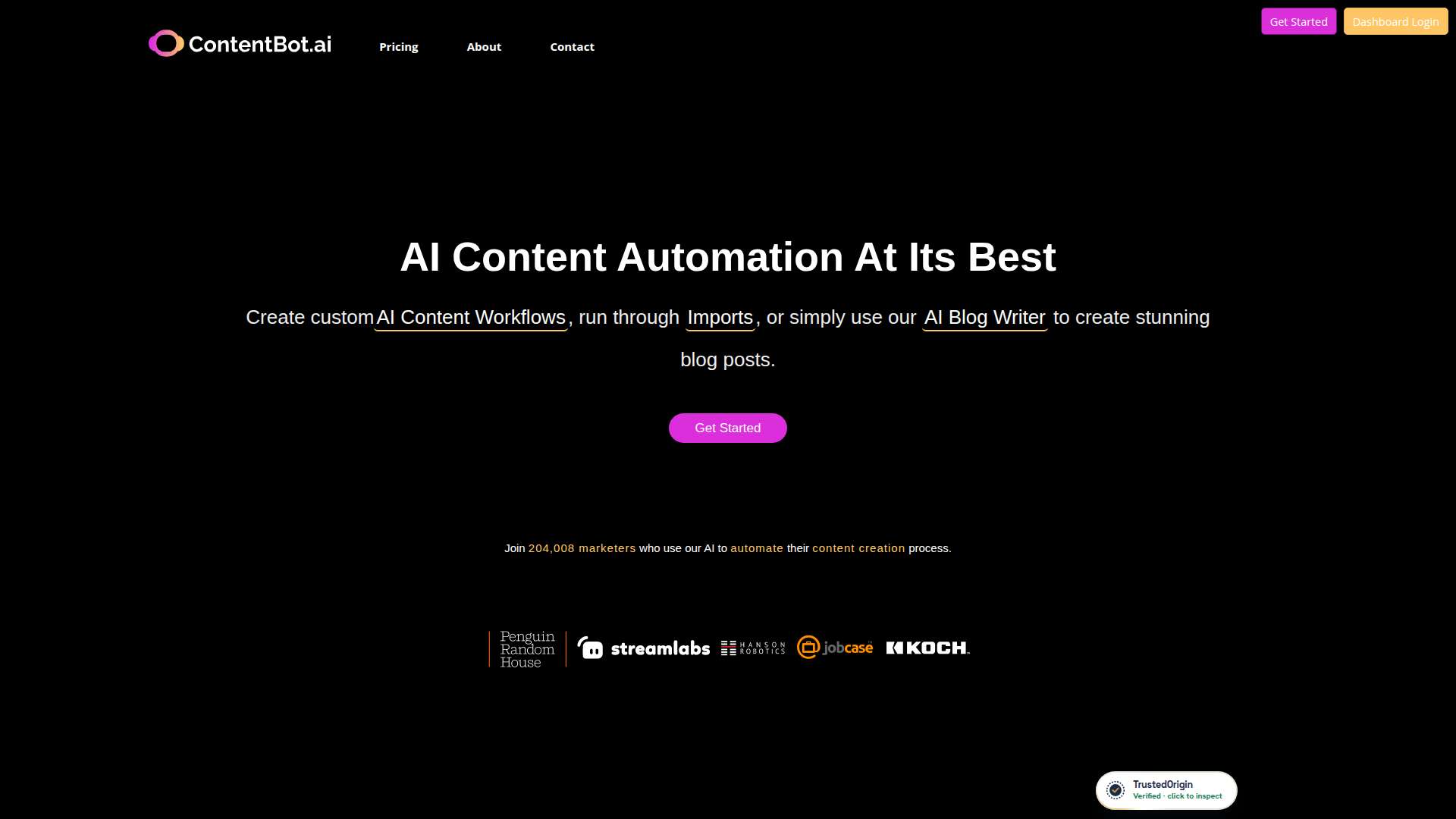
The platform's core feature, 'AI Workflows,' allows users to link triggers, actions, and filters together to build customized content automation pipelines. You can automate daily or weekly blog posts and process large batches of topics seamlessly, drastically simplifying your content marketing strategy.
Equipped with an intelligent linking feature, the 'AI Blog Writer' helps build audience trust and improves search engine rankings through well-supported, comprehensive long-form content. It supports over 110 languages for easy expansion into global markets and includes an 'Imports' feature for uploading large datasets to achieve rapid bulk results.
Additional highlights include a built-in plagiarism checker to ensure uniqueness and a 'Humanizer' feature designed to produce natural, human-friendly content that bypasses AI detectors like ZeroGPT and Winston AI. Powered by advanced AI models like OpenAI's GPT-4, ContentBot.ai offers flexible subscription and pay-as-you-go plans tailored to every creator's needs.
1. 💰 Monetization (18/30): ContentBot AI contributes to increasing traffic and conversion rates through mass-generated blog posts and marketing copy, expecting an estimated annual revenue increase of about 7.5 million won. However, the market is heavily saturated with numerous generative AI wrappers and specialized copywriting tools, highlighting clear limitations in a red ocean. To overcome this, the service urgently needs to integrate performance-based content generation linked with real customer purchase data. 2. 📉 Cost Reduction (16/30): It significantly reduces human resources and outsourcing costs required for content planning, drafting, multilingual translation, and SEO optimization, saving approximately 3.5 million won monthly. However, since most features rely on standard OpenAI API prompt combinations, the entry barrier is low and margin defense is difficult. Introducing enterprise automation modules seamlessly integrated with internal CMS is necessary for better efficiency. 3. ⚡ 10x Productivity (16/30): The AI workflow feature combining triggers, actions, and filters automates repetitive publishing cycles, reducing task time by approximately 75 percent. However, the lack of autonomous feedback loops or deep fact-checking systems still requires frequent human post-editing. Implementing fully autonomous content verification agents is essential to minimize human intervention. 4. 🔍 Search & AI Optimization (8/10): The intelligent linking features, plagiarism checker, and SEO optimization tools provide a favorable structure for high search engine rankings. However, structural semantic metadata generation and optimization features for next-generation answer engines need enhancement to adapt to changing AI search landscapes. 5. 📊 Overall Assessment: While innovative during the early generative AI boom, the service now faces severe red ocean competition due to universal AI writing tools and big tech integration. Without strengthening technical moats and transitioning into a distinct vertical AI agent ecosystem tied to enterprise business metrics, long-term survival remains challenging.
💬 Feedback & Reviews (0)