AI Legal Assistant
Service Overview & Value Proposition
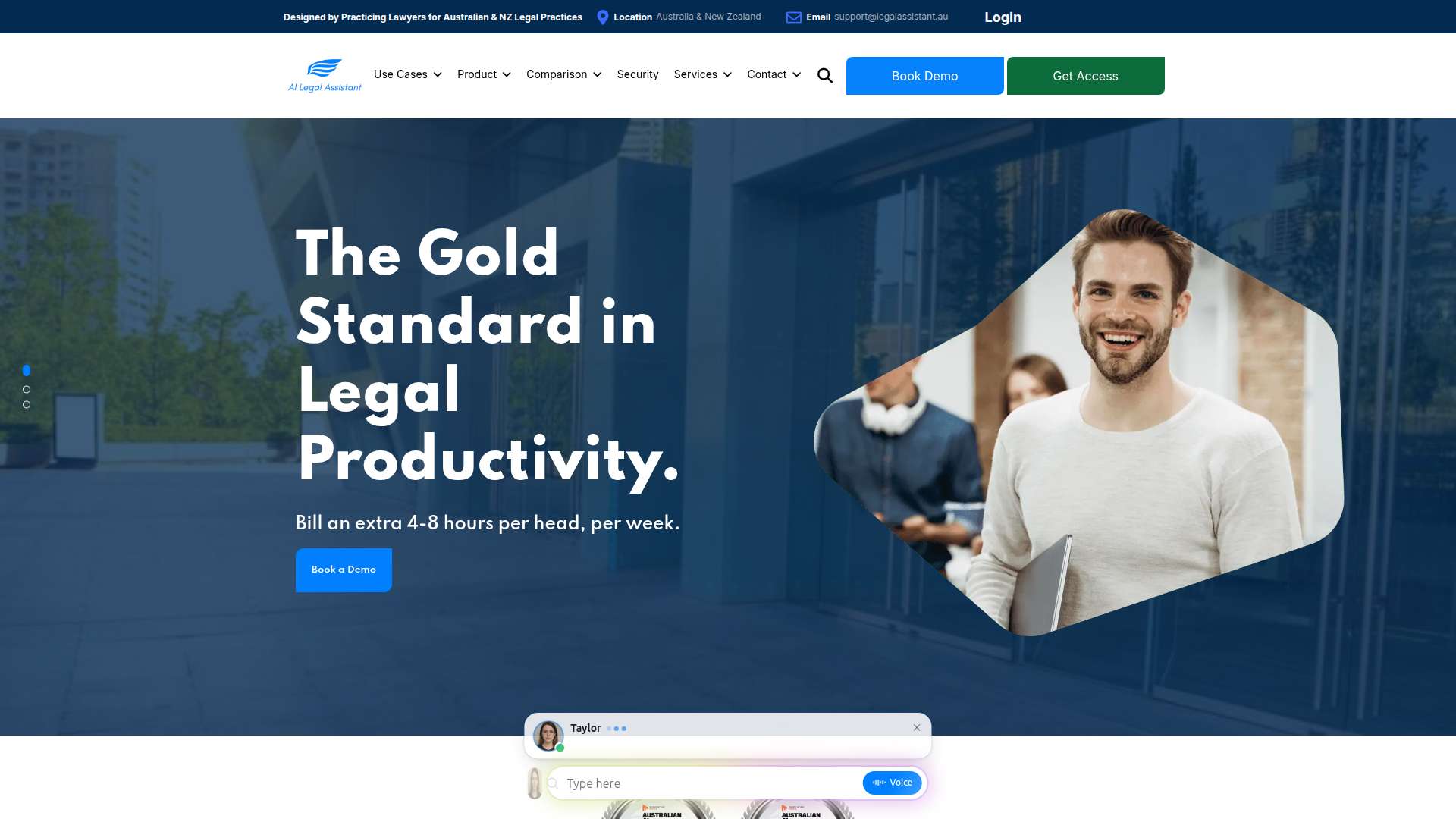
The platform goes beyond basic text generation by offering instant document review capabilities that identify ambiguities, conflicting terms, missing clauses, and non-standard language with precision. Through an intuitive conversational interface, users can discuss complex documents as if collaborating with a senior colleague, run sanity checks, and generate tailored correspondence effortlessly.
Trained continuously on Australian and New Zealand legal precedents and updated weekly with the latest cases, the built-in research assistant delivers accurate citations and deep legal insights instantly. Features like voice-to-text conversion seamlessly transform spoken discussions into structured emails, meeting summaries, and actionable items.
With stringent ISO 27001 certification and SOC 2 compliance, the platform ensures that highly confidential legal data remains secure and protected. Whether for solo practitioners, private practices, or corporate in-house legal teams, AI Legal Assistant redefines efficiency and productivity across the entire legal industry.
1. 💰 Monetization (23/30): Targeting the legal markets of Australia and New Zealand, the AI Legal Assistant secures an additional 4 to 8 billable hours per lawyer per week, substantially maximizing law firm revenues. Deploying this system in mid-sized firms is estimated to generate approximately 450,000 dollars in annual additional fee-earning revenue, demonstrating overwhelming value creation compared to manual document review. However, beyond the subscription SaaS model, diversified revenue strategies such as pay-per-use models for complex contract analysis or private on-premise custom deployment packages for large firms must be secured. To expand future revenues, a marketplace integration model connecting legal consumers with in-house legal teams should be introduced to strengthen overall platform ecosystem profitability. 2. 📉 Cost Reduction (22/30): By automating tasks that junior lawyers and administrative staff manually perform for tens of hours, such as complex contract reviews, legal research, and precedent analysis, labor costs and operational expenses are dramatically reduced. Implementing this solution saves approximately 320,000 dollars per law firm annually in labor and outsourced research costs, and considering legal risk expenses from human errors, the financial savings are even greater. However, initial onboarding time costs for training legal practitioners and temporary operational efficiency drops during data integration with legacy document management systems must be minimized. To enhance cost reduction sustainability, automation rates for repetitive legal drafting and document indexing handled by AI agents must be increased, accompanied by refined error-detection processes. 3. ⚡ 10x Productivity (24/30): It delivers innovative time savings, reducing advisory letter writing tasks that normally take a day and a half to just 3 hours, while maximizing operational efficiency through multi-document reviews and real-time research assistants. The RAG architecture, updated weekly with extensive Australian and New Zealand case law data, supports lawyers in instantly securing accurate citations and reliable legal grounds. However, precise validation layers must be added to completely eliminate occasional hallucinations during natural language conversational interfaces and to more precisely detect ambiguous clause conflicts across complex multi-contracts. To further elevate technical perfection, speech-to-text recognition rates for accents and legal jargon must be continuously improved, and workflow synchronization speeds among real-time collaborative agents optimized. 4. 🔍 Search & AI Optimization (7/10): The website's meta tags, sitemap, and semantic structure are solidly organized via WordPress plugins, allowing search engine crawlers to smoothly index key legal AI keywords. The robots configuration and agent-related keyword placement effectively drive search traffic from the target audience of Australian and New Zealand legal professionals. However, to enhance brand credibility in global AI answer engine and chatbot-based search environments, structured data markup must be expanded and rich snippet optimization related to legal AI use cases strengthened. A complementary strategy is required to restructure blog insight articles and regulatory content into natural language question formats to maximize AEO exposure share. 5. 📊 Overall Assessment: The AI Legal Assistant is a highly effective specialized solution designed directly by practicing lawyers to accurately address field pain points, yet it operates in a fiercely competitive red ocean crowded with strong global players like Harvey, Spellbook, and CoCounsel. Therefore, building differentiated local trust assets centered on region-specific regulatory compliance for Australia and New Zealand, along with ISO 27001 and SOC 2 security compliance, is core to survival. Management must accelerate the product roadmap toward minimizing human lawyer intervention through advanced multi-agent autonomous workflows and solidify market entry barriers via exclusive partnerships with major law firms.
💬 Feedback & Reviews (0)