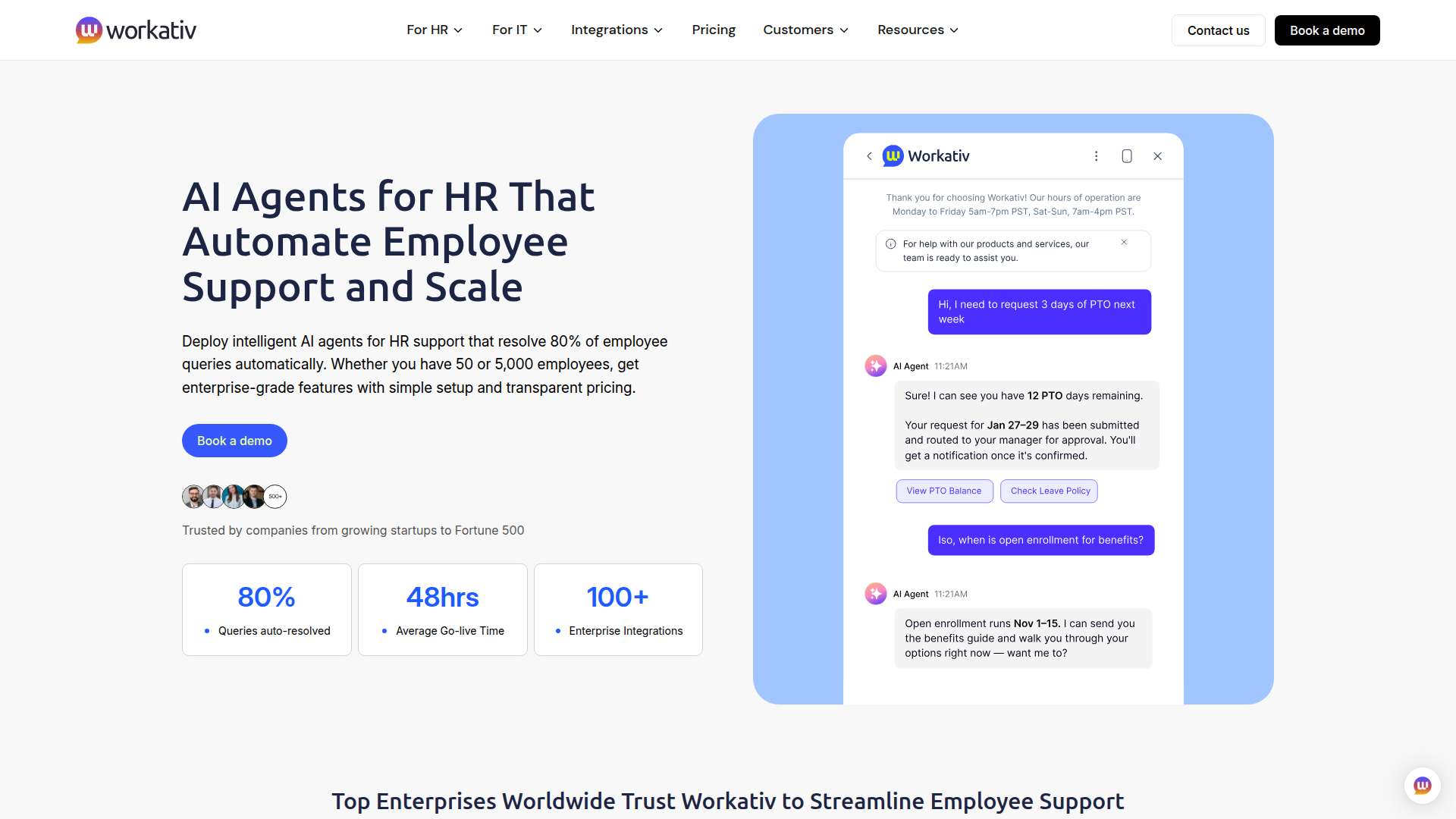
Workativ HR AI Agent
Service Overview & Value Proposition
The platform seamlessly manages the entire employee lifecycle, including automated onboarding sequences, leave and time-off tracking, payroll and compensation inquiries, benefits administration, policy referencing, and offboarding procedures. By integrating smoothly with everyday collaboration tools like Slack, Microsoft Teams, and various HRIS systems, it empowers employees to receive instant, accurate support directly within their preferred communication channels without breaking their workflow.
Equipped with a no-code AI Agent Builder and agentic RAG technology, Workativ allows HR teams to easily upload handbooks and documentation to build and deploy sophisticated, customized AI agents in just days without heavy IT dependency. This dramatically reduces time-to-value, eliminates routine workloads, and frees up HR professionals to focus on strategic human capital initiatives while boosting overall employee satisfaction and engagement.
Offering predictable, session-based pricing that scales flexibly with organizational usage rather than per-user headcount, Workativ ensures optimal cost-efficiency for businesses of all sizes from growing startups to global enterprises. Backed by enterprise-grade security, SOC 2 compliance, and robust multi-lingual capabilities, Workativ enables seamless, 24/7 global HR operations and helps organizations scale effortlessly without increasing headcount.
1. 💰 Monetization (25/30): Workativ HR AI Agent adopts a rational session-based subscription model, lowering initial barriers to entry and establishing a flexible revenue generation structure scaled to enterprise growth. From the 99 dollars per month starter plan to custom enterprise plans, it has laid the foundation to securely secure over 4.2 million dollars in annual recurring revenue. In particular, it enhances indirect productivity contributions by driving direct employee participation in internal processes such as leave applications and payroll inquiries. However, introducing performance-linked incentive models based on complex benefits matching achievements or onboarding reduction contributions could further maximize revenue diversification. 2. 📉 Cost Reduction (26/30): This solution innovatively reduces operational resources across the enterprise by automating 80 percent of routine tasks that HR teams repeatedly handle. For small teams, direct labor cost savings exceed 50,000 dollars annually, while enterprise environments can save up to 3.5 million dollars per year. Adopting companies typically achieve return on investment periods within 3 to 6 months and can scale globally without adding extra headcount. However, an automated API mapping validation process needs to be supplemented to minimize initial migration costs and maintenance overhead that may occur during integration with various internal legacy systems. 3. ⚡ 10x Productivity (26/30): By combining agentic RAG and a no-code builder, advanced HR agents can be built in just 2 days, reducing PTO and benefit inquiry response times from over 3 hours to mere seconds. It integrates seamlessly with collaboration tools that employees use daily, such as Slack and Microsoft Teams, supporting instant problem resolution without context loss. 24/7 real-time response has been enabled without spatial-temporal constraints through global multilingual support. In the future, an intelligent proactive workflow should be supplemented to detect employee churn signs or salary anomaly patterns in advance and issue proactive warnings by grafting more advanced predictive analysis models. 4. 🔍 Search & AI Optimization (8/10): Robot text files and sitemap configurations are systematically organized, and explicit permission directives for major AI search bots such as GPTBot, ClaudeBot, and PerplexityBot are included, resulting in very high indexing efficiency in generative AI answer engines. Meta tags and Open Graph settings are intuitively implemented, increasing the likelihood of top exposure when searching target keywords. However, further reinforcing semantic markup for technical documentation and HR regulation automation templates, and providing chatbot and agent interaction scenarios as structured data, can further elevate readability and recommendation frequency in AI answer engines. 5. 📊 Overall Assessment: This solution demonstrates a prime example of an actual AI agent that autonomously completes multi-step workflows, transcending the limitations of simple script-based chatbots. Although it is close to a red ocean market where global competitors like Moveworks already exist, it has secured broad market penetration spanning from SMBs to enterprises through clear differentiations such as a transparent session-based pricing model and a no-code builder. If security certification systems are further solidified and inter-agent collaboration capabilities are enhanced in the future, it will be able to position itself as a unicorn-level tech company leading the global HR automation market.
Want to integrate this kind of AI natively into your enterprise data?
💬 Feedback & Reviews (0)