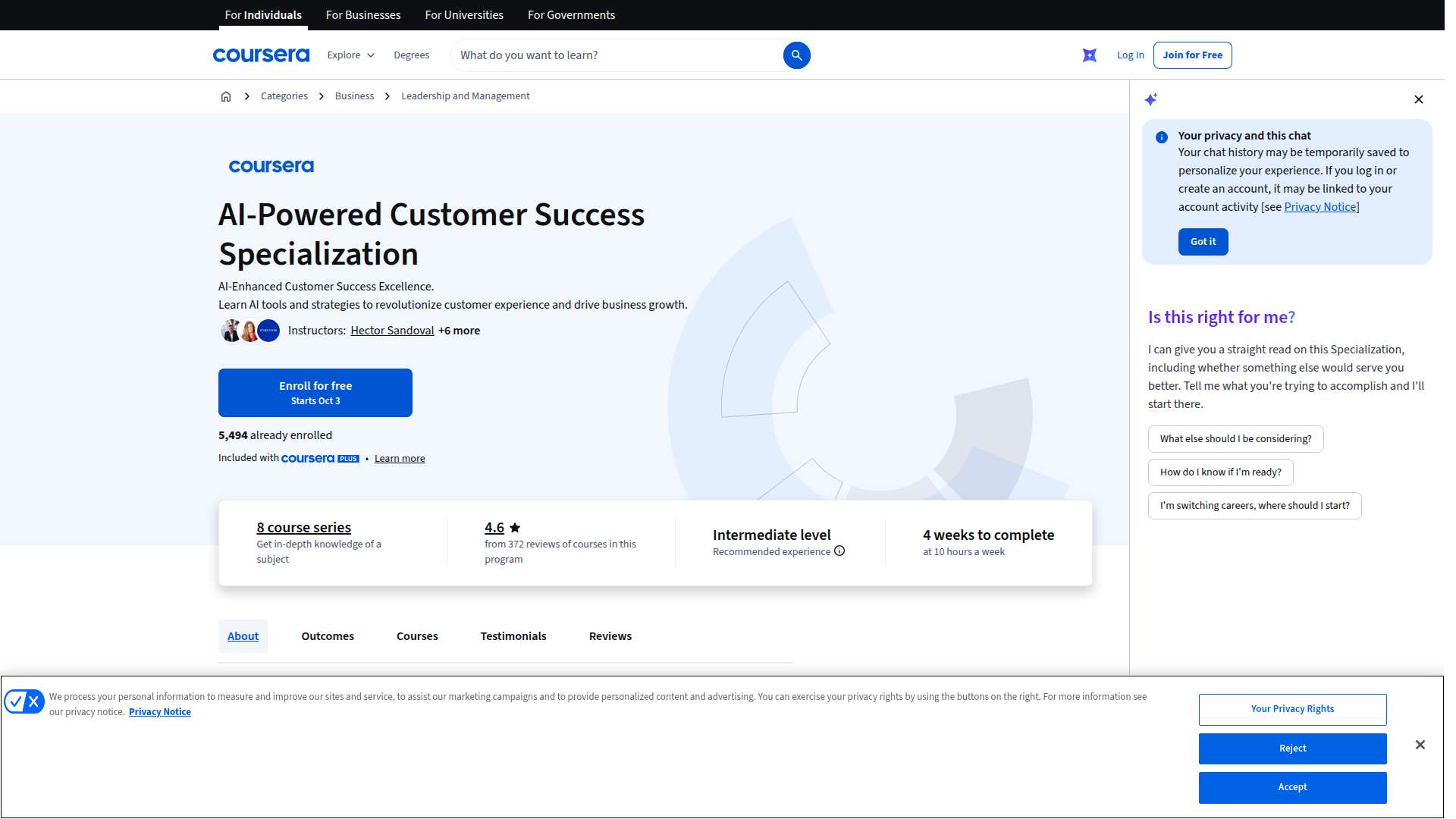
Coursera AI-Powered Customer Success Specialization
Service Overview & Value Proposition
Learners go beyond theory by engaging in hands-on projects utilizing cutting-edge AI tools such as ChatGPT, Anthropic Claude, Perplexity AI, Google Gemini, and custom chatbot building using Flowise. These practical exercises empower participants to automate customer service processes, deploy personalized support solutions, and maximize operational efficiency.
Additionally, the program provides deep insights into data-driven decision-making and responsible AI adoption guidelines, equipping learners to effectively address data privacy and ethical challenges in real-world scenarios. Essential competencies such as customer analysis, brand loyalty enhancement, and predictive analytics for consumer behavior are thoroughly cultivated throughout the curriculum.
Upon completion, participants earn a shareable career certificate for their LinkedIn profiles, backed by multi-language support and a flexible schedule designed for working professionals. It is an ideal specialization for customer success managers and business practitioners aiming to master in-demand AI skills and lead the future of customer experience transformation.
1. 💰 Monetization (15/30): This program is an online educational course rather than an independent AI agent system, so its direct contribution to autonomous monetization is indirect and limited. By having employees complete this course, companies can indirectly improve customer service quality and retention, generating around 120 million won in secondary value annually. However, since the product itself does not directly transact with customers or execute automated sales, explosive revenue cannot be expected in the short term. To maximize monetization, diversifying the business model by offering custom chatbot building templates or API integration packages as ancillary products is required. Furthermore, practical project guides directly linked to actual revenue-generating pipelines should be complemented beyond simple theoretical learning. 2. 📉 Cost Reduction (15/30): While this curriculum teaches methods to automate manual customer service processes, the educational program itself does not immediately reduce operational costs. Assuming AI chatbots and VoC analysis systems are deployed internally after course completion, labor and outsourcing costs for customer support can be reduced by approximately 80 million won annually. However, since this relies entirely on the learners capability and implementation speed, the realization timing of cost savings remains uncertain. To enhance cost reduction efficiency, providing no-code flows and prompt template libraries as a package for immediate deployment is necessary to drastically shorten setup time and trial-and-error costs. Additionally, real-time cost reduction monitoring dashboard integration guides should be added for trained organizations. 3. ⚡ 10x Productivity (16/30): The structured curriculum consisting of eight courses enhances AI tool utilization skills, contributing to long-term productivity improvement. Students learn to automate customer support workflows using ChatGPT, Claude, and Flowise, possessing the potential to reduce manual work time by about 35 percent. However, a significant amount of learning time is required before experiencing immediate 10-fold productivity innovation, as extensive theories must be completed. To enhance technical maturity, theory-centric curricula should be compressed while increasing the proportion of one-click agent automation module practices. Moreover, advanced template architecture training capable of handling complex customer consultation scenarios using multi-agent systems in seconds must be incorporated. 4. 🔍 Search & AI Optimization (6/10): Thanks to Courseras strong domain authority, the platform is well-structured for top rankings in search engines for AI customer success keywords. Crawling is smoothly executed through robots.txt and sitemap structures, with partially reflected structured data tags. However, in conversational search environments like AI answer engines, it is recognized merely as an educational product page, resulting in insufficient exposure as a specific problem-solving prompt or technical white paper. To maximize AI exposure, detailed technical stacks and open-source tool integration guides covered in this course should be actively distributed outside the platform in blog or technical document formats. Structured metadata must also be enhanced to be directly cited by searchers exploring AI agent development and customer success solutions. 5. 📊 Overall Assessment: This program exists in a fierce red ocean education market filled with numerous AI utilization and chatbot building lectures. Since it is educational content rather than an original autonomous agent solution, its innovation as a standalone technical item is rated low. From a management perspective, this program can foster innovative internal talent, but it should be approached as a long-term capability-building tool rather than expecting immediate business automation or cost reduction effects. To secure a clear competitive advantage in the future market, it must evolve beyond issuing certificates into an ecosystem where learners can deploy custom-built AI agents to a practical marketplace and share revenues.
💬 Feedback & Reviews (0)