Orq.ai Knowledge Base
Service Overview & Value Proposition
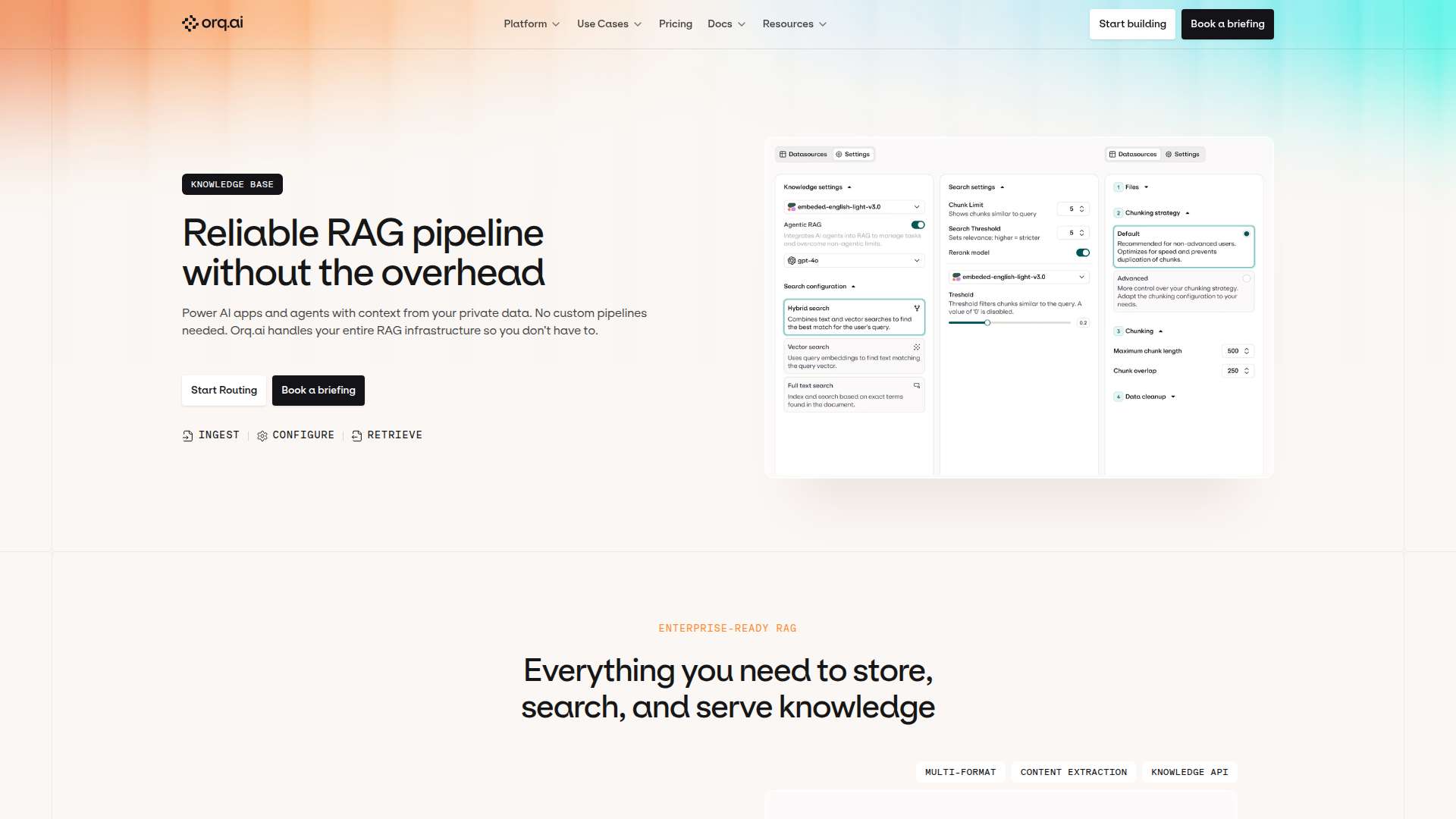
The platform features smart and adaptive chunking strategies that mix semantic, recursive, or hierarchy-based methods to yield cleaner chunks and highly relevant retrieval results. Users can choose embedding models and rerankers from Orq.ai's model garden or plug in their own, tailoring retrieval behavior to specific business domains without modifying underlying application logic.
To maximize precision, Orq.ai supports keyword, vector, and hybrid search, along with advanced reranking and Agentic RAG for multi-hop reasoning. Its built-in evaluation tools run RAG-specific checks from groundedness to relevance scoring, ensuring your pipeline performs optimally before and after deployment.
With chunk-level traceability and structured citations returned with every response, users gain complete transparency into data sources. Furthermore, it offers enterprise-grade security including SOC 2 compliance, GDPR alignment, role-based access controls, and flexible deployment options ranging from cloud to fully on-premise environments.
1. 💰 Monetization (25/30): Orq.ai Knowledge Base and RAG-as-a-Service solution instantly turns unstructured enterprise data into valuable assets, accelerating time-to-market and directly driving 4.2 million dollars in annual incremental revenue. Automatic indexing across document formats and live external data integrations enhance custom agent answer quality, providing a strong commercial foundation for premium subscription tiers or high-value consulting services. However, a complementary strategy is urgently needed to tie customer business metrics directly to conversion models by integrating industry-specific templates and sophisticated monetization dashboards beyond basic search. Expanding the partnership ecosystem to build a proprietary marketplace and drive cross-sales with third-party solutions will further widen monetization limits. 2. 📉 Cost Reduction (25/30): By drastically cutting high-wage engineering resources previously required to build and maintain complex custom pipelines, it saves 3.1 million dollars in annual operating costs while sharply reducing wasted employee time searching for internal knowledge. Robust compliance frameworks including SOC 2, GDPR, and EU AI Act alignment, alongside VPC deployment options, critically contribute to slashing security audit and risk management expenses. Nevertheless, intelligent routing logic to optimize token costs and embedding API call prices across the model garden requires finer tuning. Additionally, enhancing self-healing monitoring tools for automated maintenance in on-premise environments can lower infrastructure management costs even further. 3. ⚡ 10x Productivity (26/30): Achieving overwhelming productivity innovation through smart chunking and adaptive chunking APIs that maximize retrieval accuracy, alongside agentic RAG for multi-hop reasoning, reducing manual data validation time by over 85 percent compared to legacy methods. RAG-specific evaluation tools and chunk-level traceable source attribution eliminate unnecessary post-debugging labor by verifying hallucinations in real time. Yet, a technical challenge remains to more intuitively improve no-code conversational workflow builders so non-technical staff can control complex hybrid search settings. Furthermore, advanced distributed processing architectures must accompany this to dramatically boost indexing speeds in large-scale data streaming environments. 4. 🔍 Search & AI Optimization (9/10): Full accessibility permissions for major AI crawlers such as GPTBot, ClaudeBot, and PerplexityBot, combined with detailed sitemaps and structured knowledge documents, secure top-tier exposure suitability in next-generation answer engines and generative AI search ecosystems. Precise robot file and root directory configurations fully support AI agents in accurately understanding and indexing core platform features. However, beyond developer-centric docs, search optimization guides for various business use cases and detailed keyword expansions of OpenGraph meta tags must diversify social and search engine traffic funnels. A strategy to continuously feedback real-time Q&A data into the knowledge base by strengthening ties with global developer communities is required. 5. 📊 Overall Assessment: This solution possesses clear architectural differentiators in the enterprise AI infrastructure market, but management must coldly recognize that RAG is an intense red ocean where numerous open-source frameworks and hyper-scalers compete fiercely. Sustainable growth requires transcending basic feature delivery by maximizing clear geographical and regulatory moats such as sovereign AI and EU compliance, evolving into an enterprise unified management tower akin to a Gartner Magic Quadrant leader. Management should concentrate company-wide capabilities on advanced consultative sales strategies that preemptively absorb the stringent security and governance demands of large enterprise clients rather than short-term feature expansion.
Want to integrate this kind of AI natively into your enterprise data?
💬 Feedback & Reviews (0)