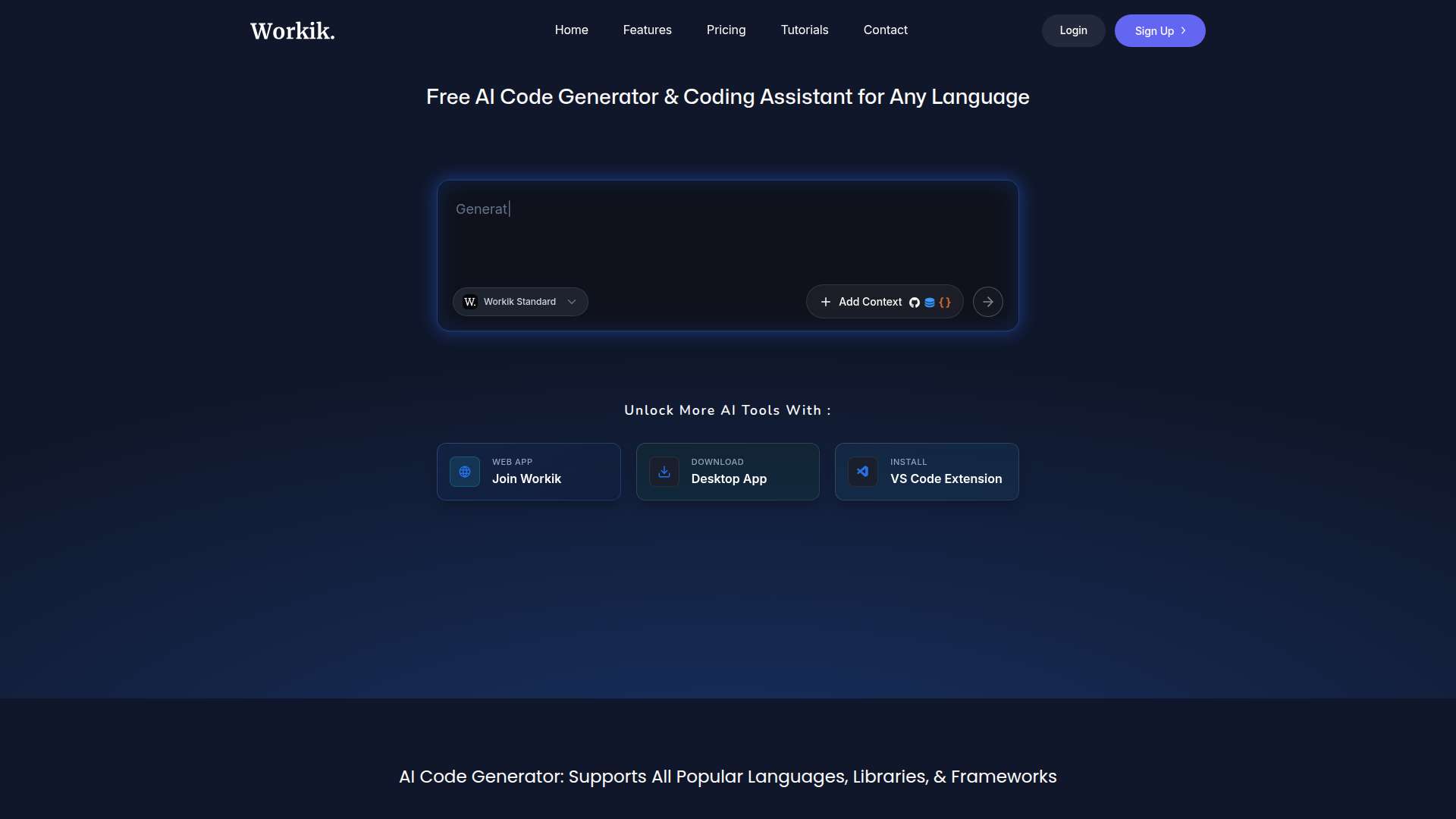
Workik AI Code Generator
Service Overview & Value Proposition
The platform allows users to freely choose and switch between the world's most powerful large language models, including GPT, Claude, Gemini, and DeepSeek, tailoring the AI experience to their specific coding preferences.
One of its most prominent features is deep context integration, enabling developers to link existing repositories from GitHub, GitLab, or Bitbucket, as well as database schemas and API blueprints, to generate highly accurate project-specific code.
Beyond basic code generation, it seamlessly handles everything from frontend UI scaffolding and backend CRUD API development to complex business logic implementation within seconds.
The tool also excels at automated code refactoring, performance optimization, and generating reliable unit and integration tests with realistic mock data to eliminate routine developer friction.
With robust support for web applications, desktop apps, and a dedicated VS Code extension, developers can easily incorporate Workik into their existing workflows without changing their preferred development environments.
Equipped with team collaboration tools and pipeline automation capabilities, Workik AI serves as an indispensable solution for solo developers and enterprise engineering teams alike to supercharge their overall software delivery lifecycle.
1. 💰 Monetization (24/30): Workik AI code generator plays a crucial role in maximizing development productivity, accelerating software release cycles, and generating additional digital service commercialization revenue. By selecting various LLM models and linking with actual repository context to generate customized code, it reduces outsourcing dependence and multiplies in-house service expansion capabilities. This is estimated to achieve an annual revenue increase and feature acceleration effect of approximately 2.1 million dollars. However, to fully automate complex enterprise-level business logic beyond simple snippet generation, customized fine-tuning options and revenue-sharing marketplace models need further enhancement. 2. 📉 Cost Reduction (24/30): This solution significantly reduces resource consumption by automating repetitive tasks across the development lifecycle, from frontend component scaffolding and backend API construction to unit test writing and large-scale refactoring. By saving countless hours developers spend on debugging and boilerplate writing, it directly reduces labor and external consulting costs by approximately 1.8 million dollars annually. In particular, automated GitHub pull request reviews and database schema documentation act as key factors in lowering maintenance costs. However, token optimization and caching layers must be additionally introduced to stably control API cost volatility resulting from multi-model calls. 3. ⚡ 10x Productivity (26/30): The workflow where AI accurately understands project structure and instantly produces high-context code through seamless integration with existing repositories like GitHub, GitLab, and Bitbucket demonstrates a classic 10x productivity boost. By simultaneously supporting web apps, desktop apps, and VS Code extensions, it possesses an exceptional architecture allowing developers to experience natural pair programming without breaking their workflow. API integration and test code writing that previously took days manually are completed in seconds, radically accelerating team processing speeds. Nevertheless, a step-by-step validation agent needs to be introduced to compensate for hallucinations and exception handling during large legacy codebase migrations. 4. 🔍 Search & AI Optimization (5/10): Analyzing the provided sitemap, robots file structure, and webpage metadata, long-tail search engine optimization tailored to various programming languages and framework keywords is moderately established. However, in the fiercely competitive AI coding assistant market, structured data markup emphasizing unique agent workflows beyond combination searches with top-tier model names like ChatGPT, Claude, and DeepSeek is somewhat lacking. Semantic tag structures in technical blog and tutorial sections must be further strengthened so that AI answer engines and search bots can accurately index real-world developer problem-solving scenarios. 5. 📊 Overall Assessment: Workik AI code generator is a practical development productivity tool equipped with powerful weapons such as multi-LLM choices and project context integration. However, it belongs to a typical red ocean area preempted by formidable competitors like GitHub Copilot, Cursor, and Codeium, making unique differentiators beyond simple feature provision essential. For future survival and growth, it must establish an autonomous multi-agent-based end-to-end pipeline automation strategy that goes beyond simple code generation and an on-premise integration strategy that perfectly protects internal corporate security contexts.
💬 Feedback & Reviews (0)