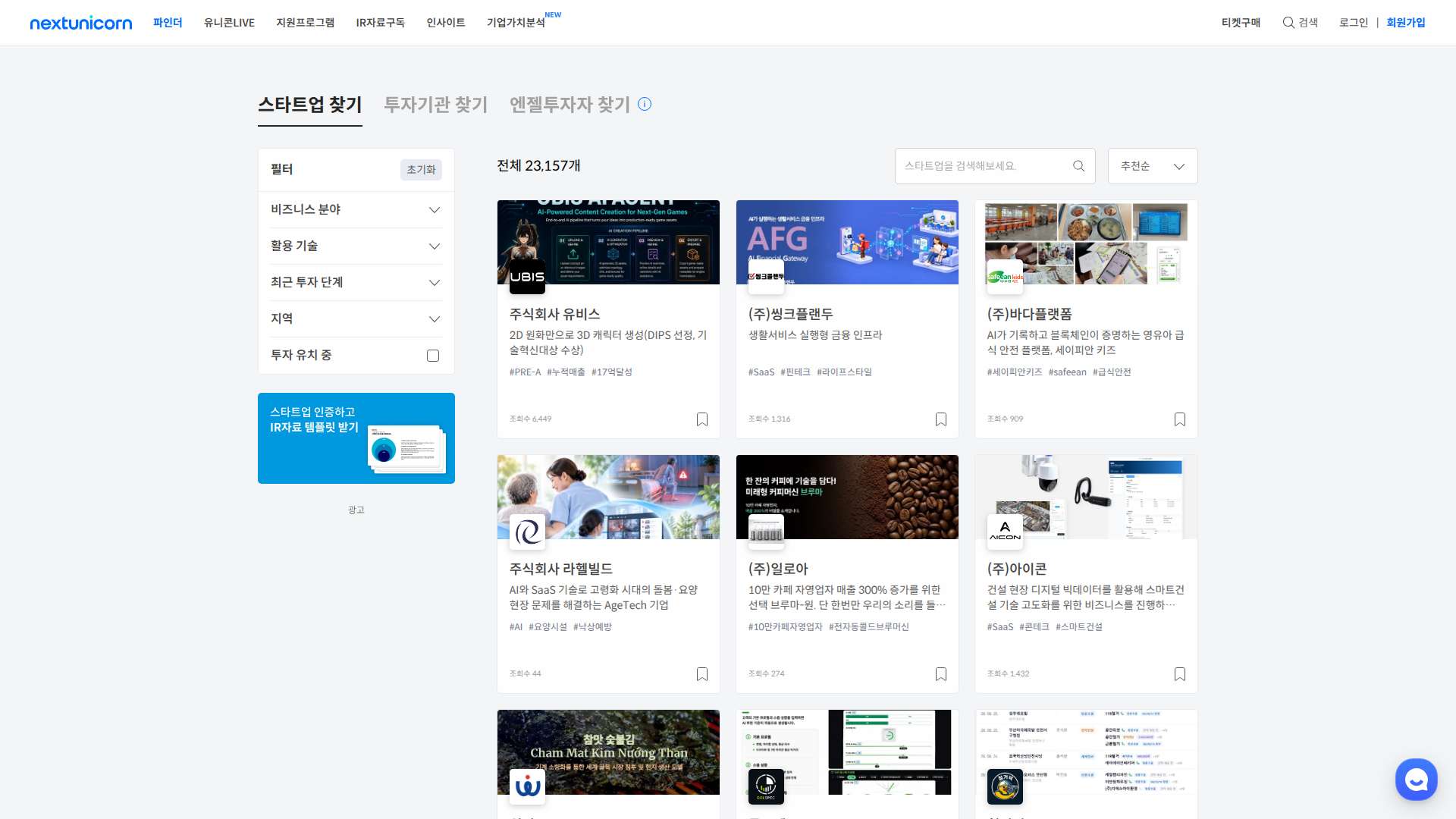
NextUnicorn Finder
Service Overview & Value Proposition
Within the platform, users can transparently review detailed business models, core technologies, cumulative funding milestones, and updates for each startup. Powered by intelligent recommendation algorithms and trend-based categorization, the platform highlights rising startups and disruptive technologies in real-time, delivering invaluable insights for researchers and enterprises seeking new business opportunities.
Furthermore, NextUnicorn Finder establishes a robust infrastructure where startups and professional investors can autonomously review IR data and communicate, facilitating highly efficient networking and deal-flow. By streamlining complex market research and transparently sharing vital venture ecosystem data, it serves as a powerful business catalyst that unlocks growth opportunities for startups and optimal sourcing channels for investors.
Constantly updated with the latest funding news and comprehensive company profiles, the platform empowers users to dynamically adapt to shifting market landscapes. Combining an intuitive user interface with powerful search capabilities, it enables anyone to effortless navigate the core pillars of the Korean venture ecosystem, solidifying its role as a pivotal platform maximizing the value and potential of the startup industry.
1. 💰 Monetization (18/30): NextUnicorn Finder has the potential to build diversified business models such as brokerage fees, premium data subscriptions, and targeted advertising by matching vast domestic startup databases with investor information. By enhancing targeting accuracy through AI recommendation algorithms and trend theme classifications, it is analyzed that it can generate an additional revenue of approximately 150 million KRW annually through paid subscriptions and lead generation within the platform. However, since it is a red ocean market where numerous corporate information platforms and venture ecosystem communities already exist, there is a limitation in lacking differentiated revenue models. To overcome this, high-value transaction brokerage features such as real-time investment prediction models or M&A matching fees must be additionally supplemented beyond simple corporate information lookup. 2. 📉 Cost Reduction (16/30): This platform has a structure that can significantly reduce research labor costs by digitizing and automating the manual processes of startup market research, IR data collection, and investor networking. By substantially reducing the monthly research man-hours required for companies to manually discover and analyze promising startups, it provides an effect of reducing operating costs and outsourced research expenses by about 32 million KRW annually per corporate customer. However, server maintenance and data pipeline management costs incurred in the initial system setup and real-time crawling and refining of massive data exceeding 23,000 items are not insignificant. Therefore, it is necessary to improve in the direction of minimizing the manual man-hours of internal management personnel spent on data cleansing by introducing a machine learning-based automated data validation agent. 3. ⚡ 10x Productivity (18/30): By supporting users to search for customized startup information they want in just a few seconds through complex filtering conditions and AI-based recommendation systems, it achieves about an 8x improvement in task processing speed compared to traditional manual search methods. It maximizes information search efficiency by integrating workflows where investment reviewers or new business planners used to visit dozens of websites to collect data into a single platform. However, it has not yet been advanced to the level of an autonomous multi-agent workflow that deeply analyzes the user's investment propensity and interests beyond simple search and filtering functions to automatically generate customized IR briefing reports. Therefore, a functional upgrade to combine LLM-based chatbot interfaces to explore corporate information interactively and immediately derive comparative analysis reports is essential in the future. 4. 🔍 Search & AI Optimization (6/10): Sitemap.xml and basic robot file settings are established to secure crawling accessibility for major web search engines, but the sophistication of structured data markup and semantic meta tags required by modern AI answer engines is somewhat lacking. Semantic optimization work to be prioritized for citation in generative AI-based search responses is additionally required compared to brand awareness and massive content assets within the platform. To compensate for this, technical optimization must be strengthened so that AI bots can perfectly understand and cite the context by structuring detailed profiles and investment trend data of each startup with Schema.org markup. 5. 📊 Overall Assessment: NextUnicorn Finder is a valuable platform that resolves information asymmetry in the South Korean startup ecosystem and connects investors and founders, but it is urgent to build a clear AI-based moat as the technical barrier to entry is relatively low and competitors are numerous. Moving away from a simple information aggregation model, it is necessary to secure unique agentic capabilities where AI agents directly predict the growth indicators of promising companies and diagnose investment eligibility for sustainable growth.
💬 Feedback & Reviews (0)