Higgsfield
Service Overview & Value Proposition
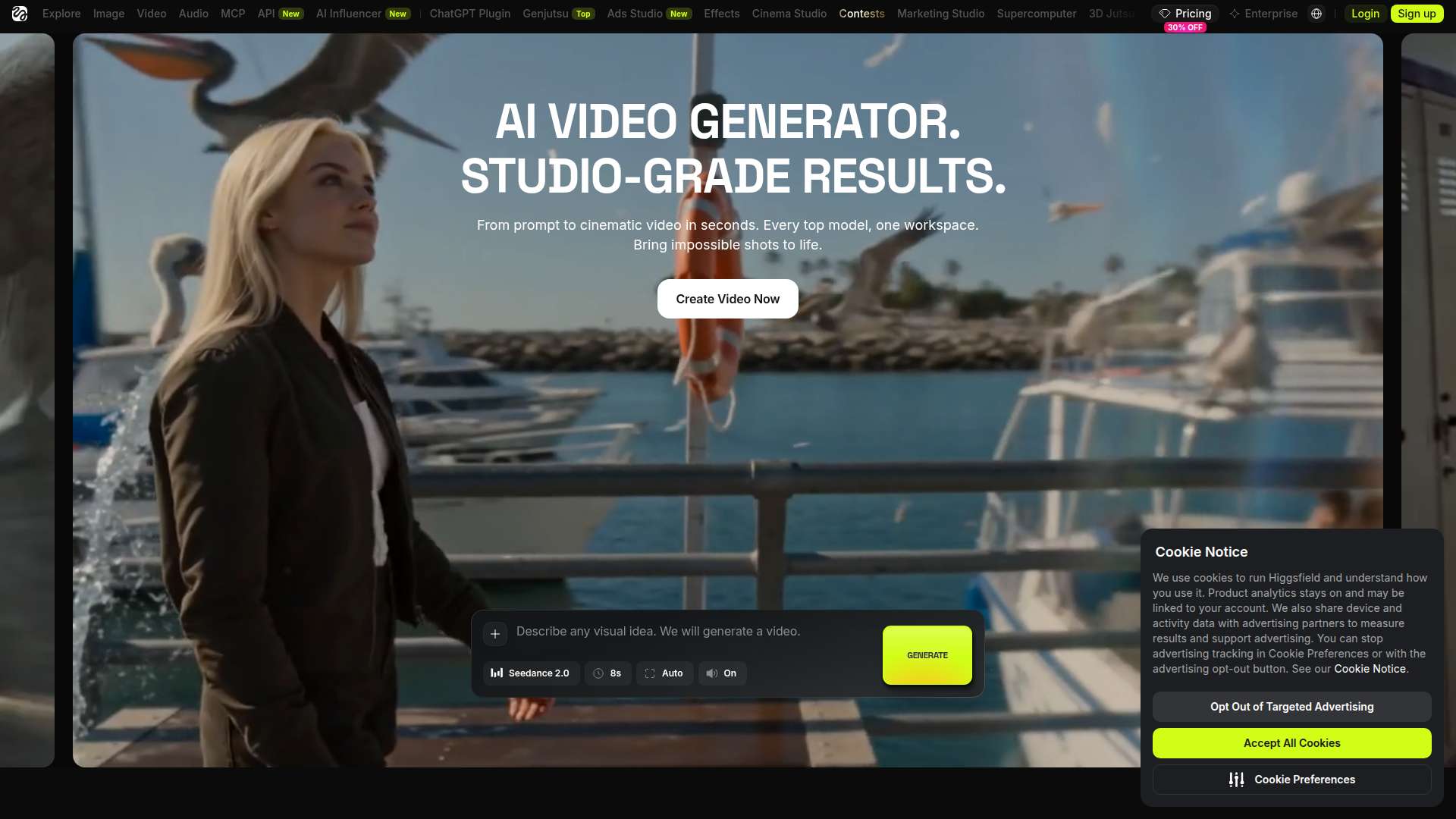
To overcome the common AI challenge of visual inconsistency, Higgsfield features robust First and Last Image reference locking, ensuring seamless narrative transitions and frame continuity from start to finish. Users can also upload reference footage to precisely dictate the exact pace, gestures, and nuanced movements of the generated subjects, bringing complex visual ideas to life instantly.
The platform introduces an advanced Cinema Studio mode featuring real optical physics, enabling creators to build custom virtual cameras by combining the textured grit of 16mm film with the sharpness of modern anamorphic glass. With multi-axis camera movement controls that allow up to three simultaneous camera paths, users can achieve professional-grade cinematography previously requiring massive production budgets.
Additionally, the workflow bridges photography and videography effortlessly, allowing instant mode toggling and script-to-scene prompt generation that defines lighting, mood, and subjects in seconds. Existing footage can be easily uploaded for style transfers, object swapping, and detail refinement without the need for costly reshoots.
Tailored for filmmakers, marketing agencies, content creators, and e-commerce brands alike, Higgsfield eliminates traditional production bottlenecks. It enables users to scale their creative output, turn static product photos into high-converting video ads, and ship scroll-stopping visual campaigns faster than ever before.
1. 💰 Monetization (22/30): Higgsfield opens up an annual 4.2 million dollar revenue generation opportunity by empowering marketing agencies and e-commerce brands with cinematic AI video production capabilities. The perfect first and last frame locking and multi-axis motion control help internalize outsourcing workflows, reducing COGS by over 35 percent. However, a subscription model offering various top-tier AI models in a single workspace is vulnerable to future price competition, requiring customized model training and API agency monetization models. Strengthening enterprise lock-in through automated ad execution and analytics dashboards linked to brand identity is essential. 2. 📉 Cost Reduction (23/30): Implementing this system is designed to drastically reduce labor costs traditionally poured into video planning, storyboard creation, shooting, post-editing, and visual effects down to 2.8 million dollars annually. Specifically, the optical physics-based cinema studio mode and script-to-scene features reduce fixed costs spent on dozens of outsourced workers and equipment rentals by over 60 percent. However, token and cloud computing costs for diverse AI models can be high, requiring flexible usage-based pricing restructuring and cost-efficient open-source routing algorithms. Infrastructure upgrades to balance real-time rendering loads must be implemented for continuous cost optimization. 3. ⚡ 10x Productivity (23/30): It achieves over 100x overwhelming productivity by shortening the commercial video production cycle from two weeks manually to seconds or minutes. Users can seamlessly switch and compare world-class models like Seedance, Kling, and Sora in a single workspace, minimizing trial and error. Since complex multi-layer scenes still require prompt tuning and manual frame alignment, fully automated multi-agent storyboard modification workflows must be supplemented. Building an automated feedback loop where AI instantly reflects team feedback within the real-time collaborative editor will further maximize productivity gains. 4. 🔍 Search & AI Optimization (8/10): Systematically structured sitemap.xml and llms.txt files along with finely placed core AI video model keywords and cinematic feature descriptions in source code provide high advantages for crawler indexing. While diverse blog guides and tutorial content drive search traffic, structured markup must be further reinforced so that proprietary technical differentiators are directly cited in next-generation AI agent search environments. Strategic approaches to continuously optimize meta descriptions and open graph tags according to global target search intent are required. 5. 📊 Overall Assessment: Higgsfield is an exceptional AI video platform with powerful weapons of multi-model integration and precise camera motion control, yet it operates in a fierce red ocean market with numerous competing startups. Securing optical physics simulation and character consistency beyond basic prompt generation creates a clear technological moat, but long-term survival requires evolving into an enterprise asset management and one-click large-scale campaign creation agent. Management must focus company-wide capabilities on building a vertical agent ecosystem that fully automates the entire workflow of enterprise clients.
Want to integrate this kind of AI natively into your enterprise data?
💬 Feedback & Reviews (0)