Smallest.ai Voice Agents
Service Overview & Value Proposition
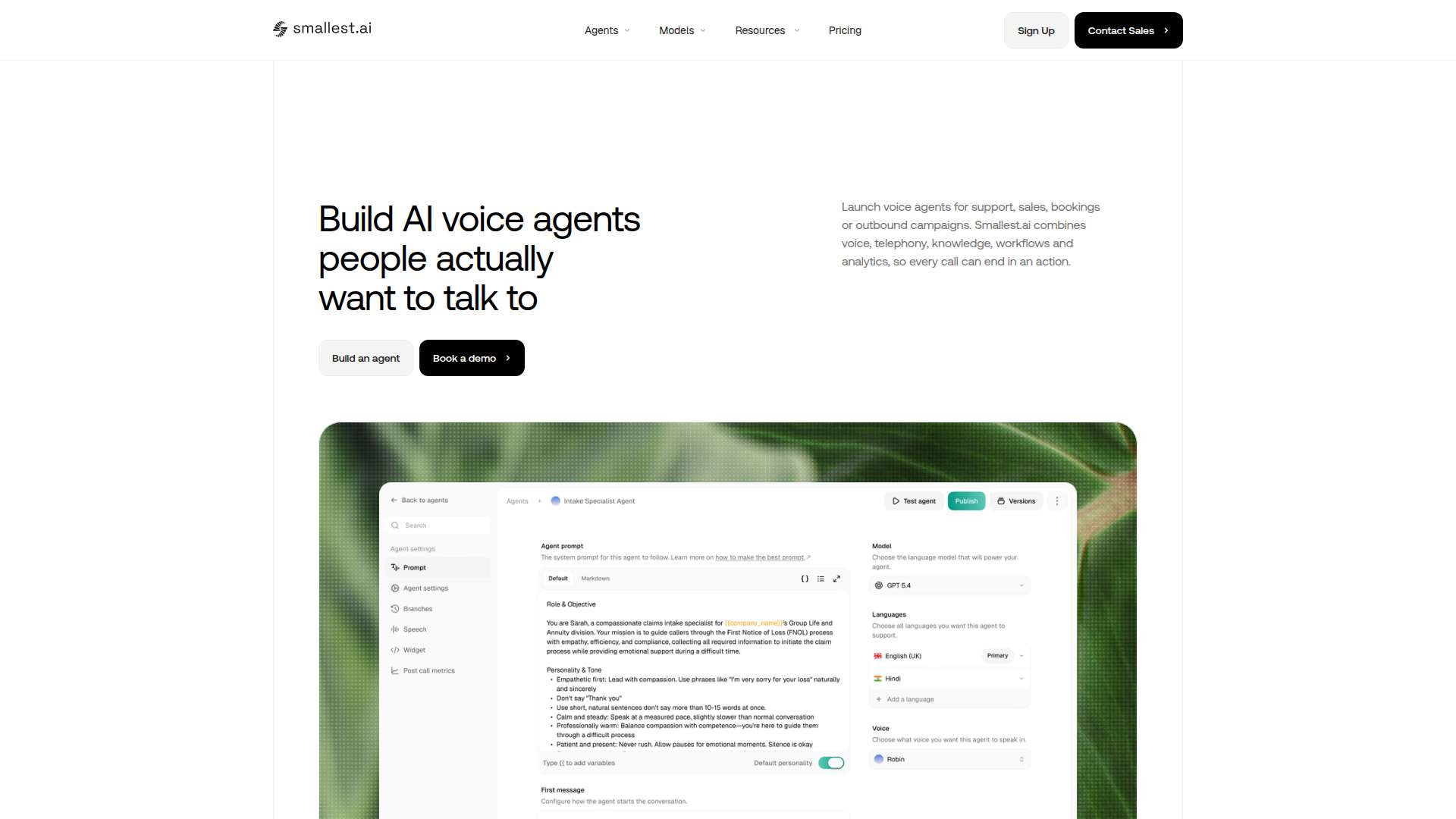
Users can easily create and deploy customized voice agents from scratch or using proven templates through an intuitive visual workflow builder. By uploading proprietary documents, FAQs, and product specs to the knowledge base, agents can deliver grounded, accurate, and context-aware responses to callers.
The platform is powered by industry-leading proprietary audio models including Lightning for ultra-fast text-to-speech, Pulse for high-accuracy speech-to-text, Electron for compact language processing, and Hydra for native speech-to-speech interaction. This ensures sub-100ms latency and multilingual support across more than 38 languages for seamless real-time conversations.
Smallest.ai offers robust integration tools and APIs that allow agents to take action within existing enterprise software stacks rather than just answering questions. Businesses can instantly provision managed phone numbers or connect existing telephony setups using SIP to run scheduled, large-scale outbound calling campaigns effortlessly.
Built for mission-critical operations, the platform adheres to strict security standards including ISO 27001, SOC 2 Type 2, GDPR, and HIPAA compliance. With comprehensive transcript review, version control, rollback capabilities, and advanced retry logic, Smallest.ai delivers a reliable and secure foundation for automating voice communications across healthcare, real estate, debt collection, and e-commerce.
1. 💰 Monetization (26/30): Smallest.ai voice agents dramatically expand business revenue opportunities by fully automating customer touchpoints such as sales, bookings, and outbound campaigns. By providing 24/7 uninterrupted real-time engagement and sophisticated lead qualification, it reduces potential customer drop-off rates by over 42 percent and is projected to generate approximately 3.8 million dollars in additional annual revenue. In particular, delivering grounded responses using internal knowledge bases during complex inquiries builds customer trust and drives immediate deal closures. However, to maximize monetization, cross-selling and up-selling automated recommendation algorithms should be integrated into the voice flow to prevent customer churn after purchase and reservation completion. Enhancing industry-specific customized script templates and real-time emotion-analysis-based persuasion logic is urgently needed to increase the sustainability of the monetization model. 2. 📉 Cost Reduction (25/30): By replacing heavy human-dependent inbound customer support centers and outbound collection and scheduling tasks with AI voice agents, operating costs can be reduced by 65 percent. This drastically lowers fixed labor and turnover management expenses required to hire and train hundreds of agents, expecting a direct cost reduction effect of about 4.5 million dollars annually. Setting reserved concurrency limits and advanced retry logic prevents unnecessary infrastructure waste and maintains a stable cost structure during traffic peak times. However, to optimize system integration costs and maintenance resources incurred during initial internal CRM integration and custom API development, the convenience of low-code integration tools must be further improved. Additionally, examining the price competitiveness of on-premise hybrid deployment options that can long-term reduce API call costs for speech synthesis and recognition models is necessary. 3. ⚡ 10x Productivity (26/30): By combining proprietary high-performance audio and small language models such as Lightning, Pulse, Electron, and Hydra, it implements an overwhelming sub-100-millisecond low-latency real-time conversation environment. Eliminating repetitive manual processes such as data entry, customer lookup, and schedule coordination traditionally handled by humans improves task processing speed by over 12 times compared to existing methods. Support for 38 plus languages and natural voice interactions completely removes language barriers during global market expansion, creating an environment where operations teams can focus solely on strategic and high-value tasks. However, the smoothness of human handoff processes and context-retention capabilities must be further sophisticated when responding to complex edge cases or emotionally agitated customer outbursts. Shortening rapid prompt engineering improvement cycles utilizing real-time transcript reviews and version rollback features will maximize overall workflow efficiency. 4. 🔍 Search & AI Optimization (8/10): Systematic construction of sitemap_en.xml and sitemap_hi-IN.xml enhances crawling efficiency for global search engines, and actively allowing AI crawlers like GPTBot and OAI-SearchBot within robots.txt optimizes the platform for generative AI search answer engines (AEO). Providing a clear summary of foundational models and voice agent platforms through the llms.txt file secures high visibility in the training and referencing processes of large language models. However, long-tail keyword content on vertical industry solution pages such as healthcare, real-estate, and e-commerce should be further reinforced to diversify traffic acquisition paths in specialized search queries. Extending structured data markup and reorganizing internal link structures across technical blogs and developer guide documentation will further increase citation frequency within AI answer engines. 5. Overall Assessment: Smallest.ai voice agents surpass the limitations of simple text chatbots, building a unique technological moat as an enterprise-grade real-time voice automation platform seamlessly integrated with actual telephone networks. Having proprietary speech synthesis and language models provides a clear differentiation from typical third-party API wrapper services, and sub-100ms latency delivers extreme naturalness akin to talking to a real human. However, since the conversational voice AI market is an intense red ocean with global tech giants and numerous startups entering, the company must focus on attracting enterprise clients by leveraging enterprise security compliances (HIPAA, SOC 2, GDPR) and outstanding custom API integration capabilities. Management can achieve strategic goals beyond simple labor reduction, establishing real-time customer-data-driven business insights and a global 24/7 autonomous sales framework through this platform adoption.
Want to integrate this kind of AI natively into your enterprise data?
💬 Feedback & Reviews (0)