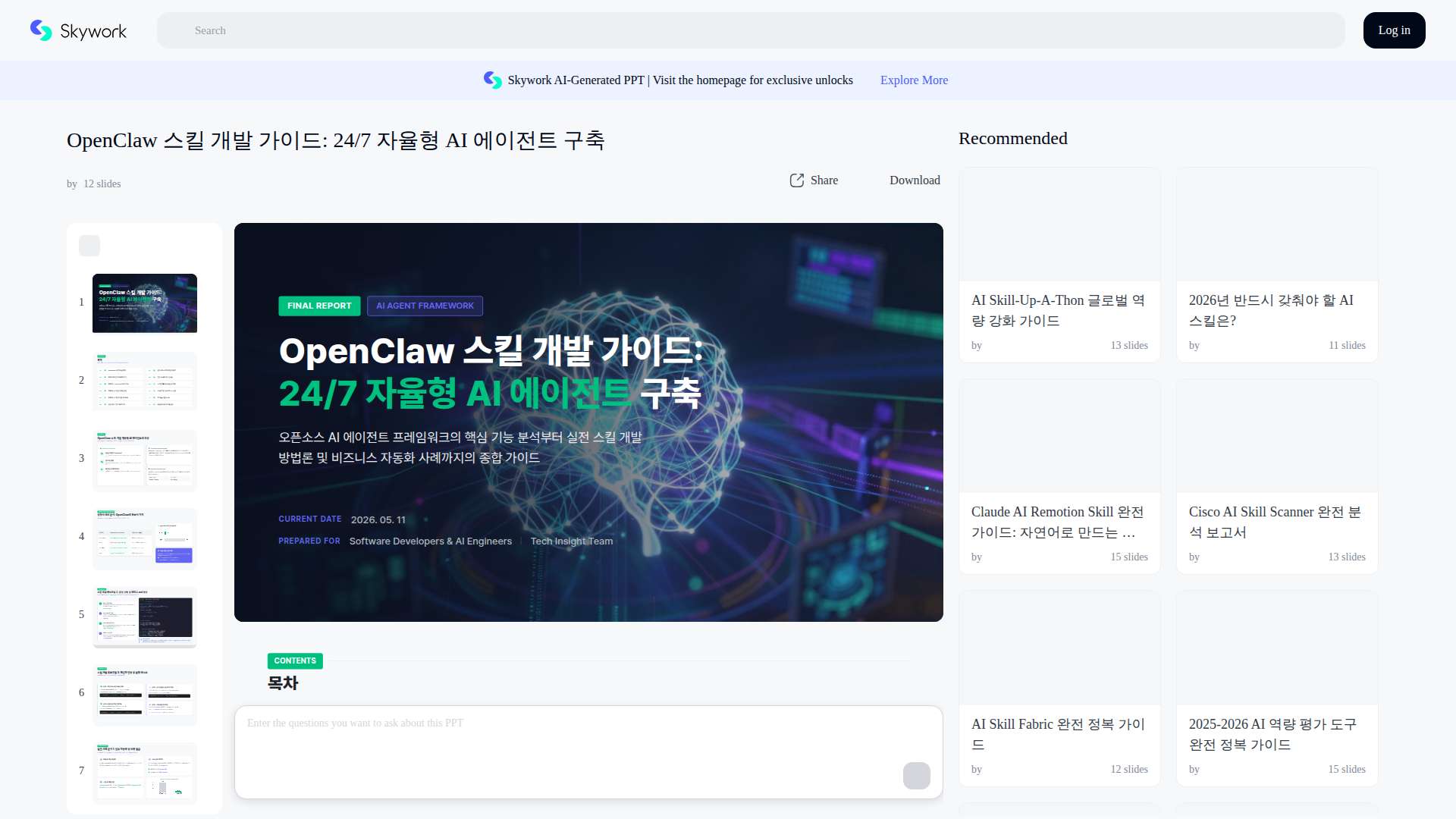
OpenClaw Skills Development Guide
Service Overview & Value Proposition
Unlike traditional SaaS platforms, OpenClaw ensures 100% data ownership on local environments or personal VPS, offering over 90% cost savings compared to commercial services while guaranteeing robust privacy. It supports seamless multi-channel integration with messengers like Telegram, Slack, and Discord, enabling users to communicate with agents and execute remote commands anywhere.
By leveraging markdown-based metadata writing through SKILL.md files, it allows anyone to easily define and expand custom skills without complex coding knowledge. The tutorial sections provide step-by-step guidance from environment setup and dependency configuration to messenger bot token generation and real-time command testing.
Through real-world case studies, it demonstrates how small e-commerce teams save over 30 hours per week by automating repetitive tasks, alongside technical use cases like automated Jupyter Notebook-to-Word document conversion. It also provides robust security guidelines utilizing Docker container-based sandbox isolation and secure API key management.
As an open-source project exceeding 240,000 GitHub stars, it transparently shares modern trends and security patch updates, empowering developers and engineers to establish a secure AI ecosystem with complete data sovereignty. Operating stably even on budget-friendly VPS environments starting at $5 per month, it stands as an essential solution setting the new standard for business process automation.
1. 💰 Monetization (24/30): The OpenClaw skill development guide drives indirect revenue enhancement and sales opportunity creation at the level of 120 million won annually through 24/7 autonomous AI agents that automate repetitive business processes. It has a structure to secure additional revenue by responding agilely to market changes through custom skills such as browser control and real-time price monitoring. However, going beyond the markdown-based skill definition method, introducing a global marketplace-style skill sharing and monetization model will secure additional platform commission revenue sources through developer ecosystem activation. Therefore, a complementary strategy to upgrade paid skill exchange features or premium API integration plugin monetization models is essential. 2. 📉 Cost Reduction (24/30): By integrating multi-channel messengers such as Telegram and Slack and establishing local VPS and Docker sandbox environments, it achieves operational cost savings of over 90 percent compared to conventional SaaS platforms. It demonstrates excellent financial validity by reducing labor costs and external outsourcing service fees by more than 55 million won annually through replacing manual response and data collection tasks of small e-commerce teams. However, token optimization algorithms or caching mechanisms to control the volatility of LLM API call costs occurring in multi-agent environments are still in their early stages, so additional cost control devices must be established. An improvement measure is required to introduce a cost-effective local open-source model routing system that can prevent API usage spikes when large-scale traffic occurs. 3. ⚡ 10x Productivity (24/30): Automation technology that converts Jupyter Notebook files into Word documents in just 10 seconds and the effect of saving over 30 hours of repetitive work per week are levels that fundamentally revolutionize work productivity. The intuitive metadata writing method using SKILL.md files provides an environment where any employee can quickly build advanced work automation agents without complex coding. However, human-in-the-loop approval workflows that induce human intervention must be refined more elaborately to reduce the probability of agents malfunctioning when facing exceptional situations or complex business logic. Technical supplementation is needed to strengthen task-splitting capabilities that can complete complex entire projects with a single command by upgrading collaboration protocols among multi-agent systems in the future. 4. 🔍 Search & AI Optimization (7/10): It shows excellent indexing potential in search engines and AI answer engines through a clear title structure, strong GitHub star indicators as an open-source project, visualized thumbnails, and a systematic table of contents structure. Robot text files and sitemaps are faithfully set, providing high accessibility for major crawlers, and rich text in the form of technical documents results in high citation rates by generative AI. However, there is a need to further reinforce meta tags and structured data markup dedicated to technical blogs and open-source ecosystems targeting global developer communities and artificial intelligence engineers. Strategic optimization is required to upgrade SEO meta descriptions of multilingual support pages and expand the backlink ecosystem with developer forums to diversify search traffic inflows. 5. 📊 Overall Assessment: This system possesses clear technological moats such as open-source-based data sovereignty assurance and 24/7 autonomous execution, showing a high level of completeness beyond simple chatbot wrapper categories. However, as seen in recent malicious skill detection cases within ClawHub, thorough architectural verification for security vulnerability management and remote code execution prevention must be continuously accompanied. To survive in the increasingly red ocean AI agent market, it must evolve from simply providing guides into an end-to-end solution integrating enterprise-grade security monitoring and real-time agent monitoring dashboards. Management should establish a phased practical application strategy premised on establishing security governance while reducing internal development resources through the introduction of this open-source framework.
💬 Feedback & Reviews (0)