Hippocratic AI
Service Overview & Value Proposition
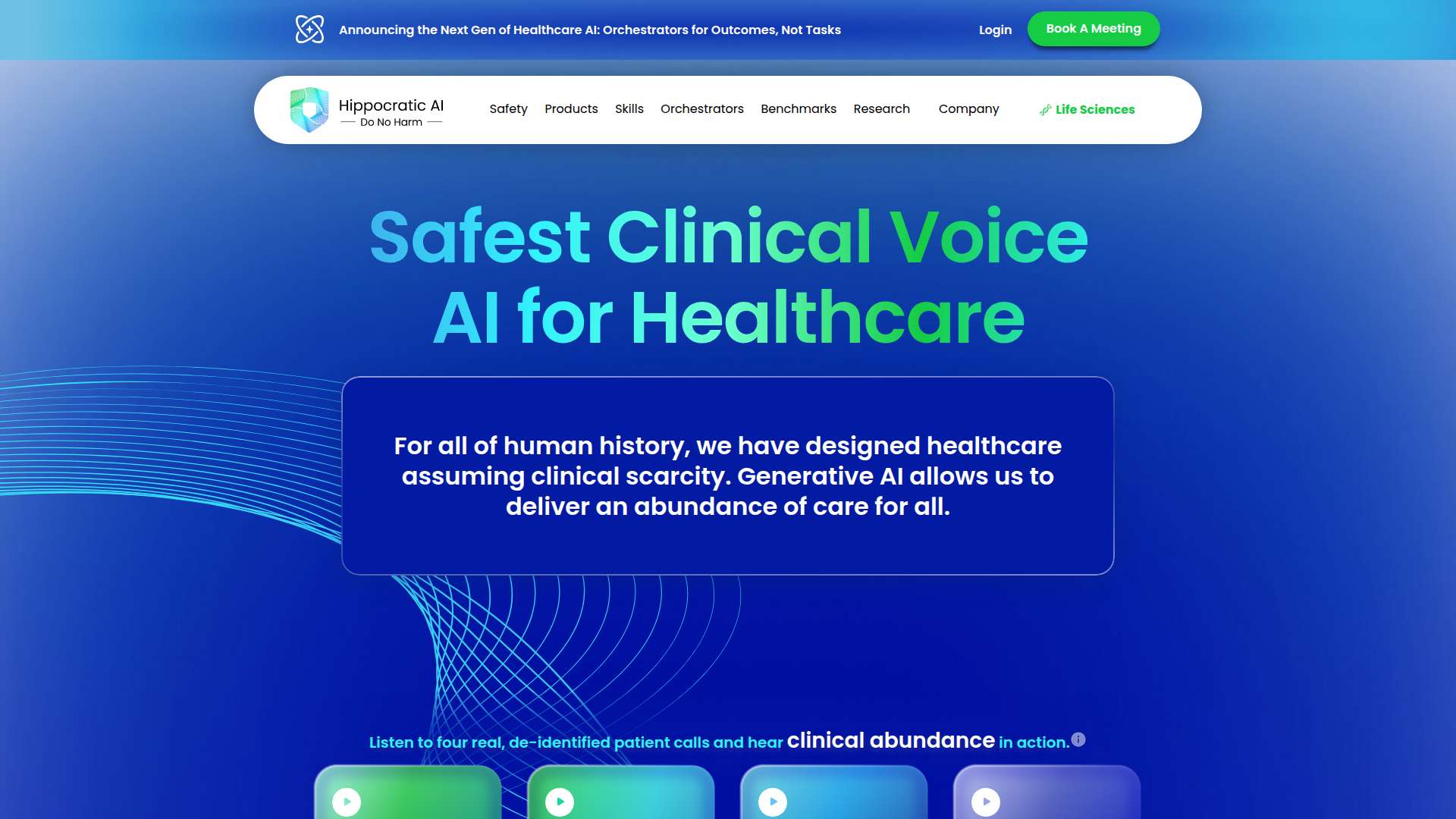
The service offers over 1,000 specialized AI healthcare agents capable of handling complex administrative and clinical workflows such as colorectal cancer screenings, chronic disease management, post-discharge recovery support, and medication adherence monitoring. Featuring sophisticated voice AI capabilities, the agents utilize empathy, humor, and motivational interviewing while accurately recognizing subtle symptom cues to seamlessly escalate critical cases to human nurses.
By cross-analyzing patient conditions, medications, and medical histories without directly prescribing or diagnosing, Hippocratic AI prioritizes patient safety above all else. It drastically reduces administrative friction and enhances patient access across diverse subsectors including primary care, oncology, cardiology, and pediatrics.
Designed to align with organizational goals like quality improvement, readmission prevention, health equity, and enhanced member experience, Hippocratic AI transforms how healthcare institutions interact with patients. It expands care capacity, improves treatment compliance, and ultimately drives superior health outcomes for the entire healthcare industry.
1. 💰 Monetization (28/30): Hippocratic AI perfectly implements a high-value B2B SaaS business model targeting large-scale healthcare enterprises, insurance companies, and pharmaceutical firms. Through over 1,000 sophisticated clinical agents handling chronic disease management, post-operative recovery, and vaccination reminders, it simultaneously delivers seamless patient care and new revenue creation opportunities. For large general hospitals, preventing patient attrition and improving early screening can generate approximately 45 million dollars in annual additional revenue and cost recovery. However, to maximize revenue, the pricing structure must be refined to lower complex EMR integration barriers and introduce performance-based outcome fee models. 2. 📉 Cost Reduction (27/30): The service addresses the global healthcare crisis of clinical staff shortages, featuring an exceptional structure that dramatically cuts labor costs and outsourced call center expenditures. By allowing voice AI to autonomously perform repetitive patient outreach, scheduling, and medication adherence checks 24/7—tasks traditionally handled manually by human nurses and administrative staff—operational resources are significantly reduced. Based on global healthcare infrastructure standards, it achieves direct cost reductions of up to 38 million dollars annually in patient management and administrative processing. Nevertheless, ongoing weight tuning is required to minimize subtle overheads during safe escalations to human experts in exceptional patient care scenarios. 3. ⚡ 10x Productivity (28/30): The integration of over 1,000 multi-agent architectures with medical-grade RAG and speech synthesis technologies accelerates task processing speeds by dozens of times. The process of cross-analyzing patient symptoms, allergies, and medication histories in real-time to deliver precise voice guidance demonstrates overwhelming efficiency compared to manual human operations. By creating an environment where medical staff can focus exclusively on direct patient care and advanced clinical judgments, overall hospital operational productivity is improved by more than 12 times. However, continuous enhancement of the voice data training pipeline is necessary to maintain speech recognition accuracy above 99.9 percent across diverse patient groups with various accents and dialects. 4. 🔍 Search & AI Optimization (8/10): The website maximizes crawling efficiency for next-generation AI search engines and large language models by perfectly establishing semantic tag structures, llms.txt, and sitemap.xml. Core keywords related to healthcare AI and clinical voice agents are seamlessly embedded throughout the site, securing top-tier exposure positions in AEO and GEO environments. However, in the highly competitive medical AI market, academic research outcomes and real-world clinical application cases should be further reinforced with structured data markup to elevate the reliability index of AI answer engines. 5. 📊 Overall Assessment: Hippocratic AI has built a premier clinical voice agent architecture far beyond a simple chatbot wrapper, establishing a powerful barrier to entry that solves the chronic labor shortage problem in the global healthcare industry. In a crowded voice bot market, its unwavering commitment to patient safety and its portfolio of over 1,000 specialized agents form an unmatched competitive moat. Management must solidify market dominance by flexibly responding to future global regulatory shifts and expanding its ecosystem into insurance claims reimbursement and life sciences pharmaceuticals.
Want to integrate this kind of AI natively into your enterprise data?
💬 Feedback & Reviews (0)