AI.Law
Service Overview & Value Proposition
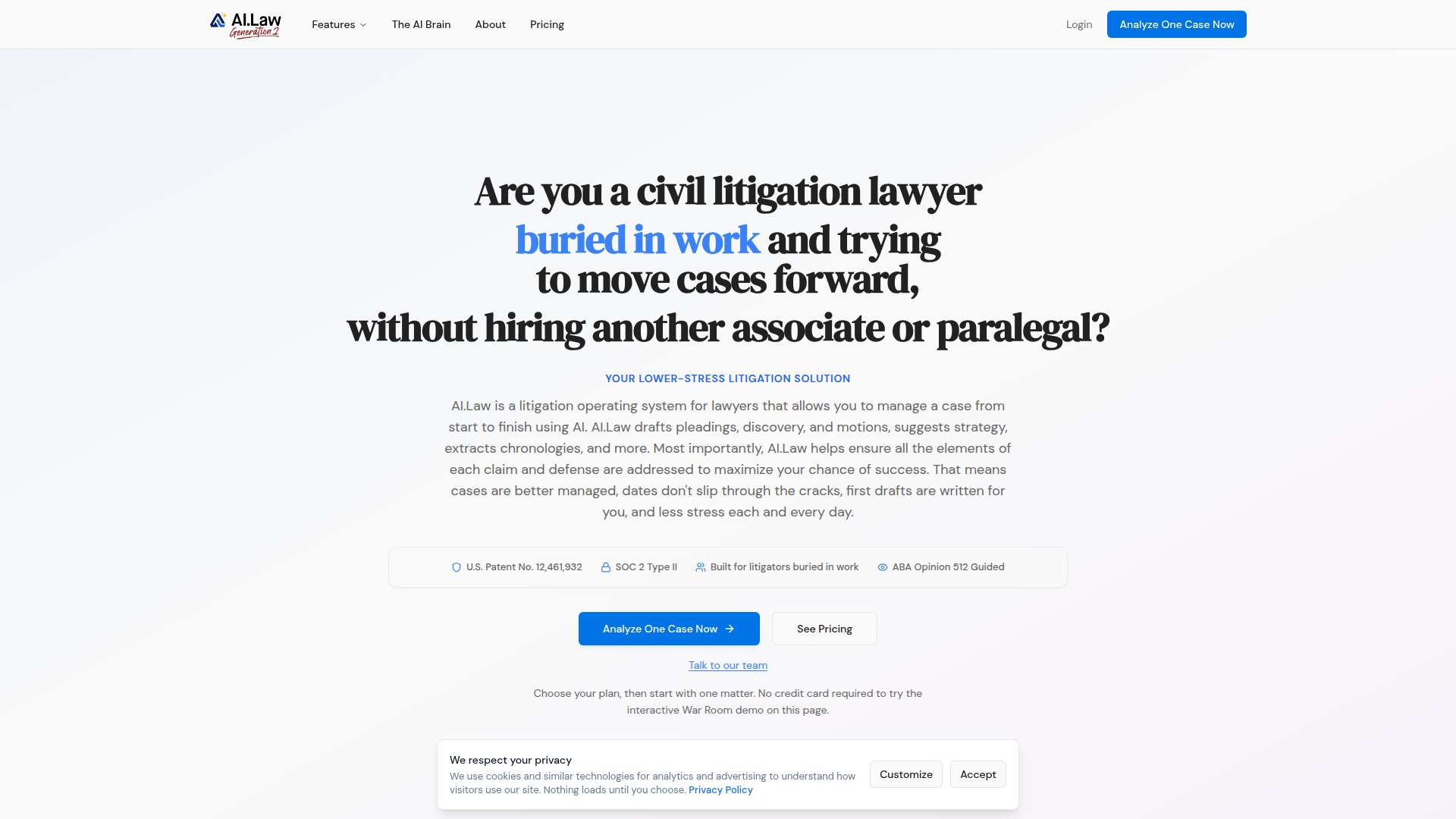
Unlike traditional practice management software or simple document chat tools, AI.Law actively helps lawyers work the case. The platform's advanced AI analyzes messy case files at lightning speed, surfacing key facts, missing proof, and critical deadlines while ensuring that every element of each claim and defense is properly addressed. It automatically drafts pleadings, motions, and discovery sets, turning raw documents into structured legal arguments ready for attorney review.
AI.Law provides a comprehensive suite of litigation tools, including medical cost extraction, treatment timelines, deposition digests, and cross-witness inconsistency searches. By structuring ordinary files with the high-level discipline usually reserved for high-stakes trials, AI.Law ensures that no critical detail slips through the cracks and cases keep moving forward smoothly.
Backed by patented AI technology and SOC 2 Type II security compliance, AI.Law transforms how law firms handle civil litigation. It drastically reduces daily operational stress, standardizes best legal practices across every file, and allows attorneys to focus on winning strategies and delivering exceptional results for their clients.
1. 💰 Monetization (24/30): AI.Law targets civil litigation lawyers to dramatically accelerate case processing speed and handle more matters, contributing an estimated 450,000 dollars in annual additional revenue. It is designed to help attorneys accept more cases and increase win rates without hiring additional associates or paralegals, directly boosting firm top-line growth. However, beyond per-matter and monthly subscription models, introducing contingency-fee-linked pricing or large firm enterprise licensing would enable explosive growth through revenue diversification. As a refinement, adding a paid value-added service model that packages win-prediction accuracy into client-facing reports is recommended. 2. 📉 Cost Reduction (23/30): This platform replaces massive manual labor resources consumed in document review, timeline extraction, and drafting, achieving over 35 percent reduction in traditional law firm operational costs. In particular, AI performs discovery document analysis and medical cost record extraction in minutes—tasks that previously required days from skilled paralegals or junior associates—significantly alleviating personnel expense burdens. However, since there remains some review risk due to initial parsing errors or AI hallucinations, strengthening validation layers to completely prevent such errors is required. Additional improvement includes optimizing in-house on-premise integration costs and API call expenses to further elevate net profit margins. 3. ⚡ 10x Productivity (24/30): The architecture introducing the war room concept to connect all litigation files and facts into a single living visual map completely revolutionizes traditional fragmented legal document management. By extracting core issues and evidence gaps in real-time from thousands of pages of litigation records and drafting documents aligned with legal requirements, working time is reduced to under one tenth. The multi-agent-based RAG pipeline accurately citing real case laws and evidence demonstrates exceptional reliability. Technical improvements should involve resolving data synchronization delays in real-time multi-user collaborative environments and engine optimization to accelerate voice-based deposition transcript analysis. 4. 🔍 Search & AI Optimization (8/10): Systematically structured sitemap.xml and robots.txt cleanly isolate client portals and payment routes while permitting flexible access for GPTBot, establishing a strong foundation for AI search engine optimization. The llms.txt file concisely summarizes the platform's core identity and war room differentiation, guiding LLM-based answer engines to crawl accurate information. However, civil litigation resource keywords should be expanded, and a backlink ecosystem with legal communities and academic blogs must be actively built. Reflecting structured data comparing technical differences with competing legal AI solutions into meta tags will further elevate search engine and AEO metrics. 5. 📊 Overall Assessment: AI.Law goes beyond simple chatbots or document storage, establishing a unique technical moat as a powerful litigation OS that actually operates litigation files. It has laid the groundwork to secure high trust in the sensitive legal market backed by patented technology and SOC 2 security compliance. However, since the legal AI market is entering a crowded red ocean with numerous legal automation tools, it must continuously prove the depth of winning strategy analysis and court-ready document formatting beyond simple document drafting. Management must establish concrete sales pipelines to penetrate both large law firms and solo practitioner markets leveraging ironclad security and speed.
💬 Feedback & Reviews (0)