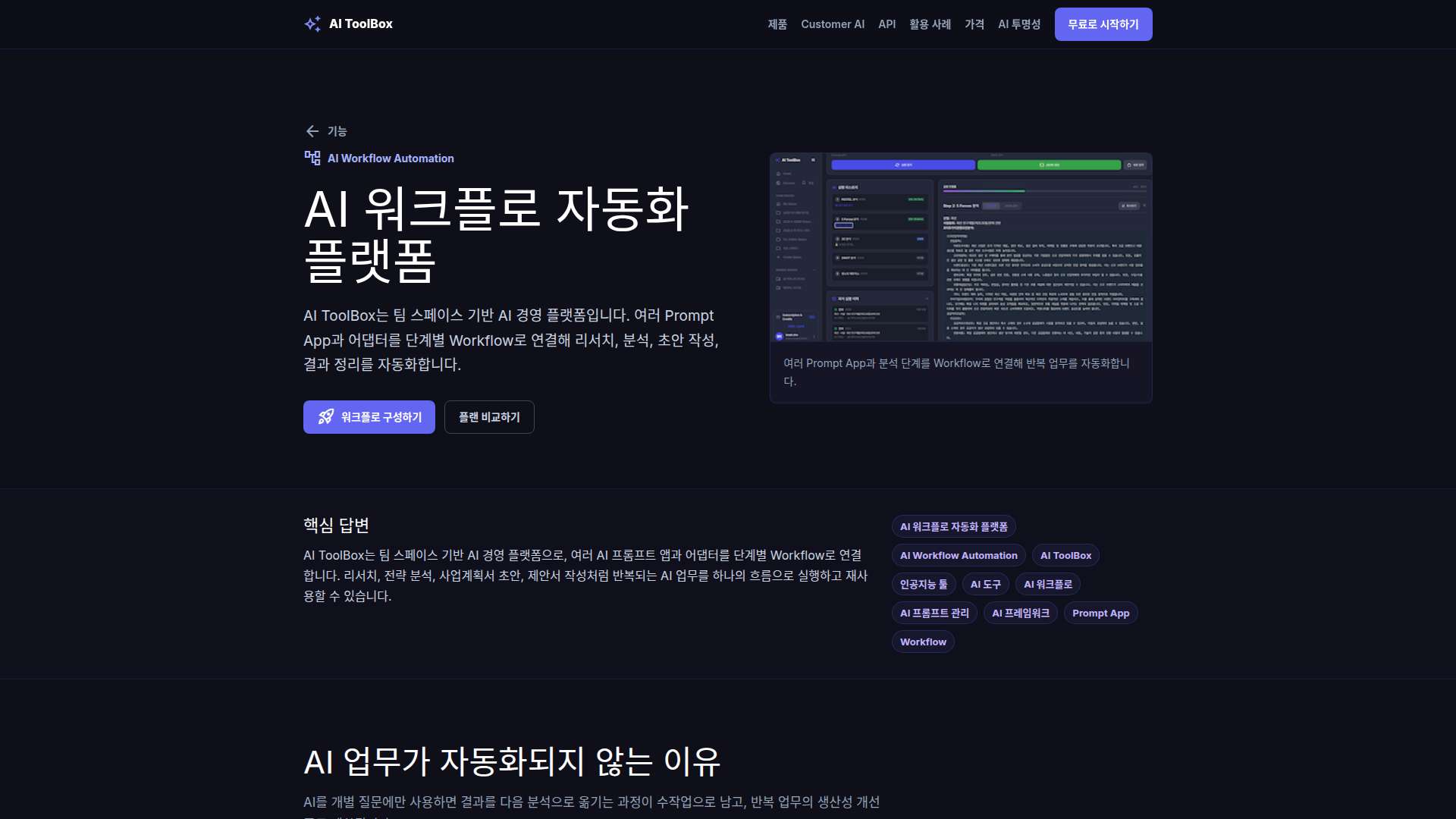
AI ToolBox Workflow
Service Overview & Value Proposition
It fundamentally solves the common issues of manual copy-pasting and re-entering data across steps that occur when relying solely on isolated AI queries, while standardizing analysis sequences and input formats to ensure consistent output quality across the entire team. It delivers powerful performance in business domains requiring sequential AI execution, such as market research, competitor analysis, SWOT generation, and drafting business plans or proposals.
Each workflow stage automatically passes the output of the previous step as the input for the next, preventing data loss and dramatically accelerating task completion speeds. All execution histories and deliverables are securely recorded within the system, enabling users to quickly identify error points and leverage them for continuous prompt and process optimization.
Repetitive research and document creation flows can be saved as reusable team assets or templates, allowing any team member to invoke a proven standard process and immediately apply it to their work. Moving beyond single AI execution tools, it elevates knowledge worker productivity through structural automation that weaves multiple AI capabilities into sequential steps.
It preserves analytical outputs and critical business judgment references in an explainable format alongside systematic flows, supporting seamless result reviews and sharing among team members through Space and Box structures. It provides an optimal AI working environment that relieves the burden of repetitive tasks, allowing teams to focus on creative and strategic decision-making.
1. 💰 Monetization (25/30): The AI ToolBox workflow adopts a structural prompt app and adapter connection method based on team spaces, standardizing and automating high-value knowledge labor such as repetitive consulting research, market analysis, and business plan drafting. This process innovation goes beyond mere internal operational efficiency, significantly accelerating the speed of drafting proposals and establishing strategies provided to external clients, possessing strong potential to generate an additional 120 million KRW in new project acquisition opportunities annually. By storing and sharing complex multi-step workflows as reusable team assets called templates, it levels up the organization's service delivery capabilities and increases the processing volume of sales and planning departments by over 35%. However, to further maximize this autonomous monetization effect, improvement work must be accompanied to track performance indicators of individual prompt apps in real-time and strengthen dynamic integration functions with customer-tailored datasets to elevate the perfection of final outputs to market-leading levels. 2. 📉 Cost Reduction (24/30): This platform fundamentally blocks massive time waste and human resource depletion occurring during the process of summarizing research results and manually transferring them back to report drafts. Since the multi-stage workflow processes market analysis and competitor investigation tasks that previously required numerous junior consultants or planners to struggle for days in just a few minutes, it is analyzed that direct labor and outsourcing service costs amounting to 95 million KRW annually can be reduced. Furthermore, by fixing analysis sequences and input formats at the system level, it achieves financial effects of reducing correction costs and communication risks caused by human error by over 40%. However, supplementary measures are urgently needed to further expand intuitive onboarding guides and pre-built premium template libraries to minimize the learning curve costs incurred while users adapt to complex workflows and adapter mapping structures during early adoption. 3. ⚡ 10x Productivity (25/30): Breaking away from the existing fragmented work method relying on individual AI questions, it has implemented an architecture that integrates and executes the entire process leading from research, summarization, strategy analysis, and draft creation into a single seamless pipeline. Since the output of the previous stage is automatically transmitted as the input of the next stage without loss, data loss or context disconnection phenomena are completely prevented, achieving an innovation where the processing speed of knowledge labor becomes at least 10 times faster than before. The systematic collaboration environment through Space and Box structures makes it easy for team members to share results and identify bottlenecks, maximizing the throughput of the entire workflow. To further enhance technical perfection in the future, a self-correction mechanism that automatically verifies the quality of execution results at each stage and provides feedback should be introduced, evolving into a full automation level that minimizes human intervention. 4. 🔍 Search & AI Optimization (8/10): The site provides clear meta tags and structured content centered around the core keyword of AI workflow automation, and is optimized through robots.txt and llms.txt so that AI search engines and crawlers can accurately index the structure and features of the platform. In particular, by proactively establishing the llms.txt file, it has laid a solid foundation for large language model-based agents and answer engines to perfectly understand and cite the service's core concepts of Space, Box, Prompt App, and Workflow. However, to secure undisputed authority in search engines and AI references, advanced SEO/GEO strategies are required to regularly publish successful workflow building cases written by actual users and specific productivity enhancement reports, continuously driving up inbound traffic and organic acquisition rates. 5. 📊 Overall Assessment: The AI ToolBox workflow goes beyond a simple chatbot wrapper, serving as a highly strategic and well-completed platform that transforms core corporate document creation and strategy establishment processes into structured multi-agent workflows. While countless single-prompt tools exist in the market, a structure that templates such complex knowledge labor processes and shares them as team-level assets provides clear technical moats and differentiation. However, as it has entered a red ocean area where competition in AI-based productivity tool markets is fierce, sustainable hyper-gap competitiveness can only be secured by expanding customized adapter ecosystems for each enterprise beyond simple task automation and rapidly establishing security-enhanced enterprise-only packages.
💬 Feedback & Reviews (0)