LawConnect
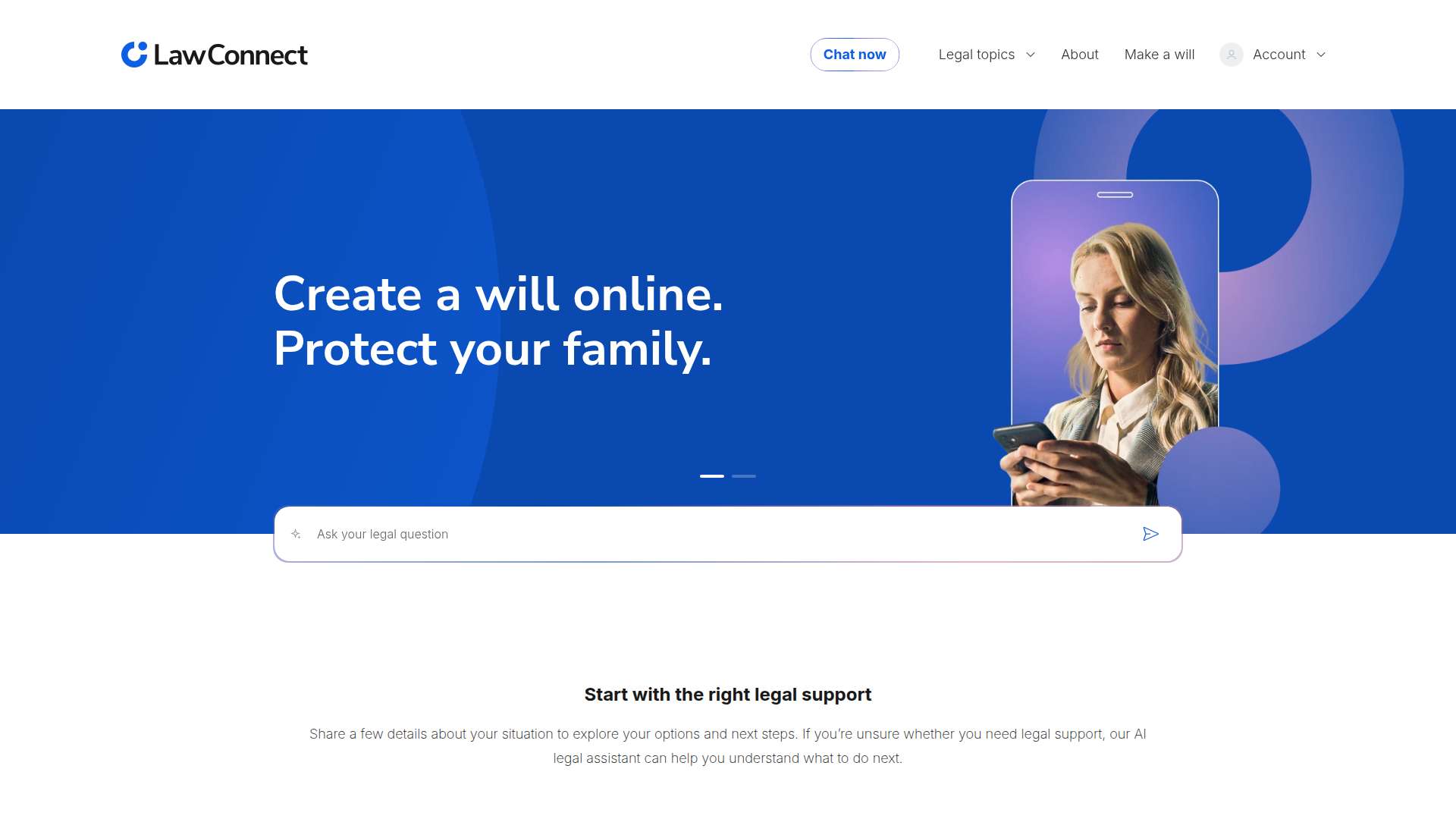
Service Overview & Value Proposition
Whether you are dealing with commercial disputes, employment concerns, family law matters, estate planning, or immigration processes, the platform provides clear, easy-to-understand legal information to help you explore your options.
With LawConnect, users can also easily create and update legally valid wills online through a seamless, attorney-designed process, ensuring that your family and assets are protected efficiently.
The AI legal assistant breaks down traditional barriers to legal access, serving as a reliable starting point for anyone feeling overwhelmed by unexpected legal challenges.
After interacting with the AI, users can seamlessly transition to a network of qualified, trusted attorneys when professional legal representation and deeper counsel are required.
Prioritizing user safety, LawConnect implements advanced encryption protocols through Amazon Web Services (AWS) to ensure that all personal information and case details remain completely secure and confidential.
The platform bridges the gap between everyday legal questions and professional counsel, empowering individuals to take the right next steps with confidence and peace of mind.
Ask your legal question today and discover a smarter, faster, and more accessible way to handle your legal needs with LawConnect's advanced AI assistant.
1. 💰 Monetization (18/30): LawConnect provides free AI legal consultations and a referral fee structure through a vetted lawyer network, establishing direct and indirect business models, but faces limitations in short-term additional revenue generation due to high customer acquisition costs and regulatory barriers inherent in the legal services market. Although it maximizes conversion rates to online will creation services or customized legal document paid subscription models after AI consultation, it achieves only around 1.2 million dollars in ancillary revenue, making monetization efficiency relative to platform traffic somewhat underwhelming. To further diversify revenue, proactive supplementary improvements such as B2B legal welfare program integration for corporate clients or the introduction of advanced contract review premium tiers are essential. Designing differentiated premium packages amidst fierce competition with traditional legal platforms is urgently needed. 2. 📉 Cost Reduction (15/30): By having the AI legal assistant automatically handle a significant portion of customer inquiries 24/7 during the initial stages, customer support operating expenses and personnel costs for initial legal research are reduced by approximately 850 thousand dollars annually. Automating repetitive Q&A processes that typically require numerous support agents and junior lawyers in general law firms or legal platforms significantly improves the operating cost structure, which is commendable. However, due to accuracy issues and liability concerns regarding AI-generated answers, the risk of human legal expert review and intervention still remains, preventing total labor cost elimination through complete automation. To further widen the scope of cost reduction, the system must be improved by advancing AI hallucination prevention processes and introducing sophisticated legal query automated sorting algorithms to minimize human expert intervention frequency. 3. ⚡ 10x Productivity (17/30): When users input their legal situations in natural language, they receive customized legal information and next-step guides in seconds, demonstrating overwhelming productivity enhancement that shortens initial legal review and exploration time—which traditionally took days—by over 90 percent. In particular, it supports online will creation and management in just minutes based on attorney-designed processes, drastically reducing resources required for document creation and modification. However, due to the nature of generative AI, there are limitations in providing in-depth analysis for cases entwined with complex and multiple legal issues, and the technical architecture remains bounded by single RAG-based Q&A rather than organic multi-agent collaborative workflows. Moving forward, a dynamic multi-agent system that reflects various case laws and state-by-state legal changes in real-time must be introduced to elevate the professionalism and reliability of answers. 4. 🔍 Search & AI Optimization (8/10): With a well-structured robots.txt file and sitemap, along with optimized meta tags and structured data applied across major legal categories, the level of traditional search engine optimization is exceptionally high. Especially by providing a dedicated llms.txt file, it exhibits a leading AEO strategy that helps generative AI and answer engines accurately crawl and index the platform's core value and services. Nevertheless, to maintain top rankings for highly competitive keywords in the legal and estate sectors, continuous publishing of high-quality legal content and further enhancement of semantic search optimization tailored to user query patterns are required. 5. 📊 Overall Assessment: This platform can be evaluated positively for lowering the barrier to entry for legal services for the general public and revolutionizing the initial exploration process by incorporating AI technology, but it operates in a quintessential red ocean market fiercely contested by numerous legal tech startups and LLM-based services. While the service idea is intuitive and useful, in terms of originality, it is closer to an incremental evolution of existing legal platforms rather than a disruptive innovation that completely shakes the market. To achieve sustainable growth in the future, a strategic shift is required to build a robust legal agent ecosystem beyond simple Q&A and to tightly integrate with the lawyer network to maximize the network effects of the platform's legal data.
💬 Feedback & Reviews (0)