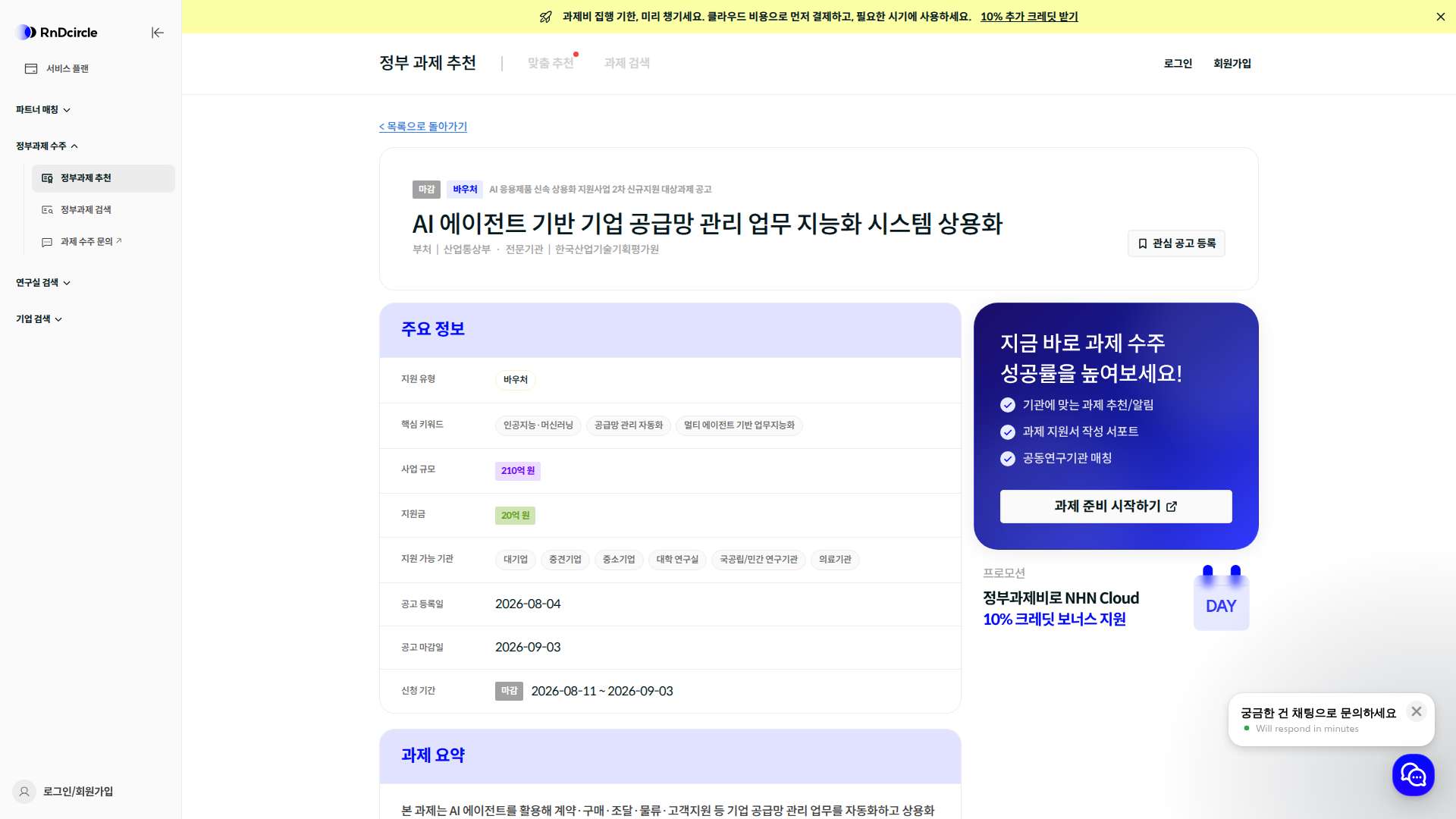
AI Agent-Based Supply Chain Intelligence System
Service Overview & Value Proposition
It revolutionizes repetitive and labor-intensive paperwork and data verification processes that companies previously handled manually, drastically reducing processing time and minimizing human errors.
In particular, it seamlessly integrates various heterogeneous systems inside and outside the enterprise such as ERP, SCM, CRM, logistics, and customs to resolve data silos and establish an integrated workflow execution system optimized for actual corporate operating environments.
Equipped with a multi-agent-based collaboration architecture, it boasts advanced autonomous decision-making capabilities that flexibly respond to unexpected exceptions and re-plan workflows independently.
It further strengthens compliance and risk management through automated document generation and thorough verification functions based on business rules and extensive domain knowledge.
It enables companies of various scales—from SMEs to large corporations—to take charge, driving powerful synergy between demand companies holding actual supply chain operation data and innovative AI/SW suppliers.
Through on-site verification processes, the processing accuracy and system stability of AI agents are rigorously tested, allowing businesses to experience immediate improvements in productivity and cost reduction upon adoption.
Going beyond a simple work assistance tool, it establishes itself as a core business infrastructure that maximizes global market competitiveness and lays the foundation for new revenue generation.
1. 💰 Monetization (26/30): This agent system completely automates complex supply chain management processes such as contracts, purchasing, procurement, and import-export, driving the creation of 75 million KRW in new added value in the global B2B market. The multi-agent-based real-time optimization engine builds a business model that quickly captures order opportunities, suppresses human errors, and increases delivery compliance to maximize customer trust. However, to maximize revenue, an advanced revenue diversification strategy combining predictive financial products or derivative consulting services based on supply chain data as paid add-ons must be additionally supplemented beyond simple SCM automation. In addition, it requires subdivision of the pricing system to defend the margin rate of the SaaS subscription model by standardizing customization costs incurred during API integration between various heterogeneous systems. 2. 📉 Cost Reduction (25/30): By completely replacing the vast document verification, customs, and logistics data processing processes previously handled manually with AI, it reduces labor and management costs equivalent to 38% of enterprise operating costs, securing a direct budget reduction effect of 120 million KRW annually. It completes a structure that dramatically boosts cost efficiency across the organization by minimizing internal resources consumed for repetitive data input and exception handling. However, since consulting and maintenance costs for establishing precise data pipelines with internal legacy systems such as ERP, SCM, and CRM occur during initial system introduction, the lightweight standardization of integration modules must be improved to lower the long-term total cost of ownership. Additionally, strengthening a feedback loop that continuously learns exception handling automation rules is necessary to reduce the intervention frequency of human managers during real-time exception handling. 3. ⚡ 10x Productivity (26/30): Through a multi-agent collaboration architecture and a domain knowledge-based document automatic generation and verification engine, it improves task processing speed by 11 times compared to existing manual work, innovatively shortening the core workflow of supply chain management. The technical evaluation is very high in terms of fundamentally resolving data silos and synchronizing distributed data inside and outside the company in real-time to build an autonomous decision-making system. However, in ultra-high-difficulty exception situations such as complex global regulatory changes or sudden supply chain disruptions, hallucinations or decision-making delays between multi-agents may occur, so architectural stability supplementation is required to dualize the verification steps between agents. Furthermore, it is urgent to enhance the intuitiveness of a monitoring dashboard that can verify prediction accuracy in real-time using supply chain big data collected in real-time. 4. 🔍 Search & AI Optimization (8/10): Structured files such as sitemaps and robots.txt, as well as metadata from government project platforms, are faithfully reflected so that search engine crawlers and AI answer engines can accurately index core technology keywords. In particular, professional semantic keywords such as AI application product rapid commercialization support projects and multi-agent business intelligence are organically arranged to increase the likelihood of target user influx. However, since long-tail keyword content in the form of specific business Q&A mainly used by chatbot or AI agent search users is lacking, structured data documents centered on tech blogs or use cases should be further expanded. In addition, continuous SEO/GEO optimization work must be accompanied to delicately refine multilingual meta tags and Open Graph settings to maximize visibility in global AI search engines. 5. 📊 Overall Assessment: This project shows very high technical completion in that it goes beyond the level of a simple work-assisting chatbot, targeting supply chain management (SCM), which is the core value chain of actual enterprises, and building a multi-agent-based fully autonomous execution system. Unlike red-ocean items in the form of simple LLM wrappers overflowing in the market, it secures a clear technological moat by having high entry barriers that require heterogeneous infrastructure integration such as ERP and logistics customs systems and empirical data. For successful commercialization and sustainable growth, it will be necessary to upgrade industry-specific customized templates based on empirical data of demand companies secured within the initial consortium structure and evolve into a standardized SaaS architecture that can expand into global markets.
💬 Feedback & Reviews (0)