T3Q.ai
Service Overview & Value Proposition
The platform integrates three core pillars: T3Q.cep for big data processing, T3Q.dl for comprehensive machine learning and deep learning pipelines, and T3Q.edge for real-time edge computing. It features GUI-based pipeline management, supporting the storage, real-time analysis, and batch processing of both structured and unstructured big data across scalable cluster environments.
By streamlining the entire lifecycle of AI development—including preprocessing, training, inference, and visualization—T3Q.ai significantly reduces the time and cost required for enterprises to implement customized artificial intelligence applications. It also provides flexible deployment options ranging from central cloud architectures to field-optimized edge systems.
Recognized as a certified innovative product with top-tier domestic certifications, T3Q.ai has been successfully deployed across major public agencies, financial institutions, and global corporations—such as the Ministry of Unification, Woori Bank, Shinhan Bank, and KEPCO—to drive large-scale digital transformation and intelligent system automation.
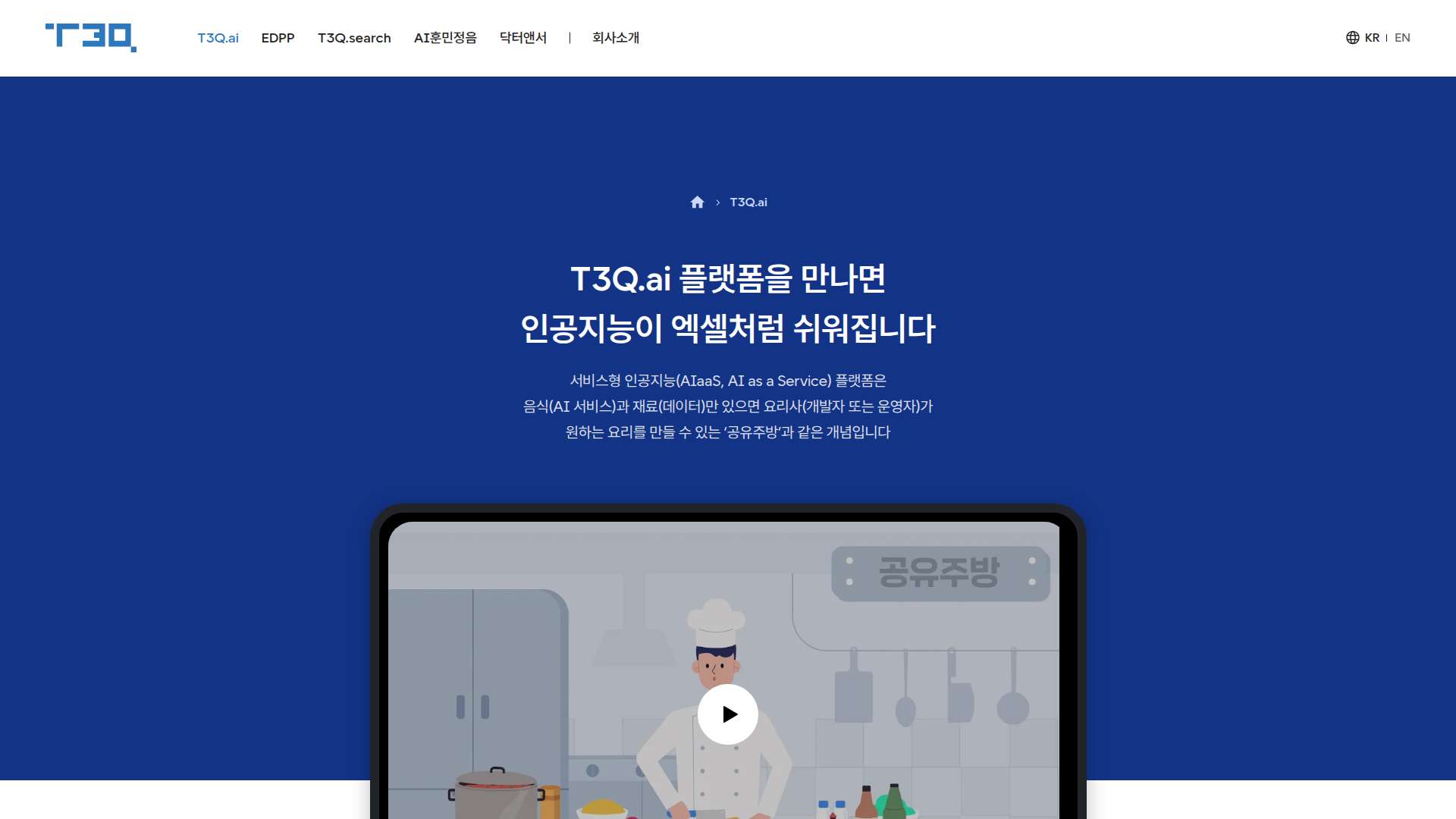
1. 💰 Monetization (22/30): T3Q.ai enables enterprises to rapidly build their own AI business models by providing standardized platforms for large-scale data processing and AI model development. Based on verified deployment references across finance, public, and manufacturing sectors, it can drive new value creation and license revenue expansion of 12 million dollars annually. Especially, the AIaaS architecture utilizing a shared kitchen concept allows customers to combine required data and AI services like Lego blocks and immediately convert them into monetizable products. However, there is a lack of specialized industry-specific packages or marketplace functions for pre-trained domain models, indicating a need to upgrade the proprietary market revenue model beyond supplying standard platforms. Strengthening the ecosystem where partners can directly trade algorithms will greatly broaden the scope of monetization in the future. 2. 📉 Cost Reduction (22/30): It dramatically cuts infrastructure costs and specialized development talent resources when enterprises build and operate AI services. Through GUI-based pipeline management and distributed cluster environments, it secures financial feasibility to reduce labor and outsource development costs by up to 8.5 million dollars annually compared to traditional manual development methods. By automating the entire process of data preprocessing, training, and inference, it significantly lowers engineers' repetitive manual input rates and maximizes operational efficiency. However, consulting costs associated with initial platform deployment and integration engineering expenses occurring during legacy system integration still exist, requiring a more flexible cloud-based subscription on-demand deployment model. Strategic supplementation to lower initial deployment costs close to zero by strengthening self-service automated configuration wizard functions is required in the future. 3. ⚡ 10x Productivity (24/30): T3Q.ai integrates the entire process from data storage and real-time analysis to deep learning training and inference into a unified pipeline, shortening total work time by more than 70 percent compared to conventional methods. Through visualization tools for machine learning and deep learning algorithms, it creates an environment where non-expert business operators can intuitively monitor and control AI model performance. By interlocking with the edge system T3Q.edge, it secures availability even during network anomalies and strengthens field-customized responsiveness, completely blocking real-time service interruption risks. However, there is still a technical limitation that human operators' partial intervention is required in the area of autonomous collaboration workflows between multi-agents or complete automation of complex business logics. It should evolve in the direction of eliminating coding or configuration processes altogether by upgrading generative AI-based natural language pipeline automatic generation functions in the future. 4. 🔍 Search & AI Optimization (8/10): The overall metadata, titles, and technical tags of the website well reflect the core keywords of artificial intelligence platform and big data solution, possessing a structure appropriate for search engine crawlers to recognize. Since credible modifiers such as GS certification acquisition and government innovative product designation are placed throughout the text, it is advantageous for LLM-based answer engines to classify it as a reliable technical solution. However, blind spots in technical optimization exist, such as some error pages being exposed in robot files or sitemap access paths, which can hinder deep indexing by search engine bots. Semantic web markup should be strengthened and structured data should be reinforced to register as accurate entities in the knowledge graphs of major AI search engines in the future. 5. 📊 Overall Assessment: This solution is a competent all-in-one AI and big data platform with references from numerous domestic public institutions and large enterprises, but it faces the task of proving clear differentiation in the AIaaS market where numerous big tech companies and cloud providers are competing. If it fails to evolve into a vertical AI agent hub that creates substantive business outcomes beyond a simple infrastructure provider, it risks facing price competition in a red ocean. Therefore, while maintaining the strengths of a general-purpose platform, we strongly suggest a strategic pivot to raise market entry barriers by packaging turnkey agent solutions specialized for high-value-added industries such as finance, manufacturing, and public sectors.
💬 Feedback & Reviews (0)