Maya
Service Overview & Value Proposition
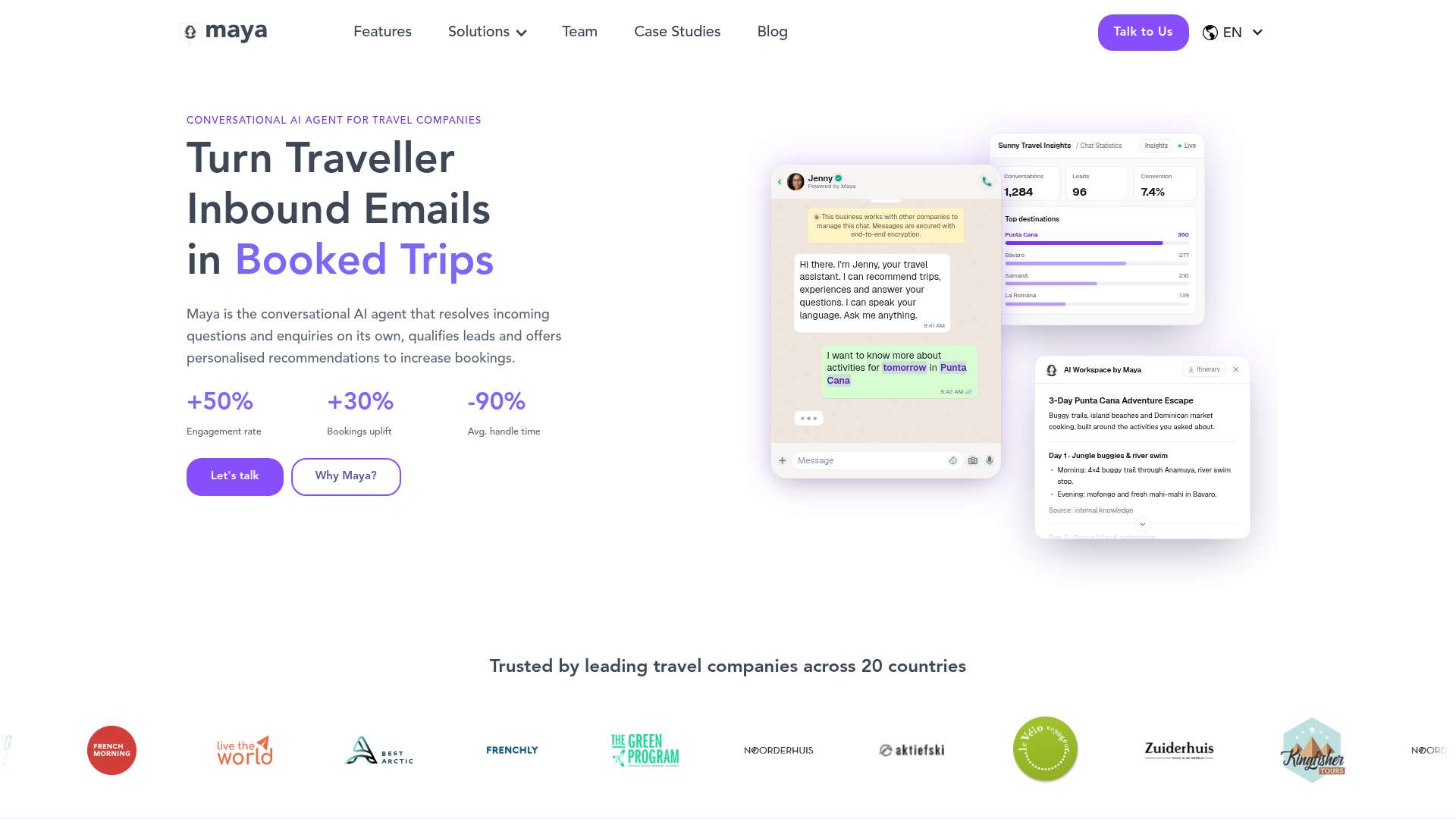
Unlike traditional keyword-matching chatbots, Maya understands the intent behind natural language queries, delivering accurate, on-brand responses trained exclusively on each organisation's trip catalogues, policies, reviews, and live pricing. Supporting over 50+ languages, it breaks down language barriers and provides seamless communication for global travellers around the clock.
Maya integrates effortlessly across multiple channels including website chat, WhatsApp, Instagram, Facebook Messenger, Gmail, and Microsoft Outlook. Whether capturing high-intent visitors pre-booking or resolving routine support enquiries post-booking, Maya ensures a consistent brand voice and experience across every touchpoint.
When human intervention is required, Maya hands over complex enquiries with full context to the right team member, eliminating repetitive explanations and saving valuable time. It also integrates smoothly with collaboration tools like Slack and Microsoft Teams, bringing AI actions directly into your team's everyday workspace.
Travel brands leveraging Maya have achieved remarkable business outcomes, including up to a 50% increase in website engagement, a 90% reduction in average handle times, and up to a 3x growth in visitor-to-booking conversion rates. Launching in just two weeks without complex rule trees, Maya turns every customer interaction into actionable insights to help travel businesses scale efficiently.
1. 💰 Monetization (26/30): Maya automates the entire journey from website visitor acquisition to personalized trip recommendations and booking conversion, driving tangible revenue growth. According to actual deployment cases, booking conversion rates against visitors grow by up to 3x, robustly driving over 1.5 million dollars in additional annual revenue. Multilingual support and 24/7 real-time engagement drastically reduce bounce rates for high-intent potential customers, guaranteeing a high ROI by focusing purely on the core KPI of increased travel sales. However, to maximize average order value further, the platform should enhance dynamic packaging algorithms that automatically suggest cross-selling and up-selling options such as room upgrades or supplementary tour packages. Additionally, integrating real-time promotional discounts or personalized coupon issuance during conversations would further elevate conversion rates. 2. 📉 Cost Reduction (25/30): It drastically cuts labor costs by largely replacing operational staff previously bogged down in routine customer inquiries and simple booking responses. By reducing average handle times by 90 percent and autonomously resolving the vast majority of inquiries, it allows customer service teams to handle surging global inquiry volumes without scaling headcounts. Managing inquiries across WhatsApp, Instagram, and email within a single workspace cuts separate multichannel solution costs, yielding around 800 thousand dollars in annual resource savings. However, complex refunds, cancellations, or exceptional itinerary changes still require human agent intervention, necessitating stronger real-time two-way integration stability with backend booking systems to boost automation rates for exception handling. Furthermore, automated quality management tools for training data must be added to reduce error inspection costs in multilingual translations. 3. ⚡ 10x Productivity (26/30): Unlike keyword-matching chatbots, it accurately grasps customer natural language intent and cross-references actual product catalogs, cutting search and response times to mere seconds. Seamless integration with collaboration tools like Slack and Teams allows internal staff to gain insights and approve AI-drafted email replies directly within their workspace without checking separate dashboards, boosting productivity tenfold. The swift onboarding process allowing live deployment within two weeks using existing content dramatically reduces the time and effort required for IT infrastructure setup. Nevertheless, to prevent hallucinations when company-specific internal rules or real-time inventory changes are not instantly reflected, the speed and accuracy of real-time data synchronization pipelines must be continuously improved. Also, indexing methods in the RAG search architecture need to be advanced to reduce latency when generating complex multi-destination itineraries. 4. 🔍 Search & AI Optimization (8/10): It optimizes crawling efficiency for search engines and AI bots through robots.txt and sitemap configurations while securing global search visibility by appropriately utilizing multilingual hreflang tags. As a vertical travel AI platform, it is structured to suit LLM-based answer engines, providing favorable conditions for key term visibility in AI search results. However, to further boost summarization and citation rates in AI answer engines, structured data markup should be expanded and semantic web standards compliance for tour detail pages must be strengthened. Furthermore, complementing dynamic content generation strategies and blog network integrations to target long-tail keywords in global target markets will help reduce irrelevant traffic and maximize high-efficiency lead acquisition. 5. 📊 Overall Assessment: Maya transcends the category of simple chatbots, serving as an exceptional vertical AI agent solution deeply integrated with the specialized business logic and catalog structures of the travel industry. It has proven clear market fit with over 100 global travel brands adopting it and achieving verified success, successfully differentiating itself from generic chatbots. However, the global travel software market is an increasingly competitive red ocean with large OTAs internalizing technology and various vertical AI startups entering the fray. Therefore, the company must build a fully autonomous transaction process covering everything from booking to payment and post-management, establishing an unassailable technological moat through deep integration with customer data platforms.
💬 Feedback & Reviews (0)