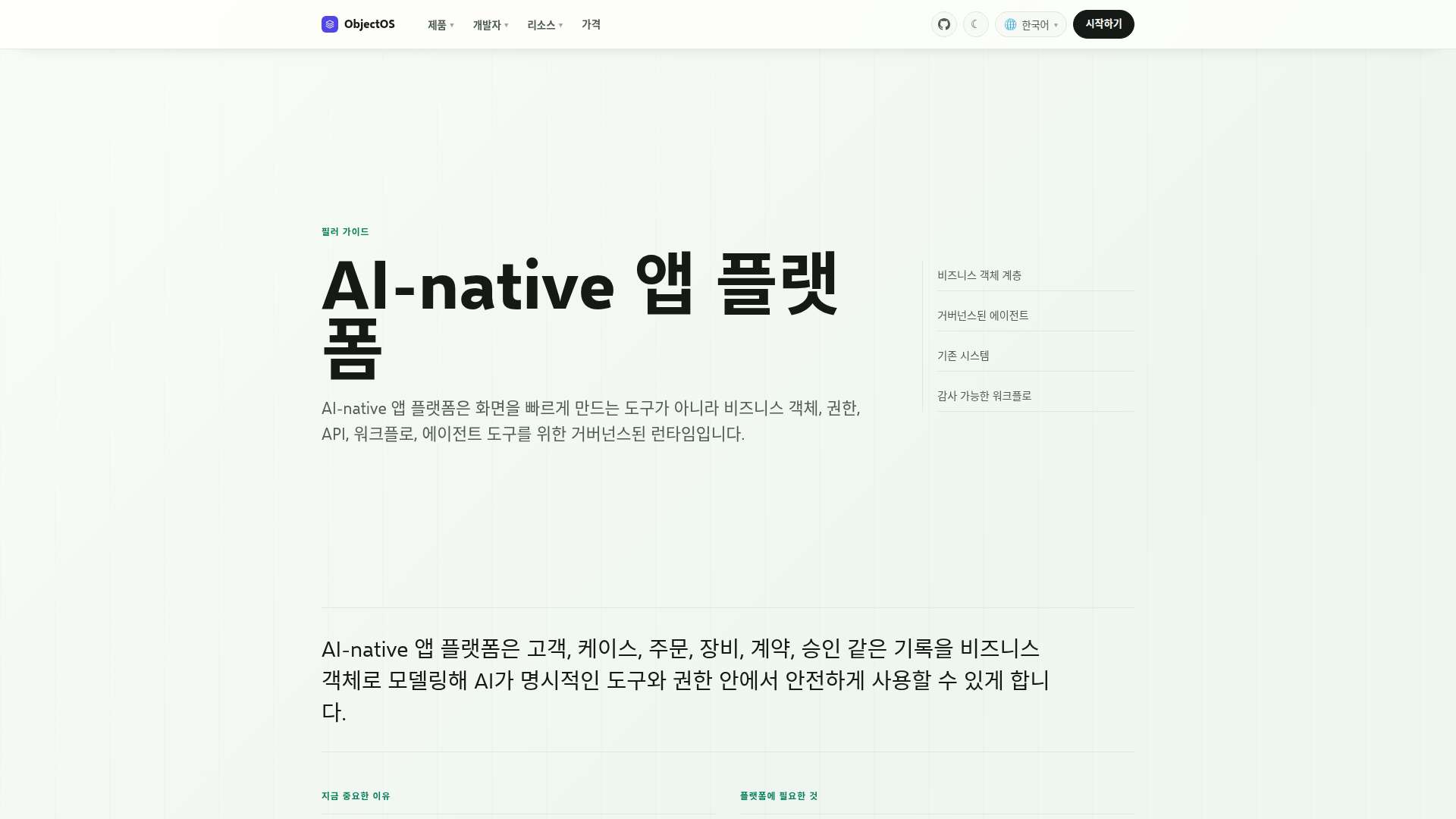
ObjectOS AI-native App Platform
Service Overview & Value Proposition
Without the need for disruptive migrations or complete system replacements, ObjectOS seamlessly connects with existing CRMs, ERPs, and legacy databases, allowing organizations to adopt AI directly within their current infrastructure. Developers and business teams can generate screens, workflows, APIs, and agent tools from a single unified business specification, dramatically accelerating productivity.
Security and governance are deeply embedded by design. Both human users and AI agents operate within identical permission, approval, and audit boundaries. High-risk operations are automatically routed to human approval gates, and every action taken by an agent is fully trackable and auditable to comply with strict enterprise compliance standards.
While traditional low-code platforms focus primarily on forms and rapid prototyping, ObjectOS prioritizes long-term maintainability, complex business logic, enterprise integration, and strict governance. It enables teams to deploy actionable applications for repair services, internal operations, and customer support while injecting AI-powered search, summarization, and anomaly analysis into legacy data stores.
Ultimately, ObjectOS provides the definitive runtime environment for enterprises looking to move beyond superficial AI implementations. By anchoring AI agents to controlled business objects and strict permission frameworks, it empowers organizations to unlock the full potential of autonomous workflows without ever compromising security, control, or data integrity.
1. 💰 Monetization (26/30): The ObjectOS AI-native app platform maximizes autonomy across practical processes by directly connecting core business objects such as customers, orders, and contracts to the AI runtime. Without forcing the replacement of legacy systems, enterprises can generate AI agent tools based on refined business specifications, achieving approximately 3.8 million dollars in new auxiliary revenue generation and process optimization annually. Especially in repair services and internal operations, agents proactively analyze and handle exceptions, delivering significant financial benefits through enhanced customer retention rates. However, to further maximize additional revenue, the platform must automate API integration steps with external partner systems and expand a marketplace-type third-party agent tool ecosystem. Diversifying automated conversion templates is also a crucial complementary point to reduce the initial setup overhead generated during business object modeling. 2. 📉 Cost Reduction (25/30): By deploying governed AI agents to replace routine administrative tasks previously handled manually by humans, such as manual data entry, repetitive case classification, and approval process reviews, operating costs are substantially reduced. Through this platform adoption, enterprises can cut annual labor and external outsourcing operational expenses by approximately 2.9 million dollars or more, while completely preventing financial losses caused by human error. Since agents are not granted indiscriminate administrator privileges, instead operating within user privilege inheritance and secure approval boundaries, potential loss costs resulting from security incidents are preemptively avoided. Nevertheless, internal consulting and management resources required to synchronize existing systems with metadata and establish governance policies during the initial adoption phase must be minimized. To achieve this, automated approval rule sets for permission settings and exception approval workflows should be advanced to further reduce human labor input. 3. ⚡ 10x Productivity (26/30): The architecture enabling simultaneous generation of screens, workflows, APIs, and AI agent tools within the same business specification elevates development productivity by over 10 times compared to conventional low-code solutions. Coding agents directly model existing database tables into objects and operate within security privilege boundaries, making development cycle reduction effects extremely pronounced. The response speed to long-term business changes accelerates, allowing business application creation and modification tasks that previously took weeks to be completed within hours. To implement technologically superior automation, latency times that may occur during multi-tool calls by agents must be optimized, and context token management efficiency must be enhanced. Furthermore, architectural improvements are required to resolve performance bottlenecks in distributed transaction management and real-time audit tracking logs within complex enterprise environments. 4. 🔍 Search & AI Optimization (8/10): The provided website's sitemap, robots.txt, llms.txt, and multilingual support metadata are structured extremely systematically so that AI answer engines and search engine crawlers can precisely comprehend the platform's technical architecture. Particularly, clear indications of the linkage with the open target format ObjectStack and the Apache open-source license structure secure high scores in technical documentation searches. However, to simultaneously target global developers and C-level executives, professional case study content related to business object governance and AI agent safety must be expanded. It is necessary to diversify technical blog backlinks in key search keyword domains such as enterprise AI governance and agent runtime to further elevate awareness and authority. 5. 📊 Overall Assessment: This platform transcends simple screen creation tools to build a powerful enterprise runtime environment ensuring AI agents operate safely within enterprise actual data and stipulated permissions. It fundamentally resolves the limitations of the low-code market, such as complex business logic handling and the absence of governance, securing a distinct technical moat in the red ocean low-code/no-code market through a differentiated architecture of explicit object modeling. However, to convince C-level executives of this solution, quantitative reporting features demonstrating how dramatically security audits and permission controls lower actual regulatory compliance costs must be further strengthened. Having struck a flawless balance between AI autonomy and corporate control, this platform possesses the potential to redefine future enterprise software development standards.
Want to integrate this kind of AI natively into your enterprise data?
💬 Feedback & Reviews (0)