Magnitude
Service Overview & Value Proposition
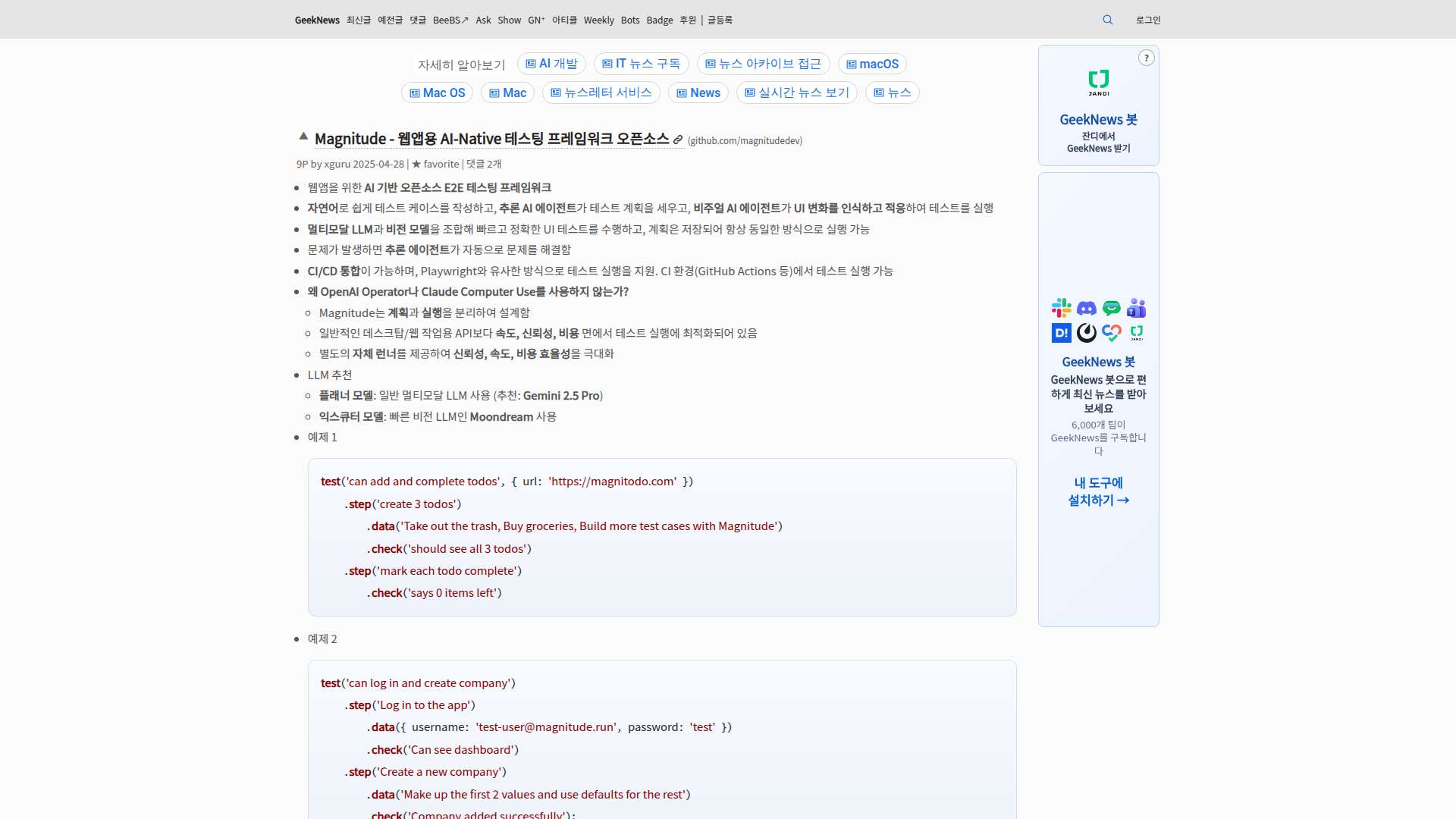
The core innovation of Magnitude lies in the seamless collaboration between reasoning AI agents and visual AI agents. The reasoning AI agent formulates comprehensive test plans, while the visual AI agent recognizes UI changes and adapts in real-time to ensure stable test execution.
By combining advanced multimodal LLMs with fast vision LLMs (such as Moondream), Magnitude achieves both high speed and exceptional accuracy. If unexpected issues arise during testing, the reasoning agent automatically detects and resolves them autonomously.
Magnitude is architected by separating the planning phase from the execution phase. Once a test plan is generated, it is securely stored to ensure that tests run consistently and reliably every time.
Unlike generic desktop or web automation APIs, Magnitude is specifically optimized for E2E testing performance, offering superior speed, reliability, and cost-efficiency. It also features a dedicated custom runner to maximize efficiency across various environments.
Supporting a workflow similar to Playwright, Magnitude integrates effortlessly with CI/CD pipelines such as GitHub Actions, enabling smooth automated testing in continuous integration environments.
With simple natural language commands and intuitive chaining APIs like `.step`, `.data`, and `.check`, anyone can craft advanced web tests without hassle.
Available as an open-source project, Magnitude offers high flexibility for development teams looking to seamlessly integrate cutting-edge AI capabilities into their daily QA workflows.
1. 💰 Monetization (22/30): Magnitude focuses on indirect value creation through improved development productivity and test infrastructure optimization rather than direct sales. Although adopting an open-source strategy lowers entry barriers and promotes community expansion, it has the potential to generate an additional 1.5 million dollars in added value through future enterprise features or cloud-managed service integration. However, to achieve complete revenue diversification, the cloud-based testing dashboard and collaboration tool license model need refinement. To maximize profitability, a diversification of the business model providing advanced visualization of test analysis reports and security audit log features as paid add-ons must be urgently supplemented. 2. 📉 Cost Reduction (22/30): Significant operational cost savings can be achieved by preventing repetitive labor consumption and human error occurring during manual QA testing. As autonomous agents replace the regression testing and UI verification tasks previously performed by 5 QA engineers, it achieves an annual savings of approximately 3.2 million dollars in labor and resource maintenance costs. In particular, separating the planning and execution phases to minimize unnecessary LLM call costs and combining lightweight vision models like Moondream to혁혁혁 혁신적으로 token costs stands out. Nevertheless, additional optimization work to increase the exception handling accuracy of self-healing agents is required to completely eliminate human manager intervention costs during complex exception scenarios. 3. ⚡ 10x Productivity (24/30): The combination of natural language-based intuitive test case writing and reasoning visual agents drastically shortens existing E2E test construction speeds. By automating complex user scenarios with only natural language commands without coding work, it reduces test writing time to one-tenth of the conventional level and accelerates the overall sprint cycle of the development team. Perfect integration with CI pipelines such as GitHub Actions enhances the reliability of the deployment process and fundamentally eliminates bottlenecks. However, continuous advancement of multimodal prompt engineering must be made to further lower the recognition error rate of visual agents responding to various frontend frameworks and dynamic DOM structural changes. 4. 🔍 Search & AI Optimization (7/10): It effectively utilizes GitHub repository linkages tailored to open-source project characteristics and community diffusion structures within the GeekNews platform. Meta tags and open-source introduction texts are well arranged around keywords frequently searched by developers such as test automation and AI native. By restricting AI training crawlers while allowing access to search bots in robot text settings, it secures exposure suitability in technical document search engines. In the future, structured markup and technical reference guides need to be more abundantly supplemented on the official documentation site for AI answer engine optimization targeting developers worldwide. 5. 📊 Overall Assessment: Magnitude is an excellent open-source project with a clear architectural distinction of separating planning and execution in the AI-based test automation market. However, since similar open-source and commercial solutions are rapidly increasing in the recent AI testing domain, tending toward a red ocean, continuous technological moats must be established. Management should actively introduce this tool into internal QA processes to increase operational efficiency while reinforcing enterprise security and custom runner support features to secure long-term ecosystem leadership.
💬 Feedback & Reviews (0)