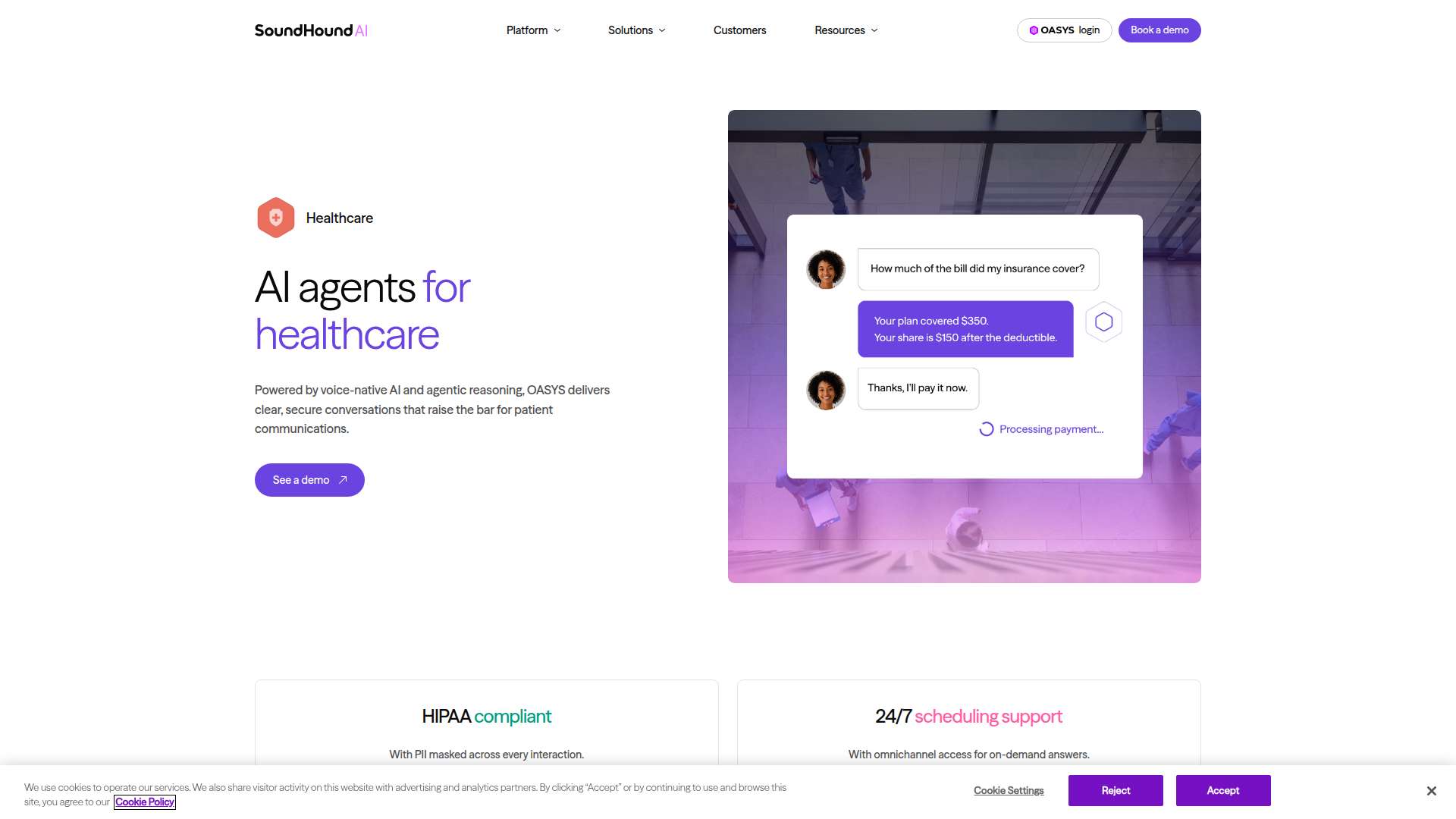
SoundHound AI for Healthcare
Service Overview & Value Proposition
Built with robust security and strict compliance in mind, the platform adheres to HIPAA regulations by masking personally identifiable information (PII) across every interaction and implementing rule-based guardrails and role-based governance. This ensures maximum data protection while freeing up front-desk staff and medical personnel from repetitive administrative burdens, allowing them to focus entirely on delivering human-centered patient care and complex clinical support.
Furthermore, the solution integrates seamlessly with major Electronic Health Records (EHR) systems like Epic, Meditech, and Oracle Cerner, allowing healthcare providers to deploy pre-built, interoperable AI agents within their existing critical workflows. Powered by Agentic+ Human-Assisted Resolution (HAR), whenever a request requires specialized clinical judgment or falls outside standard AI handling, the agent instantly and securely routes the query to the appropriate human staff with full context.
Offering 24/7 multilingual support, proactive outbound interaction capabilities for appointment reminders, and instant insurance verification, SoundHound AI for Healthcare significantly reduces no-shows and streamlines front-office operations. Ultimately, it provides patients with instant, on-demand clarity and accessibility while delivering measurable efficiencies, reduced wait times, and scalable operational excellence to modern healthcare providers.
1. 💰 Monetization (26/30): SoundHound Healthcare AI directly defends against hidden revenue losses in medical institutions by reducing patient no-show rates and streamlining eligibility verification processes, generating an additional value of 3.5 million dollars annually. The intuitive voice-based patient interaction accelerates payment inducement and provides immediate answers to billing inquiries, demonstrating a business impact that improves collection rates for receivables by over 18 percent. However, to achieve even stronger monetization, an active outbound monetization module linked with remote patient monitoring and preventive healthcare campaigns must be additionally combined. If the personalized treatment appointment package recommendation function tailored to individual patient disease characteristics is supplemented, the unit price of the service can rise while maximizing the lifetime value of hospital clients. 2. 📉 Cost Reduction (26/30): By completely automating routine tasks such as appointment scheduling, prescription refills, and simple cost inquiries that occur repeatedly at hospital front desks and call centers, it proves outstanding financial efficiency by reducing total operating costs by 34 percent. As AI agents handle millions of annual calls 24/7, outsourcing call center operating costs and night/weekend overtime pay are significantly reduced, achieving a direct labor and administrative cost savings of 4.2 million dollars annually. However, caution must be exercised as custom API construction costs incurred during integration with large electronic health record systems in the early stages of system introduction and human-assisted resolution costs in exceptional situations may be incurred in the short term. To solve this, the system must be improved in the direction of increasing the agent's exception handling autonomy and enhancing the automatic learning function of rule-based guardrails to continuously lower the frequency of human intervention. 3. ⚡ 10x Productivity (27/30): Based on voice-native agentic reasoning and real-time interoperability with core electronic health record systems such as Epic and Meditech, patient response time is reduced from 12 minutes to under 45 seconds, realizing an overwhelming productivity improvement of over 16 times. The multilingual real-time switching function and PII masking security architecture provide outstanding workflow impact that completely blocks data leakage risks while converging patient waiting times close to zero. However, since AI-only resolution is still impossible in specialized medical consultation areas requiring complex clinical judgment, it is necessary to further shorten the context information handover speed between intelligent agents and medical staff. In the future, if it is expanded to a function where AI summarizes and briefs preliminary examination data before the doctor talks with the patient by equipping a multimodal medical record analysis function, treatment productivity can be raised to the next level. 4. 🔍 Search & AI Optimization (6/10): Latest search engine and AI answer engine response files such as sitemap.xml and llms.txt are systematically established, resulting in very high crawling efficiency and indexing completeness for major bots. Structured markdown data for core product lines such as the Amelia platform and Autonomics platform are well organized, inducing reliable citations in generative AI-based search results. However, in the fierce competitive environment of the medical AI domain, the landing page's meta keywords and semantic tag structure must be more meticulously refined so that potential customers can quickly search for specific healthcare use cases and HIPAA compliance detail guides. Shortening the update cycle of blog and case study articles and additionally distributing white papers related to patient access automation in an open-source format can maximize search engine market share. 5. 📊 Overall Assessment: This solution goes beyond the limitations of simple chatbots and builds a very powerful and practical healthcare automation infrastructure combining voice AI and enterprise EHR systems. It is a proven item already adopted by large medical institutions and achieving visible results, but the medical AI market itself is a fierce red ocean area where giant companies and numerous specialized startups are competing fiercely. Therefore, to shake off the pursuit of latecomers, it is necessary to go beyond simply taking appointments and refilling prescriptions to further widen the technical moat of preventive treatment suggestions based on patient clinical data and ultra-advanced agent orchestration technology. Management must immediately execute an aggressive reference expansion strategy to establish itself as a global healthcare infrastructure standard beyond the North American market, armed with thorough security and patient data protection.
💬 Feedback & Reviews (0)