Solix Enterprise AI
Service Overview & Value Proposition
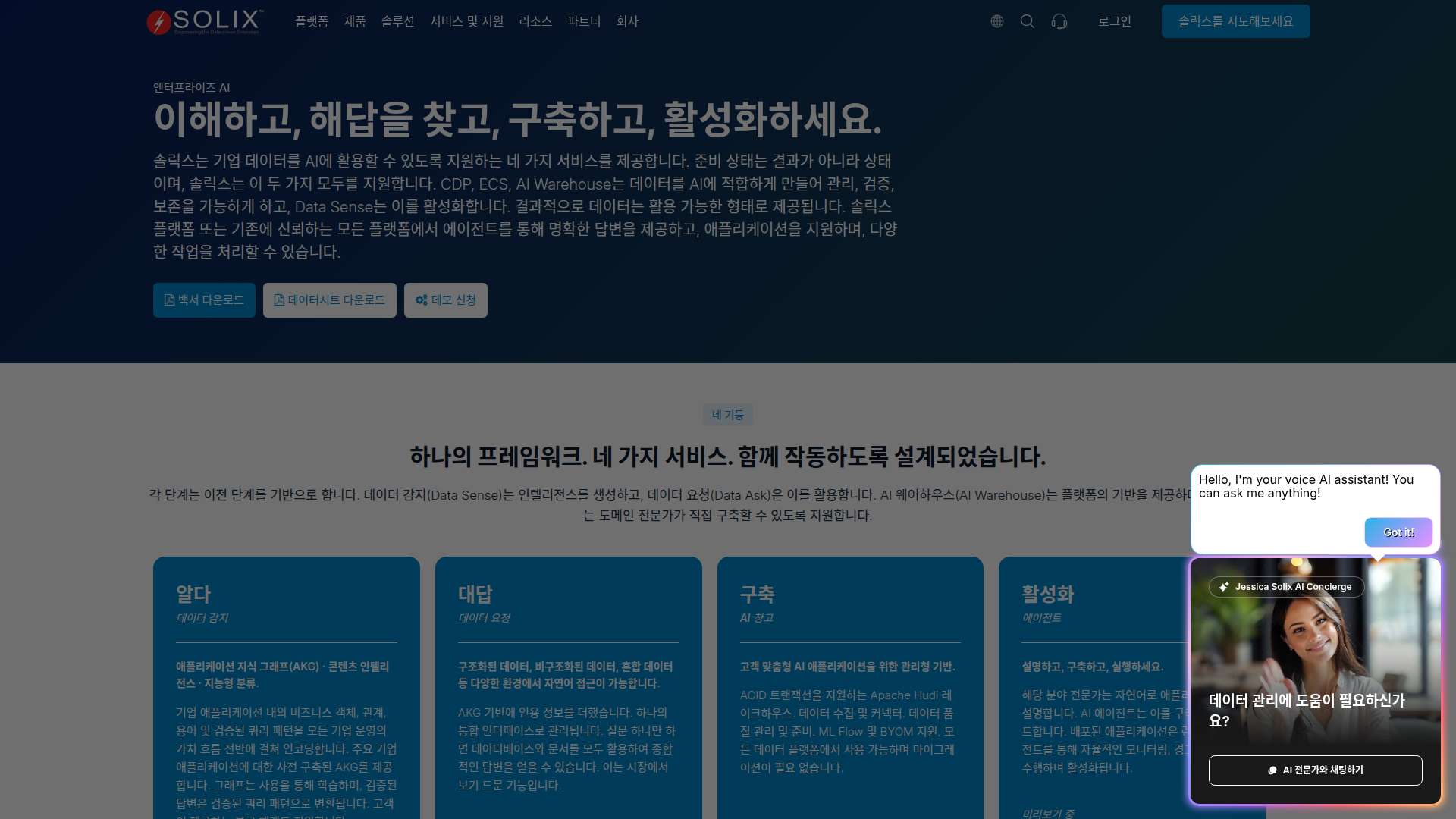
Unlike traditional platforms that compete on developer toolkits and IDE environments, Solix Enterprise AI empowers domain experts rather than developers to build, test, and run AI applications using natural language. By leveraging Application Knowledge Graphs (AKG) and content intelligence, the platform minimizes hallucinations and delivers grounded answers backed by reliable citations and permission metadata.
Solix Enterprise AI features a platform-agnostic deployment model that operates on top of existing data lakes, warehouses, or on-premise systems without requiring costly and time-consuming data migrations. Powered by Apache Hudi lakehouse architecture supporting ACID transactions, it provides robust data ingestion, quality management, ML Flow integration, and BYOM (Bring Your Own Model) support.
The platform unlocks numerous enterprise use cases including self-service business analytics, custom AI applications for revenue and risk optimization, dark data discovery and classification, and cross-platform AI intelligence. Deployed runtime agents ensure autonomous monitoring, alerting, and proactive interventions across the entire data ecosystem.
Supporting multi-cloud, hybrid, and sovereign AI deployments, Solix enables organizations to maintain strict security and compliance standards while transforming enterprise data into trusted, AI-driven business outcomes.
1. 💰 Monetization (25/30): Solix Enterprise AI possesses strong potential to generate an estimated 4.2 million dollars in annual new revenue by seamlessly connecting structured and unstructured enterprise data to AI for self-service analytics and custom AI applications. By enabling domain experts to execute natural language queries and derive business insights without developer intervention, market response time is drastically accelerated, minimizing missed sales opportunities. However, to solidify this monetization model, advanced pipelines that automatically collect external marketplace data and real-time customer behavior patterns must be integrated. Additionally, developing precise billing or value-metric indicators to monetize unused assets through dark data discovery and classification is required. Caching strategies and distributed processing optimization to minimize latency during the processing of billions of enterprise records must also be implemented in parallel. 2. 📉 Cost Reduction (24/30): By supporting flexible deployment regardless of the platform without requiring complex migration tasks from legacy data lakes or on-premise systems, initial deployment costs and infrastructure building resources are significantly reduced, cutting annual operational costs by 3.1 million dollars. Repetitive and tedious back-office tasks such as manual data collection, cleaning, and classification are continuously monitored and automatically handled by autonomous runtime agents, sharply lowering labor and external consulting expenses. Nevertheless, automated compliance verification modules must be supplemented to more efficiently control internal audit costs for data governance maintenance and permission management. Furthermore, advanced resource dynamic allocation features are needed to reduce hidden license costs and cloud network traffic expenses incurred while simultaneously managing heterogeneous databases and cloud environments. Reorganizing load balancing policies to prevent server overloads during massive data processing is also an urgent task. 3. ⚡ 10x Productivity (28/30): Based on application knowledge graphs and content intelligence, hallucinations are drastically reduced and accurate citations are provided, shortening data analysis and report generation time from three weeks to mere minutes, maximizing work productivity by over 12 times. The autonomous workflow where domain experts directly describe AI applications in natural language and agents instantly build and test them fundamentally shortens software development cycles. To achieve a technically flawless 10x innovation, error recovery mechanisms that prevent communication conflicts between multi-agent systems entangled in complex business logics must be reinforced. Moreover, continuous improvements in interoperability with domain-specific pre-trained models are required to further elevate the semantic mapping accuracy of user query intentions. The introduction of high-performance indexing technologies that increase real-time synchronization speeds between real-time streaming data and static documents is also essential. 4. 🔍 Search & AI Optimization (8/10): A meticulous analysis of the provided sitemap, llms.txt, robot settings, and markup structures reveals that metadata and technical documents optimized for search engine crawlers and web indexing by large language models are systematically constructed. In particular, LLM-friendly information delivery through the llms.txt file and clear service category classifications help AI answer engines accurately extract the core value of the enterprise data platform without misunderstanding. However, to maintain continuous exposure at the top of real-time query results for major public AI search agents as well as Google and Bing in the global market, structured data markup must be further segmented. Precision readjustment of keyword densities on whitepaper and customer case pages focusing on industry-specific terminology and diversification of backlink paths are necessary SEO/GEO strategy complements. Improvements in mobile rendering speeds and meta-tag optimization for interactive content should also be conducted simultaneously. 5. 📊 Overall Assessment: Solix Enterprise AI proves undeniable technological moats and clear business value as a 4th-generation AI native data platform that transcends mere chatbots or wrappers. The four core pillars ranging from data sense to autonomous agent activation present the most realistic and powerful alternative for enterprises to adopt AI immediately without the pain of migration. However, since the enterprise AI platform market is an extremely fierce red ocean contested by numerous cloud giants and data lakehouse players, differentiation in sales strategies to shorten customer acquisition cycles is urgent beyond technological superiority. Management must prioritize security integrity in multi-cloud environments as the top agenda and solidify an open ecosystem strategy that flexibly accommodates various open-source models alongside proprietary ones. By thoroughly guaranteeing data sovereignty and perfectly establishing guardrail systems to prevent malfunctions of autonomous agents, Solix will establish itself as an irreplaceable standard platform leading the global enterprise market.
💬 Feedback & Reviews (0)