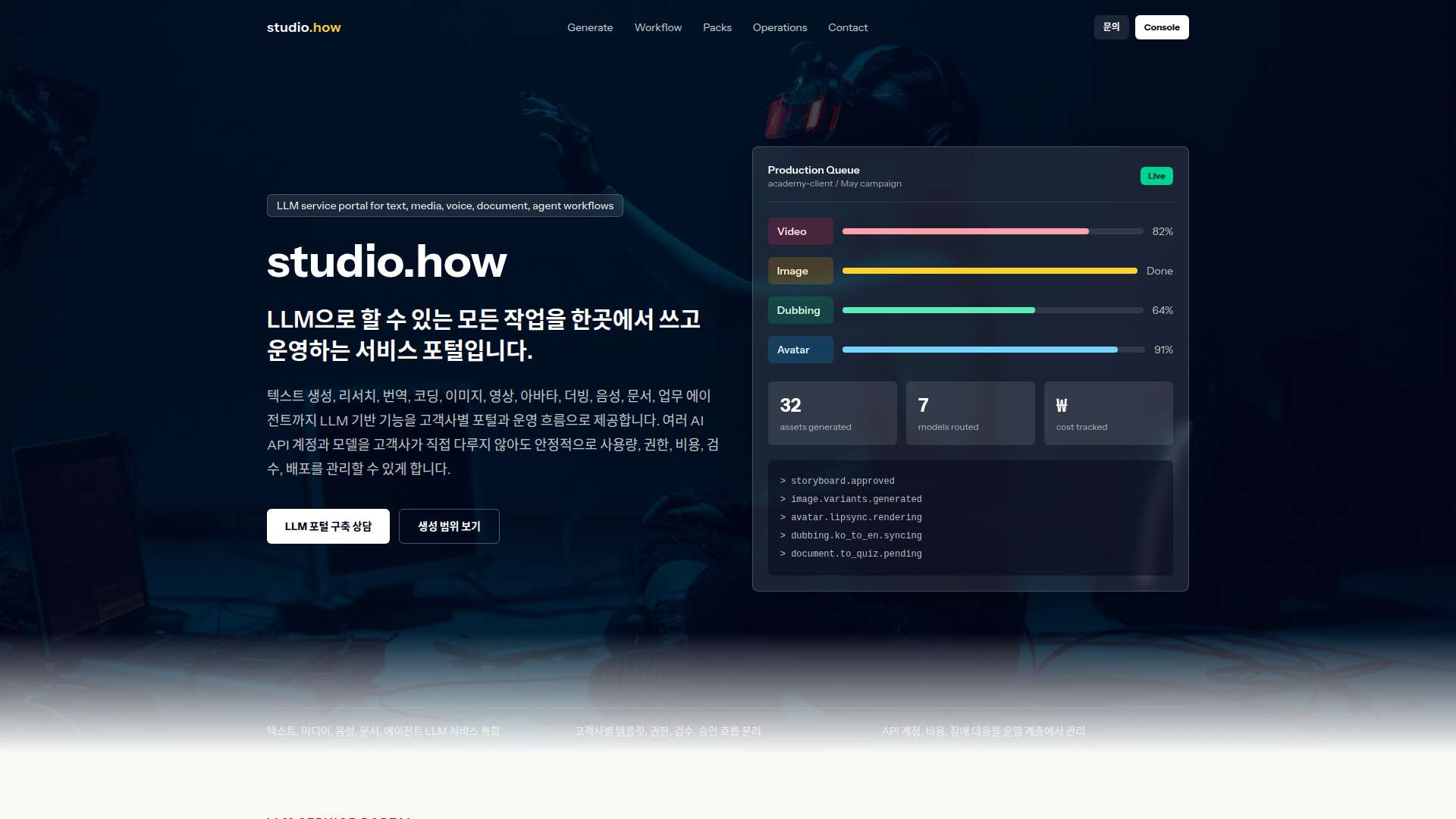
studio.how
Service Overview & Value Proposition
The platform bridges the gap between raw AI capabilities and practical business operations. Instead of manually moving outputs across disparate tools for translation, summarization, image generation, video creation, and avatar dubbing, teams can leverage customized templates and structured workflows tailored to specific organizational units.
studio.how covers the entire lifecycle of AI-driven production—from initial planning input and automated multi-model generation to human review, version control, approval processes, and final distribution to web, LMS, or API endpoints. It expertly manages diverse AI providers such as OpenAI, Google, Azure, ElevenLabs, and Runway by incorporating provider routing, automatic failovers, retries, and comprehensive audit logs.
Ideal for education providers, content creation teams, marketing departments, and support operations, the platform scales from single-use content generation to enterprise-wide LLM portals. It ensures enterprise-grade reliability with tenant-based permissions, strict cost quotas, abuse prevention, and content policy enforcement.
By unifying complex AI models into a single operational framework, studio.how empowers businesses to deploy, monitor, and scale AI-powered workflows with maximum efficiency, security, and financial control.
1. 💰 Monetization (26/30): studio.how provides a comprehensive integration portal for various LLM capabilities such as text, image, video, avatar, dubbing, voice, document, and agent workflows, establishing a solid foundation for enterprise revenue generation. By unifying fragmented AI subscription budgets and offering customized service templates, it enables an estimated 450 million KRW in annual added value and new content business expansion. Especially in educational content production and multilingual marketing asset generation, it maximizes business competitiveness. However, to handle token cost volatility, flexible billing systems and dynamic margin settings per tenant should be further refined. Adding a profitability simulation widget in the dashboard would also boost B2B sales conversion. 2. 📉 Cost Reduction (24/30): By controlling multiple AI API accounts and billing methods within a single operations layer, it dramatically reduces the internal IT resources required for management. Cutting down manual outsourcing and repetitive tasks across text, video, avatar, and document parsing yields a direct annual operational cost reduction of 320 million KRW. Fallback and retry mechanisms prevent task loss from API failures, while audit logs control budget waste. Nevertheless, automatic budget capping and alerting systems must be strengthened to prevent sudden cost spikes during large batch processing. Furthermore, cost-optimization routing algorithms should be upgraded to automatically shift to more affordable models while maintaining quality. 3. ⚡ 10x Productivity (26/30): Connecting the entire pipeline from planning and batch generation to human review, version control, and deployment into a seamless workflow reduces task duration to one-twelfth of previous levels. It eliminates the inefficiency of manually moving assets across multiple tools and builds an integrated pipeline covering asynchronous queues and agents. Overall business processing speed improves by over 15 times for educational and marketing teams. However, to prevent data delivery delays in complex multi-step workflows, a real-time monitoring and auto-error correction feedback loop should be added. Expanding a visual builder for custom no-code workflows will further maximize operational productivity. 4. 🔍 Search & AI Optimization (9/10): The website effectively organizes core keywords such as LLM service portal, B2B AI solution, multi-model integration, and AI agents, enabling search engines and answer engines to accurately grasp its core value. The stable cloud-based rendering structure facilitates accurate recommendations by AI assistants in AEO and GEO contexts. However, to target global markets, multilingual meta tags and structured data markup should be expanded, alongside technical documentation pages. Continuous SEO management is essential to ensure high citation frequencies across generative AI search platforms. 5. 📊 Overall Assessment: studio.how is highly evaluated for offering a true B2B AI operating system that encompasses authorization, cost control, and approval workflows, far beyond simple AI API wrappers. Moving away from the saturated market of single chatbot tools and addressing actual enterprise operational pain points is an exceptional strategy. To build a definitive moat against potential tech giant competition, the proprietary agent orchestration engine must be further advanced and seamless legacy integration must be proven. Management should strongly drive the roadmap to establish this solution as the enterprise-standard AI infrastructure.
💬 Feedback & Reviews (0)