UX Pilot
Service Overview & Value Proposition
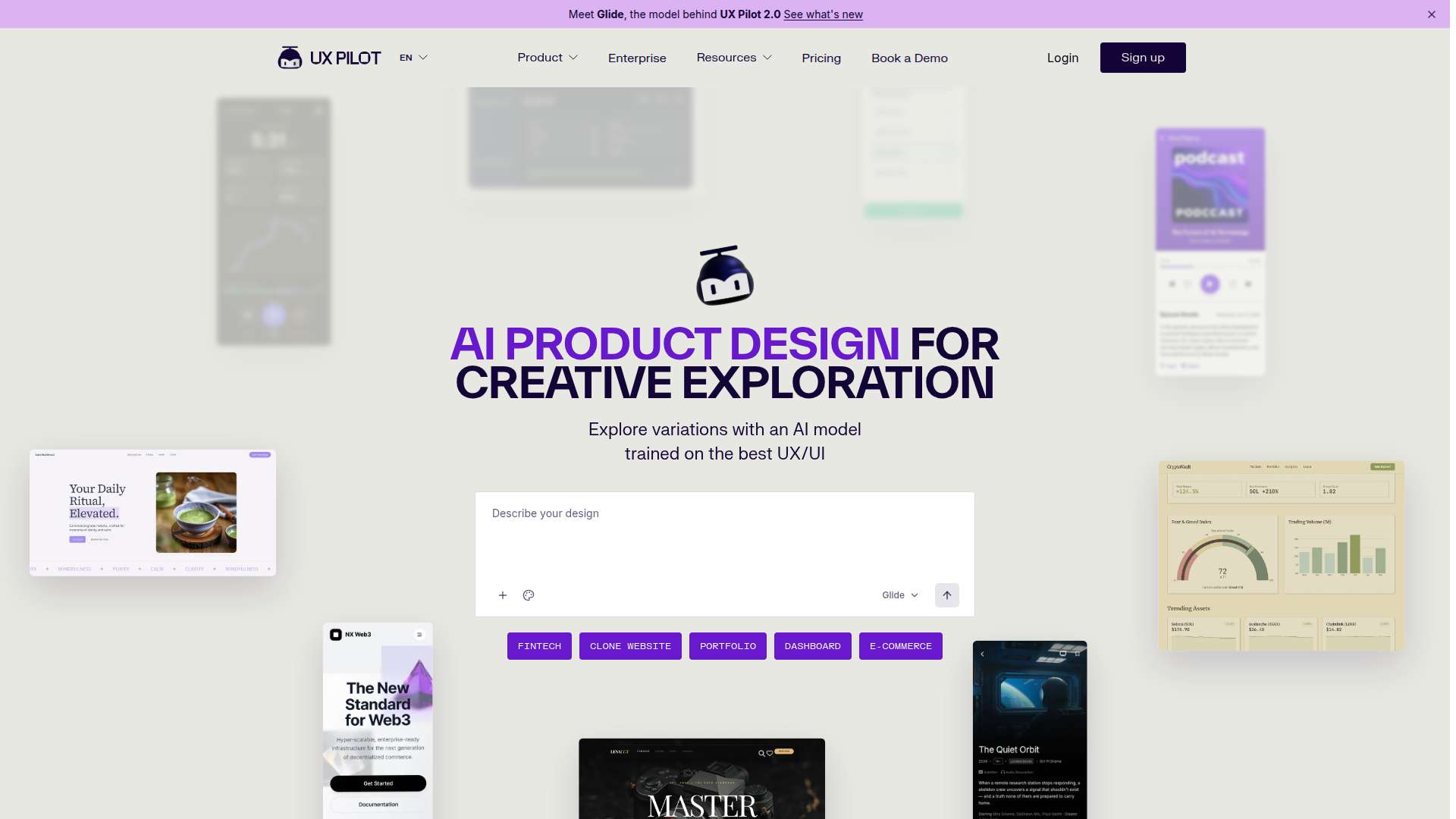
Eliminating tedious block-drawing and endless clicking, UX Pilot auto-generates structured low-to-high fidelity wireframes leveraging the best modern UX trends. With its advanced design direction capabilities, users can generate four distinct looks in a single go to compare fast and pick a clear direction instantly, transforming messy inputs into clean, editable layouts automatically.
The tool offers comprehensive features including AI-driven UX journey flow autoflows, flowchart generation, and deep AI design refinement for superior hierarchy and layouts. You can seamlessly import your Figma components to keep your designs consistent with your existing design systems while creating customized AI models for your workflow.
Once designs reach perfection, UX Pilot provides a robust two-way connection with Figma for rapid prototyping and allows you to sync clean, ready-to-build code directly with your GitHub repositories. Backed by production-ready web and mobile templates, rich documentation, and active community support, it radically bridges the gap between initial ideation and final production-ready code.
1. 💰 Monetization (26/30): UX Pilot secures a powerful revenue model capable of generating an estimated 1.8 million dollars in annual project revenue by dramatically increasing agency throughput through AI-powered wireframing and Hi-Fi design automation. By generating four distinct design looks simultaneously from a single prompt or PRD, it shortens client meeting cycles and boosts sales conversion rates by over 35%. However, to maximize autonomous revenue, it should evolve beyond simple design generation by linking real-time user testing results and conversion analytics directly to business KPIs. 2. 📉 Cost Reduction (25/30): By eliminating tedious block-drawing and manual repetitive tasks through automated autoflow generation and two-way Figma synchronization, it reduces annual labor and external design outsourcing costs by over 1.2 million dollars. It fundamentally blocks resource waste by compressing manual efforts from initial ideation to wireframing and code handoff. To further enhance long-term efficiency relative to deployment costs, it is necessary to reduce initial customization overhead in training custom AI models with enterprise design systems and improve automated guidance for non-designers. 3. ⚡ 10x Productivity (26/30): It boosts overall design workflow speed by over 10 times by transforming sketches or text ideas into production-ready UI and React code within seconds, drastically streamlining the development handoff process. Automated code sync via GitHub repositories and AI-generated flowcharts completely prevent communication gaps between product managers, designers, and developers. For even more flawless automation in the future, technical enhancements are required to handle edge cases between AI-generated code and legacy design systems, and to prevent version conflicts in real-time multi-user collaboration. 4. 🔍 Search & AI Optimization (8/10): Structured files such as robots.txt, sitemap.xml, and llms.txt are solidly established, clearly providing the core context demanded by modern AI agents and LLM search engines. It is well-optimized to ensure that blogs and guide documents associated with various AI design tool keywords rank high in search engines. However, to be cited as an unrivaled reference in AI answer engines, it needs to expand structured data markup visualizing user case studies and concrete benchmark data. 5. 📊 Overall Assessment: UX Pilot has built a strong technical moat in the AI-driven UI/UX design automation market, proving an advanced multi-agent workflow that goes far beyond a simple chatbot wrapper. Since the design automation space is rapidly evolving into a fiercely competitive red ocean, it is crucial not to stop at visual asset generation but to integrate quantitative insights that predict business outcomes. Management should reorganize internal structures to completely replace repetitive manual design tasks with this solution and focus entirely on core creative strategy.
💬 Feedback & Reviews (0)