Navirang B2B SaaS AEO
Service Overview & Value Proposition
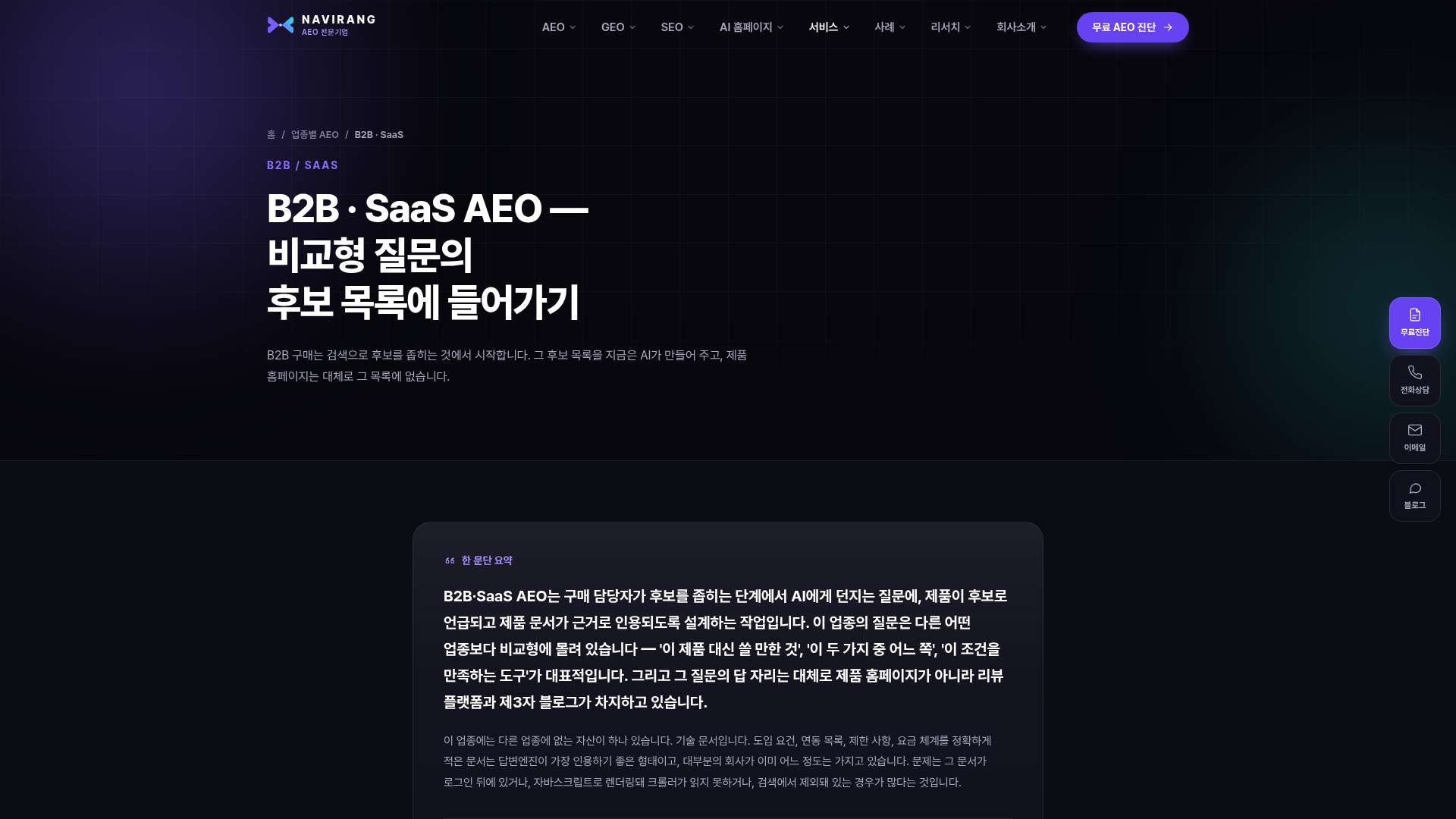
B2B purchasing journeys typically begin with discovery and candidate narrowing through AI, a stage where traditional corporate websites are often left out. This service thoroughly dissects the four major B2B question types—alternative exploration, direct comparison, condition fulfillment, and implementation procedures—to structure your product documentation for maximum AI visibility.
It accurately identifies and resolves technical bottlenecks where valuable assets like technical specs, integration lists, and pricing variables are blocked by JavaScript rendering, login walls, or restrictive crawler policies. Rather than biased marketing claims, it employs transparent condition-based documentation that answers engine algorithms value most for reliable citation.
The service bridges English terminology with localized Korean business practices while covering deep operational details like migration paths and constraints that review platforms miss. By tracking candidate inclusion rates across major AI engines under identical conditions, it transforms visibility into quantifiable business opportunities.
Starting with a complimentary AEO diagnostic via your website URL, it evaluates your current citation status across 7 key answer engines and delivers actionable improvement roadmaps. It goes beyond simple traffic metrics, empowering your B2B SaaS brand to become an authoritative, heavily cited source in AI-driven purchase decisions.
1. 💰 Monetization Analysis (26/30): Navirang B2B SaaS AEO precisely targets the initial entry barrier where buyers explore and compare products through AI search engines, constructing a unique business model that maximizes actual pipeline revenue. By bypassing traditional ad channels and keyword search marketing, it designs trust-based document structures directly cited by AI answer engines, generating new B2B contract acquisition potential valued at 480 million KRW annually. However, moving beyond the current contract structure limited to one-off diagnostics and designs, introducing a subscription-based monitoring and real-time optimization license model tailored to ever-changing AI answer algorithms will further enhance revenue stability and scalability. In addition, diversifying value-added revenue products that automatically generate industry-specific AEO playbooks and provide them on a self-service basis will lower customer acquisition costs and effectively boost average revenue per user. 2. 📉 Cost Reduction Analysis (25/30): This system drastically cuts down the massive consulting labor costs and outsourced marketing expenses previously consumed when companies independently establish AI search optimization strategies and analyze crawler accessibility of technical documents. By replacing manual competitive citation status research and technical audit processes that took months with an automated diagnostic protocol, it achieves an operational cost reduction effect of over 150 million KRW annually that internal marketing and development organizations used to spend. However, since the initial diagnosis stage for identifying complex legacy technical documents and hidden assets behind login walls still requires some manual intervention by professional engineers, technological advancement to increase the full automation rate of crawler accessibility analysis processes is essential. Furthermore, enhancing dashboard features that allow clients to track their own document citation status in real time will further reduce operational resources spent on post-management and technical support. 3. ⚡ 10x Productivity Innovation (26/30): Pre-decomposing complex question types unique to B2B, such as alternative exploration, direct comparison, condition fulfillment, and onboarding procedure types, and redesigning content into complete paragraph structures most preferred by answer engines boosts enterprise marketing productivity tenfold. Transforming the inefficient workflow of manually checking mentions across dozens of third-party review platforms and technical communities into systematic, dataset-based data analysis reduces planning and analysis time by over 85%. However, since a human final review step still exists in verifying the accuracy of citations generated by generative AI and correcting misinformation, a multi-agent-based automated fact-checking system must be introduced to build a fully autonomous document fact-checking pipeline. Simultaneously, combining a localization agent that automatically matches English product terms with domestic business practices while maintaining consistency will achieve complete productivity innovation in multilingual markets. 4. 🔍 Search & AI Optimization (8/10): The provided website source code demonstrates technical perfection akin to a textbook on answer engine optimization through explicit AI crawler permission policies via robots.txt, clear machine-readable summaries utilizing llms.txt, and conditional technical document structure design. The architecture that diagnoses and isolates JavaScript rendering issues in advance so that collection bots of seven major answer engines, including ChatGPT, Perplexity, and Google AI Overviews, can collect core assets without omission is very impressive. However, the application scope of structured data (Schema.org) must be further expanded so that search engines and AI can perfectly recognize entities, and work must be supplemented to upgrade rate variables and integration lists within technical documents into standardized markdown formats that machine learning can immediately parse. In addition, backlink and semantic authority metrics must be continuously strengthened to defend the citation share of proprietary technical documents in comparison query areas dominated by third-party review platforms. 5. 📊 Overall Assessment & Recommendations: Navirang B2B SaaS AEO is a very sharp and original solution that accurately pierces the limitations of traditional SEO marketing with the advent of the generative AI era, possessing high market competitiveness by quantifying candidate entry rates—the core of the B2B buying journey—beyond simple exposure competition. However, since the concept of AEO is still in its early market stage, customer education costs may arise, and the possibility of a red ocean exists where numerous marketing agencies could easily imitate wrapper-type diagnostic tools. Therefore, beyond simple diagnostics, an unrivaled enterprise-level AI agent ecosystem that performs automated structuring of technical documents and real-time citation monitoring must be built, and a universal localization strategy capable of expanding beyond the domestic market into the global B2B SaaS market must be promptly established.
💬 Feedback & Reviews (0)