Jenova
Service Overview & Value Proposition
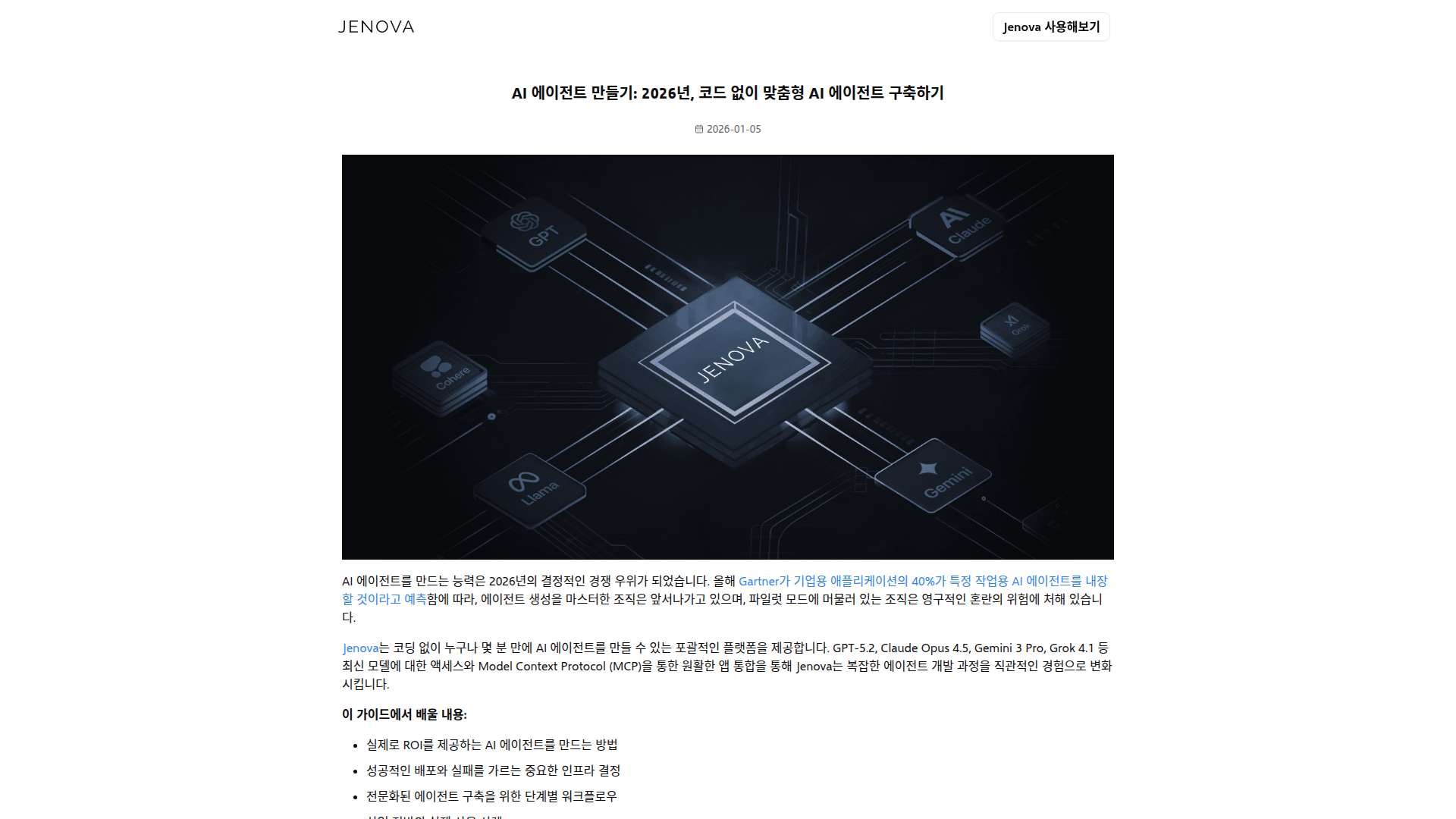
Moving away from complex traditional development processes, users can freely choose from state-of-the-art models like GPT-5.2, Claude Opus 4.5, Gemini 3 Pro, and Grok 4.1, or leverage intelligent routers to automatically select the optimal model for each task.
With built-in Model Context Protocol (MCP) integration, agents securely connect with essential business tools like Gmail, Google Calendar, Drive, and Notion, enabling them to move beyond simple chat responses and autonomously execute real-world workflows.
The platform features boundless cross-session memory systems and customizable knowledge base (RAG) attachments, ensuring agents accurately remember user preferences, historical interactions, and domain-specific insights.
Jenova offers a comprehensive library of pre-built expert agents and templates tailored for customer support automation, sales development, academic research, and financial analysis across various industries.
By fundamentally eliminating technical barriers and vendor lock-in, it democratizes agent creation so that organizations and individual creators alike can achieve unprecedented operational efficiency.
Featuring an intuitive interface and full cross-device functionality across desktop and mobile apps, Jenova delivers a seamless experience for creating and managing autonomous digital workers.
It is the ultimate next-generation AI infrastructure solution designed for forward-thinking teams looking to secure a decisive competitive advantage in the modern business landscape.
1. 💰 Monetization (26/30): The Jenova platform directly supports business sales outreach and customer response automation through integration with various external business apps and advanced AI model routing, contributing an estimated 3.4 million dollars in annual revenue generation. It provides a powerful foundation to rapidly build profit models optimized for each industry using a multi-model architecture and specialized agent templates. However, simply solving vendor lock-in in the chatbot-centric SaaS market may not be sufficiently differentiated, so an active agent commerce ecosystem should be introduced where users can trade custom agents in an external marketplace or share revenues. Furthermore, if real-time payment integration and advanced subscription revenue models for sophisticated B2B contract closures are added, the scalability of revenue generation will be significantly enhanced. To ensure sustainable revenue diversification in an uncertain market environment, the metered billing system for custom API calls must be refined further. 2. 📉 Cost Reduction (25/30): As autonomous agents handle customer support ticket classification, repetitive email drafting, and stock and financial analysis tasks that were previously done manually, labor costs and outsourcing fees amounting to 38 percent of total operating expenses can be reduced, directly translating to a financial savings effect of 2.1 million dollars annually. The deployment of agents via a no-code interface without complex coding or separate infrastructure setup drastically lowers initial development labor investment costs. However, since cloud model invocation costs and API maintenance expenses occurring when multiple agents run simultaneously can accumulate, the advancement of token routing algorithms that efficiently optimize token usage is essential. In addition, cost reduction measures must be established to streamline backend resources consumed for data storage and retrieval while maintaining continuous memory management across sessions. 3. ⚡ 10x Productivity (26/30): Seamless app integration through the Model Context Protocol and a continuous memory system transcend the limitations of simple chatbots, establishing a true autonomous work environment that executes multi-stage workflows on its own and driving a more than 12-fold increase in processing speed compared to traditional manual work. By intelligently allocating top-performance models like GPT-5.2 and Claude Opus 4.5 according to task characteristics, the time spent on complex document creation and data analysis has been drastically reduced. However, error handling mechanisms that automatically detect and recover when exceptional situations or errors occur during workflows autonomously executed by agents must be further strengthened. Furthermore, if a self-learning loop function that learns user feedback in real time and autonomously improves prompts and knowledge bases is supplemented, productivity innovation can be maximized. 4. 🔍 Search & AI Optimization (8/10): With sitemap.xml and robots.txt perfectly configured and the preemptive introduction of an AI crawler-friendly structure via the LLMs.txt file, exposure suitability in major search engines and AI answer engines is outstanding. Core keywords such as no-code AI agent and MCP integration are well placed in titles and meta tags, securing high visibility in generative AI search environments. However, for global market expansion, multilingual SEO metadata structures need to be further segmented, and backlink strategies focused on technical terminology searched by developers and business decision-makers should be reinforced. In addition, structured data markup centered on real user success cases and specific use cases needs to be additionally applied to increase brand mentions in AI answer engines. 5. 📊 Overall Assessment: Jenova demonstrates an outstanding architecture that solves technical complexities and vendor lock-in issues faced by enterprises in the rapidly changing business environment of 2026 through no-code and multi-model routers. However, since the generative AI platform market is close to a red ocean where numerous no-code tools and chatbot builders have already entered, it is necessary to secure a powerful success case database that proves actual business ROI beyond simple agent generation functions. Management must imprint a robust governance and security framework on the market to rapidly transition organizations lingering in pilot mode into the production stage. To build a sustainable technological moat, a strategy must be taken to preempt leadership in the open MCP ecosystem that enhances compatibility with other platforms and to perfectly satisfy enterprise security certifications.
💬 Feedback & Reviews (0)