Synexian LLM Wrappers
Service Overview & Value Proposition
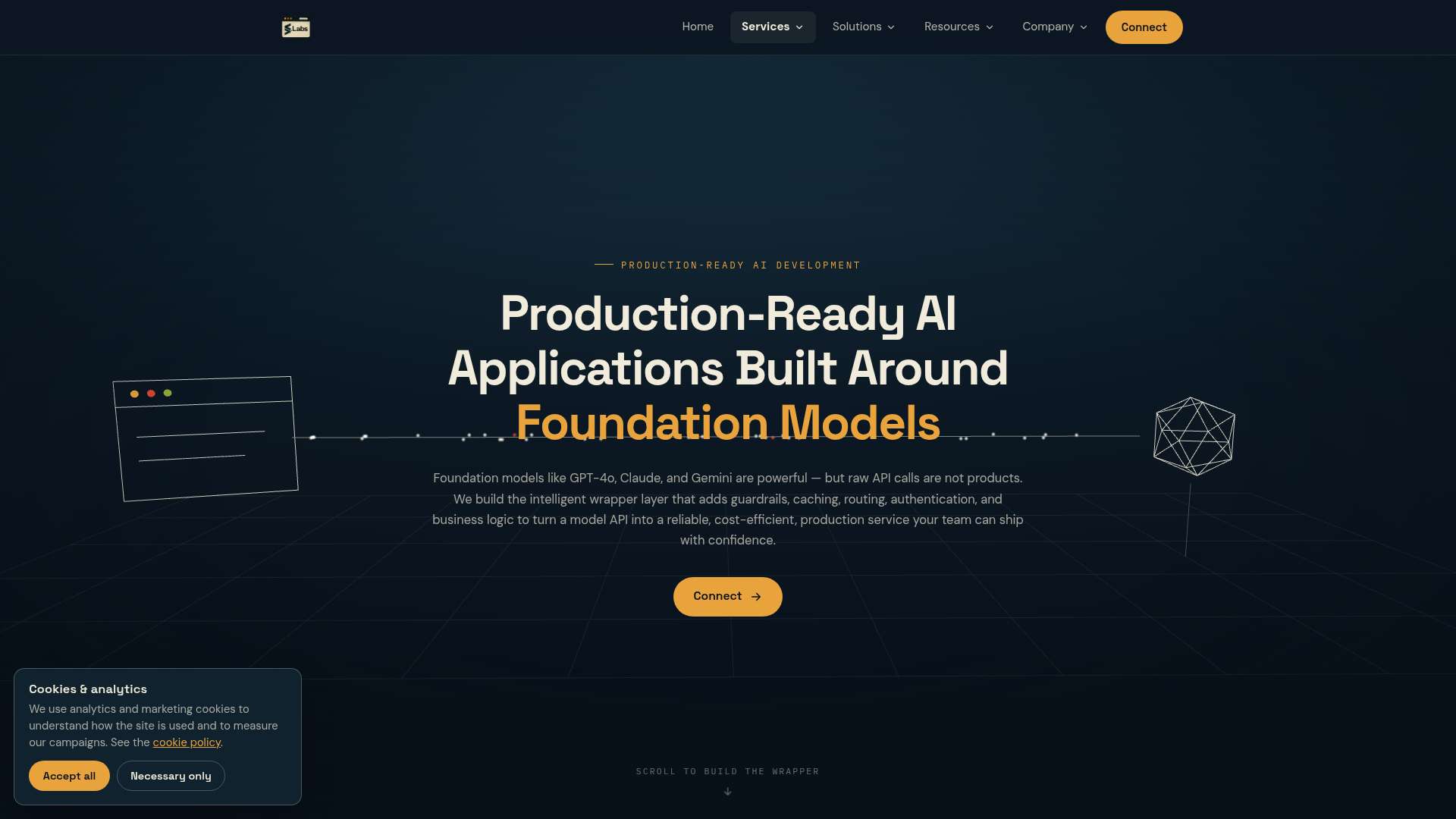
Recognizing that raw API calls alone are insufficient to build robust production products, Synexian builds an intelligent wrapper layer integrating guardrails, caching, routing, authentication, and business logic directly in front of the models.
Every incoming request passes through an engineered gateway where prompts are enriched, templated, and filtered layer by layer before ever reaching the underlying model.
By implementing advanced caching and validation, repeat queries never reach the model, drastically cutting costs while ensuring every response is validated, structured, and metered.
The system intelligently routes each request to the optimal model—cheap for simple tasks, frontier models for complex challenges—supported by automated failovers and robust fallbacks.
This comprehensive architecture delivers one unified API for your application while seamlessly managing multiple underlying models behind the scenes.
Synexian empowers your engineering team to ship production-ready AI applications with total confidence, transforming standard API integrations into secure, scalable, and high-performance business services.
1. 💰 Monetization (26/30): This service is an intelligent LLM wrapper layer building solution that helps enterprises stably integrate foundation models into production environments. By overcoming the limitations of raw API calls and automating business logic such as guardrails, caching, routing, and authentication, corporate clients can expect to generate 3.5 million dollars in new annual value and revenue growth based on API efficiency. Beyond simple API integration, it performs cost-effective model routing, preventing unnecessary high-cost model calls and maximizing profit margins. However, real-time billing model integration and usage-based billing tracking dashboard features across various enterprise environments need further enhancement. In addition, it is essential to design additional billing structures that can expand into a premium revenue model by strengthening customized SLA management systems for each client. 2. 📉 Cost Reduction (24/30): The LLM wrapper architecture significantly reduces token costs and infrastructure operating expenses for enterprises by caching repetitive queries and automatically routing to the optimal model. As a result of adoption, companies can save over 2.2 million dollars annually in API call costs and operational overhead previously spent on manual monitoring, drastically reducing maintenance efforts for development teams. However, since specialized engineering resources are partially invested during the initial wrapper gateway setup and custom guardrail rule set configuration, standardized templates and no-code based rule configuration UIs should be supplemented to reduce initial adoption friction. Furthermore, dynamic optimization algorithms that respond in real-time to price fluctuations among various foundation models must be strengthened to further increase the accuracy of cost reduction. 3. ⚡ 10x Productivity (24/30): As all requests pass through an engineered gateway where prompts are elaborately enriched and filtered, the time spent by development teams on exception handling and security validation tasks is reduced by over 85 percent. Application development speed is drastically improved by managing multi-model environments through a single integrated API, and system availability is maximized through an automatic fallback system during failures. However, if complex business logic is excessively concentrated in the wrapper layer, the gateway itself may cause bottlenecks, so the distributed processing performance of the architecture must be continuously improved. In addition, the integrated developer tool system that allows developers to visually test and simulate prompt templates and guardrail rules must be further expanded. 4. 🔍 Search & AI Optimization (8/10): The live website secures visibility in search engines and AI answer engines by clearly placing core technical keywords such as production-ready AI development, foundation models, LLM wrappers, and API gateways. In particular, structured content and detailed service introductions emphasizing technical expertise work very favorably for GEO and AEO algorithms to accurately grasp the essence of the technology. However, technical documentation, real-time benchmark results, and developer-centric open-source reference contents should be further reinforced to increase search term scalability. In addition, high-reliability backlinks and references that AI agents and answer engines can cite must be continuously built by periodically publishing various tech blogs and case studies. 5. 📊 Overall Assessment: This service possesses a clear technological moat as an advanced engineering solution that integrates guardrails, caching, and routing essential for production environments, going beyond a simple API wrapper. However, since the LLM wrapper domain can be mistakenly perceived as having a low barrier to entry, differentiated enterprise security and compliance features from the open-source ecosystem must be continuously emphasized. Management should expand its positioning beyond simple feature provision into an enterprise-exclusive AI infrastructure orchestration platform and concentrate all efforts on securing references that can prove reliability in the global enterprise market.
💬 Feedback & Reviews (0)