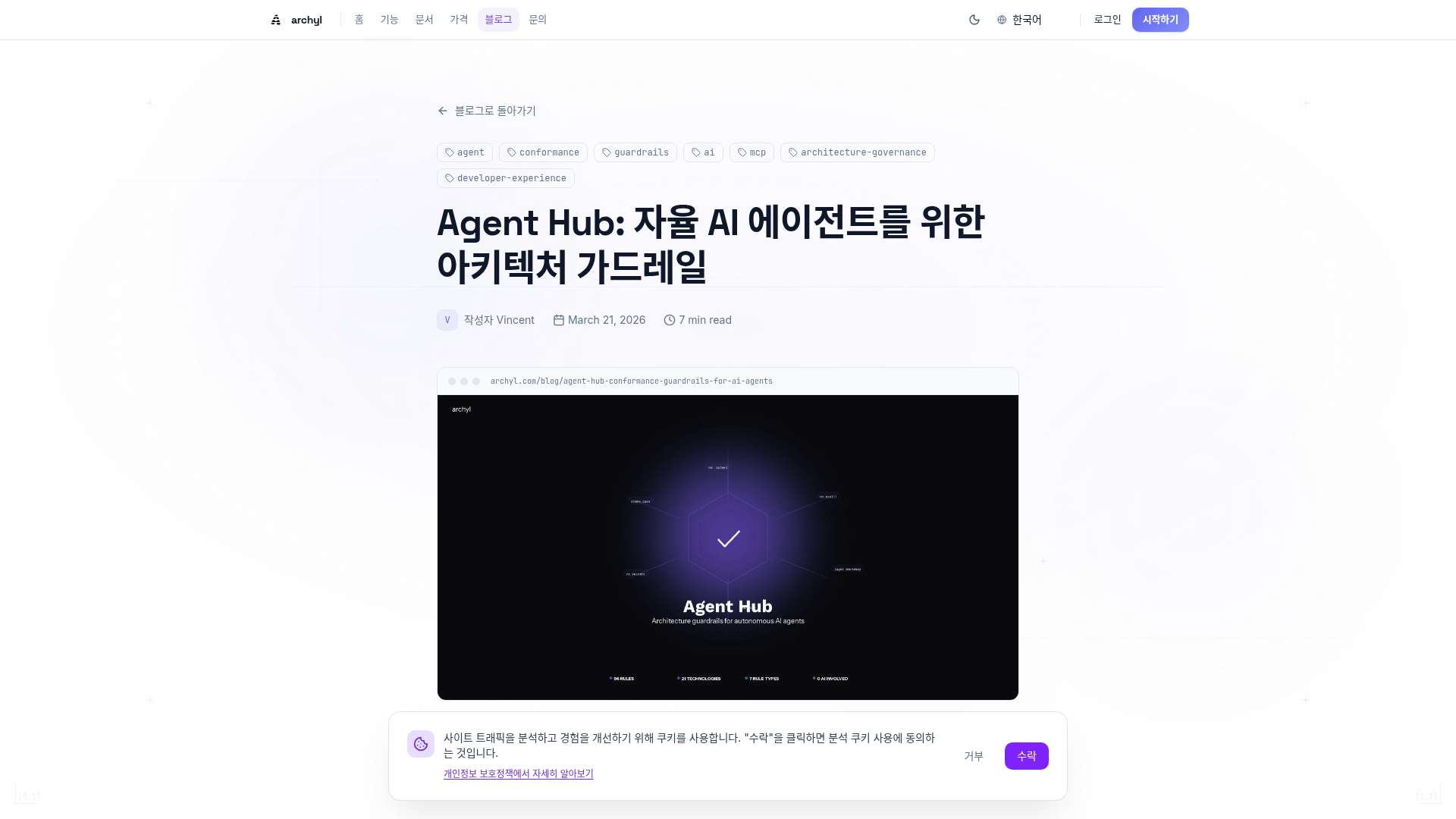
Agent Hub: Architecture Guardrails for Autonomous AI Agents
Service Overview & Value Proposition
While AI coding tools like Claude Code, Cursor, Copilot Workspace, and Devin can build entire services and generate code in minutes, they often write code that ignores team standard tech stacks and architectural patterns.
For instance, even though a team standardizes on PostgreSQL and specific layer structures, an AI agent might use MongoDB or generate direct database calls, introducing a ticking time bomb of architectural drift that still passes CI.
Agent Hub provides a governance environment that automatically enforces architecture checks and standard conventions during the CI pipeline to protect systems from the reckless code generation speed of autonomous AI agents.
Development teams can proactively block issues such as mixed frameworks, unauthorized data access patterns, and deprecated libraries introduced when multiple AI agents collaborate simultaneously.
This solution helps maintain system consistency and stability without slowing down productivity, positioning itself as essential infrastructure in AI-native development environments.
It relieves the burden of repetitive manual code reviews and supports automated rule validation so that entire engineering organizations can adhere to consistent architectural principles.
It offers a powerful alternative for any engineering team looking to systematically manage increasingly complex codebases and maximize long-term maintainability as AI-generated code continues to grow.
1. 💰 Monetization (25/30): Agent Hub systematically blocks architectural entropy and technical debt arising in autonomous AI coding environments, preventing direct system downtime costs and providing a foundation for new revenue generation and risk protection estimated at 4.5 million dollars annually through a long-term enterprise licensing model. By precisely targeting the structural disorder organizations face due to the accelerated adoption of high-performance coding tools like Claude Code and Cursor, it can drive high subscription value from large-scale software development organizations. However, it should be improved to expand guardrails beyond simple code specification verification to business logic optimization stages to enhance added value. Building a plugin ecosystem that can dynamically accommodate the specialized custom governance requirements of enterprise clients will complete a more robust structure in terms of revenue diversification. 2. 📉 Cost Reduction (24/30): It significantly reduces the repetitive effort of senior engineers previously spent on manual code reviews and refactoring processes caused by architectural violations, achieving massive labor and operational cost reductions of 3.2 million dollars annually. Since it automatically and fundamentally blocks the bottlenecks that occur when humans inspect countless codes generated by AI agents at the CI pipeline stage, quality control costs decrease dramatically. However, the automated onboarding process needs to be advanced to minimize the consulting and engineering resources incurred during the initial setup of internal technology stacks and custom rules. In addition, it is necessary to strengthen the machine learning-based rule optimization feedback loop to reduce the cost of developers manually handling exceptions when false positives occur. 3. ⚡ 10x Productivity (27/30): It perfectly resolves the gap between the code generation speed of development organizations and system stability, improving work efficiency in multi-agent environments by over 90 percent and shortening rework time caused by architectural drift. By preventing agents from indiscriminately adopting different frameworks or deprecated libraries, it maintains consistency without slowing down the overall software lifecycle. However, it is necessary to further strengthen technical flexibility to synchronize guardrail rules in real-time according to the rapid update cycles of various AI coding assistants. Furthermore, productivity could be further maximized if an inline guide function at the prompt level is added to suggest correct conventions in real-time when AI agents generate code, rather than just stopping at unidirectional blocking. 4. 🔍 Search & AI Optimization (9/10): Core keywords such as architecture guardrails, code governance, and AI agents are organically arranged throughout the title, meta tags, and body text, showing high exposure suitability in developer-related search engines and AI answer engines. It is advantageous to continuously reinforce technical whitepapers and migration case study content so that it can be clearly recognized as a development productivity tool in LLM-based search environments. In particular, contextual expansion using specific error scenarios and solutions actually searched by developers as keywords will ensure accurate targeting without misrecognition. 5. 📊 Overall Assessment: Agent Hub is a highly original and timely solution that accurately identifies the most realistic and critical architectural collapse problems organizations face amidst the flood of AI coding tools. It possesses strong potential to establish itself as an essential governance infrastructure for the autonomous agent ecosystem, going beyond a simple red-ocean style code analysis tool. To build an unrivaled moat in the future market, it must enhance interoperability with global open-source standards beyond enforcing standards for a single company and secure universal adapters that integrate immediately with various LLM agent frameworks. Management should define this solution not merely as a development assistance tool, but as a core risk management asset in the AI transformation era, and aggressively promote its adoption and expansion.
Want to integrate this kind of AI natively into your enterprise data?
💬 Feedback & Reviews (0)