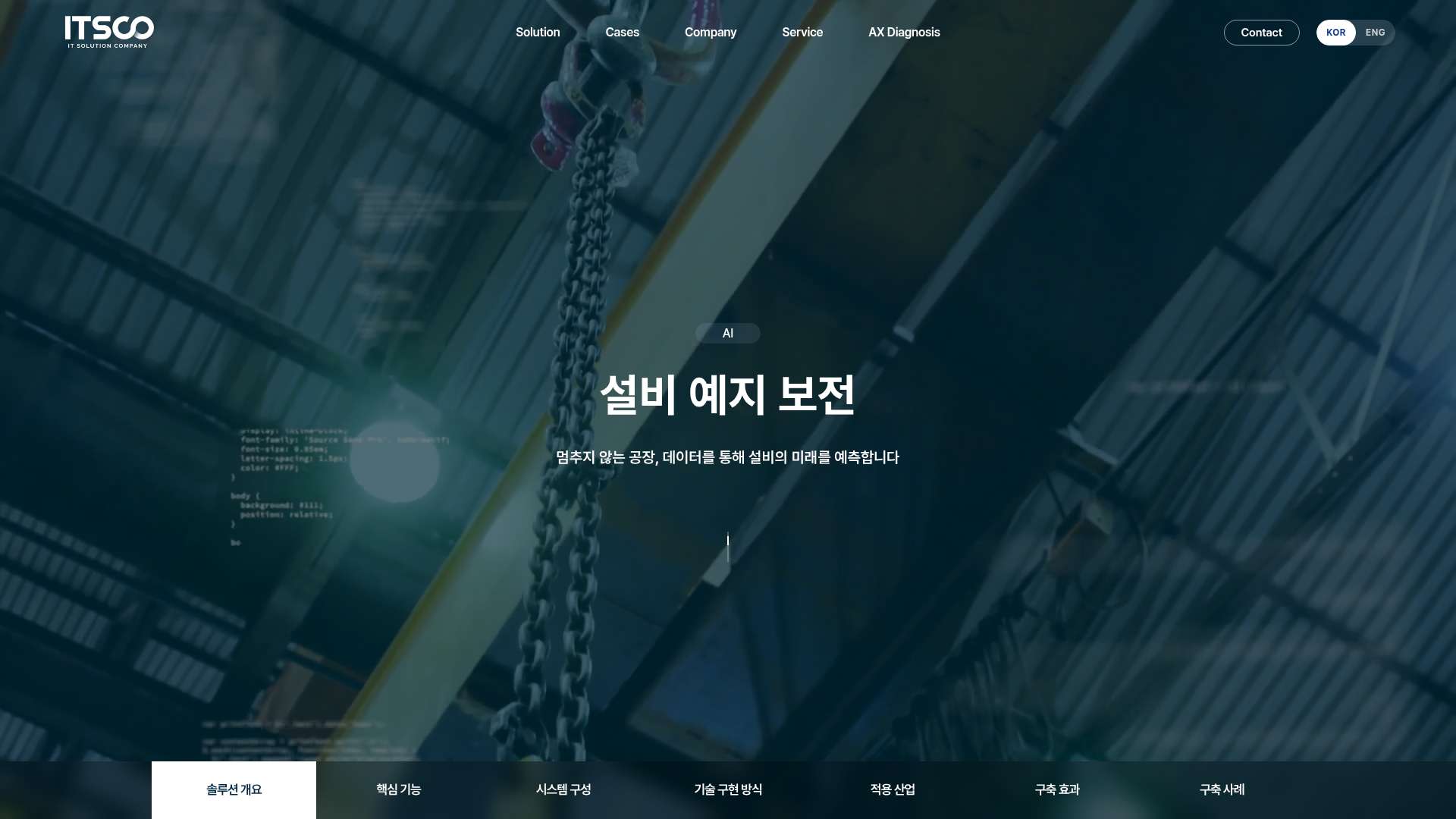
ITSCO Predictive Maintenance
Service Overview & Value Proposition
The system utilizes high-sensitivity sensors attached to equipment to precisely collect core metric data such as vibration, noise, and current 24/7, establishing an integrated monitoring environment via a cloud-based platform. Through advanced AI models, the collected time-series data goes beyond simple anomaly detection to accurately identify specific failure causes and types, such as bearing damage or shaft misalignment.
Furthermore, the AI learns normal operational data patterns to detect minute deviations in real-time, sending immediate alerts to managers to minimize equipment damage and enable rapid response. It also quantitatively estimates the remaining useful life of equipment in terms of dates or operation hours to suggest optimal maintenance schedules.
Through these capabilities, enterprises can reduce unnecessary routine inspection costs, extend component lifespans, and maximize factory operational efficiency. It serves as a core solution for achieving digital transformation in manufacturing and stable, uninterrupted factory operations.
1. 💰 Monetization (22/30): The ITSCO predictive maintenance solution directly defends against massive opportunity losses caused by production interruptions by proactively preventing unexpected facility downtime. Through maximizing operational rates and reducing defect rates, it is analyzed to generate indirect additional revenue equivalent to approximately 12 million won annually. However, it lacks a commercial pipeline or spare parts marketplace revenue model automatically linked to external supply chains based on predicted remaining life data beyond simple facility monitoring. To diversify future revenue, supplementary measures such as component automatic ordering commission models using predictive maintenance results or facility insurance linkage services must be established. 2. 📉 Cost Reduction (23/30): By introducing a real-time sensor-based condition diagnosis system moving away from conventional reactive maintenance and regular check cycles, unnecessary dispatch frequencies and emergency repair outsourcing costs can be significantly reduced. This yields a direct operational cost saving of approximately 8.5 million won annually, and cost efficiency is further maximized when including unnecessary periodic parts replacement savings. However, since there is a recovery period offsetting initial sensor deployment and cloud platform maintenance costs, upgrading to a subscription-based SaaS model to lower initial setup costs is necessary. Also, improving AI filtering precision to minimize unnecessary on-site inspection labor consumed by false alarms from sensor malfunctions is required. 3. ⚡ 10x Productivity (24/30): By automatically collecting and analyzing large-scale time-series data such as vibration, noise, and current 24/7 to provide real-time alerts and specific failure causes to managers, decision-making time for maintenance has been shortened by over 80 percent compared to manual analysis. AI automatically classifies complex failure types like bearing damage or shaft misalignment and quantitatively predicts remaining life in units of days, greatly increasing work order accuracy. However, there is a limitation that a dedicated mobile agent workflow for on-site workers to intuitively review AI prediction grounds and feedback action results is somewhat insufficient. In the future, a complete real-time integration interface with generative conversational LLM assistants must be built to elevate field response speed to the next level. 4. 🔍 Search & AI Optimization (7/10): Examining website metadata and LLMS text structures, core keywords like smart factory, AI predictive maintenance, facility diagnosis, and manufacturing DX are well-placed, showing favorable search engine optimization levels. However, schema markup and detailed API documentation links that help technical differentiators of this solution be sufficiently crawled in generative search environments like global AI answer engines, Perplexity, or ChatGPT search are lacking. To ensure B2B buyers and C-level decision-makers are immediately exposed to concrete ROI figures and implementation effects upon entry via AI search, Open Graph and semantic tag structures must be substantially reinforced. 5. 📊 Overall Assessment: This solution targets a clear pain point of facility predictive maintenance within the digital transformation trend of manufacturing sites, but it is situated in a somewhat competitive area already entered by numerous large corporations and specialized IT companies. Without proving unrivaled prediction accuracy beyond simple data collection and anomaly detection and a complete autonomous integration architecture with field systems, there is a high risk of struggling in red ocean price competition. Therefore, alongside thorough field data-based learning advancement, it must evolve into a fully autonomous maintenance pipeline that minimizes human intervention to secure sustainable market competitiveness.
💬 Feedback & Reviews (0)