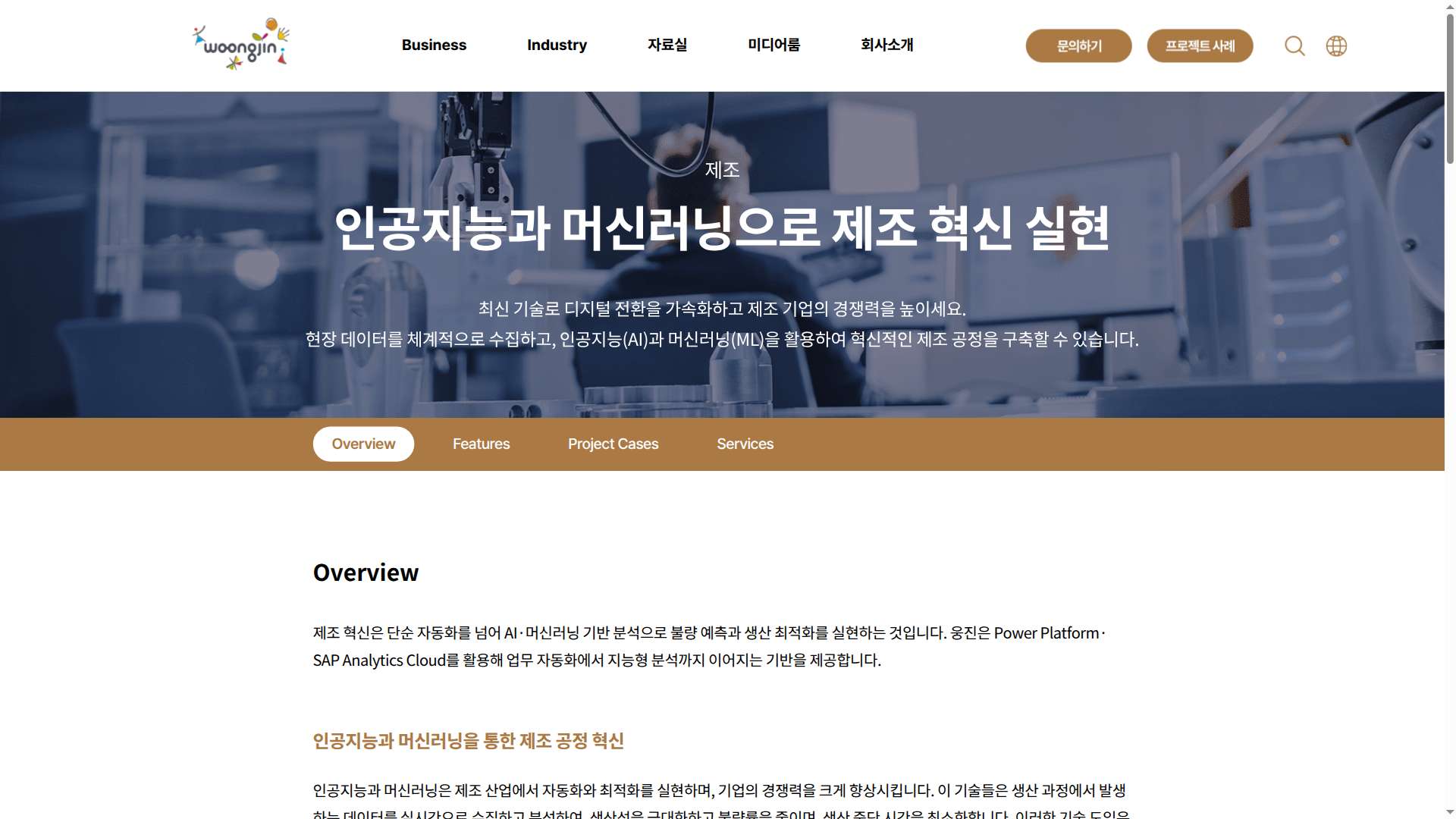
Woongjin Manufacturing AI & Machine Learning Solution
Service Overview & Value Proposition
Integrated seamlessly with platforms like Power Platform and SAP Analytics Cloud, the solution connects routine business automation with advanced intelligent analytics. By monitoring real-time production data and detecting anomalies early, it prevents unexpected downtime and drastically reduces maintenance costs.
Furthermore, sophisticated machine learning algorithms autonomously learn and predict quality degradation factors, minimizing defect rates and maximizing operational efficiency. It supports flexible process design centered on plans and objectives, elevating overall operational capabilities and strengthening global competitiveness for manufacturing enterprises.
In modern manufacturing industries where strict quality control and cost reduction are essential, Woongjin's solution empowers data-driven decision-making. Companies can efficiently allocate resources and build future-proof smart factories geared toward sustainable growth.
1. 💰 Monetization (24/30): The Woongjin Manufacturing AI and Machine Learning solution fundamentally improves the profit structure of manufacturing companies by preemptively predicting defect rates and optimizing production. Actual adopting companies can generate approximately 4.5 million dollars in additional economic value annually through reduced claim costs and improved quality yields. Integration with Power Platform and SAP Analytics Cloud enables real-time sales and cost data synchronization, drastically accelerating decision-making speed. However, to further maximize this revenue-generating effect, a complementary point exists to proactively combine intelligent demand forecasting modules linked with client ERP order trends beyond mere ex-post analysis. In addition, securing additional revenue sources will be possible if multi-scenario automated simulation functions capable of responding to supply chain volatility are strengthened. 2. 📉 Cost Reduction (24/30): By detecting anomalies in field facilities early and performing preventive maintenance, astronomical costs consumed by unexpected facility shutdowns are dramatically prevented. Replacing operational human resources previously invested in manual data collection and error verification processes yields direct resource and labor cost savings of approximately 3.2 million dollars annually. As it operates integrated with SAP EWM and smart factory packages, inventory holding costs are minimized and resource allocation efficiency is maximized. However, since additional consulting costs may occur during the initial large-scale data pipeline construction and legacy system integration process, improvement work to lower initial construction costs by further simplifying cloud-based modular onboarding processes is essential. In addition, internal training costs must be continuously reduced by advancing no-code-based dashboard interfaces that field workers can intuitively utilize without separate training. 3. ⚡ 10x Productivity (22/30): It provides powerful innovation that shortens work processing time by more than 70 percent compared to before by automating the entire process from field data collection and analysis to defect prediction. As the machine learning algorithm self-learns product quality degradation factors and provides feedback, the process improvement cycle is shortened from several weeks to real-time units. Bottlenecks in production lines are instantly resolved and overall OEE operation rates are maximized through flexible process design centered on plans and goals. However, to maintain algorithm accuracy in a rapidly changing manufacturing environment, a regular model retraining pipeline is essential, but the current structure has technical limitations requiring some manual intervention by specialized data engineers. To solve this, the system must be upgraded in the direction of minimizing human intervention by introducing a fully automated MLOps pipeline equipped with automatic data cleaning and model auto-tuning functions. 4. 🔍 Search & AI Optimization (8/10): The website's metadata and content structure effectively include keywords related to manufacturing digital transformation and smart factories such as smart factory, production optimization, artificial intelligence, and machine learning. Semantic markup and structured data are relatively faithfully implemented so that major search engines and AI answering engines can clearly recognize the core value and integration functions of the manufacturing AI solution. However, to further increase the citation rate of AI answering engines and conversational search bots, white papers and structured FAQ sections containing specific ROI figures and success stories of actual adopting companies should be reinforced more deeply at the bottom of the website. In addition, content marketing strategies that can respond to natural language queries from a business perspective entered into search engines by manufacturing executives must be pursued in parallel, moving away from descriptions centered on technical terms. 5. 📊 Overall Assessment: This solution targets the huge market opportunity of digital transformation in traditional manufacturing industries and secures clear technical architecture and enterprise-level interoperability. Although it is close to a red ocean market where many competing solutions already exist, it possesses Woongjin's differentiated weapon of strong ecosystem integration with SAP and Power Platform. Management should put quantitative performance indicators verified by actual clients at the forefront of the sales pipeline rather than simply introducing features. Introducing autonomous collaboration workflows between agents to evolve into a fully autonomous smart factory will enable building an unrivaled technical moat in the market.
💬 Feedback & Reviews (0)