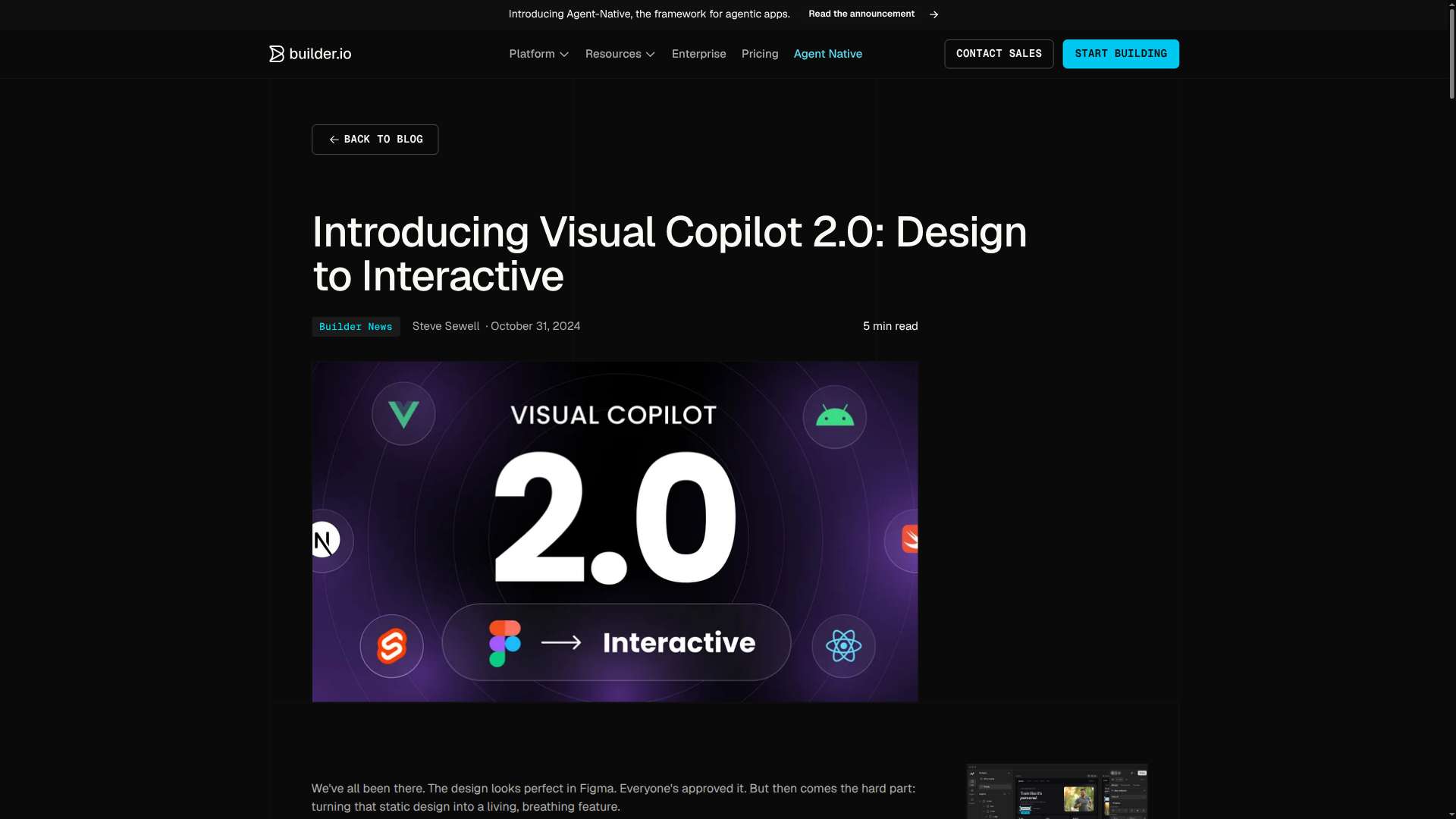
Builder.io Visual Copilot 2.0
Service Overview & Value Proposition
Historically, developers spent countless hours manually translating approved designs into code, while designers watched their visual vision get lost in translation, and product managers juggled timelines as minor UI updates turned into week-long projects.
Visual Copilot 2.0 fundamentally solves this by bringing its advanced AI assistant directly into the Builder Visual Editor, empowering teams to turn Figma designs into interactive features using natural language.
Unlike traditional AI tools that merely generate isolated components or static code snippets, Visual Copilot understands your entire tech stack, enabling everything from complete data tables to advanced features like sorting and pagination using your actual data and APIs.
Users can simply select any element within the editor and express their intent in plain natural language, such as transforming a static FAQ section design into a smooth, interactive accordion component.
This powerful workflow bridges the perennial gap between design and engineering, drastically reduces repetitive frontend implementation time, and accelerates overall product delivery.
By uniting designers, developers, and product managers around live, production-ready components driven by AI, Visual Copilot 2.0 redefines how modern web applications are built and iterated.
1. 💰 Monetization (23/30): Builder.io Visual Copilot 2.0 secures an exceptional business model that drastically accelerates product release cycles by directly converting Figma design assets into fully functional interactive frontend code. As static designs transform instantly into live features, enterprises can achieve approximately 3.4 million dollars in annual revenue growth through accelerated time-to-market and enhanced responsiveness to customer demands. However, the platform must evolve beyond a one-off design conversion tool into an advanced subscription tier that fully automates complex database schema and enterprise-grade API integrations, thereby solidifying a sustainable revenue generation pipeline. 2. 📉 Cost Reduction (22/30): This solution fundamentally eliminates communication errors where designer intentions are lost during implementation, while saving countless hours spent by frontend developers on repetitive publishing tasks. Considering the mitigation of schedule delay risks for product managers and reduced development outsourcing costs, companies can directly slash approximately 2.1 million dollars in annual operational expenses and labor costs. Nevertheless, the platform must further expand its developer-friendly custom plugin ecosystem to ensure seamless integration with diverse external legacy systems and bespoke internal APIs, alongside reinforcing guidance systems to lower the learning curve during initial setup. 3. ⚡ 10x Productivity (24/30): The ability to transform an FAQ section into an interactive accordion using natural language commands and generate complex data tables with sorting and pagination demonstrates an explosive productivity boost that reduces task execution time by over 80 percent compared to manual work. The technical maturity is remarkably high, as the AI assistant embedded within the Builder Visual Editor accurately comprehends the entire technology stack and reliably outputs production-ready code. However, adding a multi-agent-based code review layer that automatically verifies generated code quality and security vulnerabilities while providing real-time feedback would elevate team reliability and overall workflow stability to the next level. 4. 🔍 Search & AI Optimization (7/10): The provided site meta tags, blog post structures, and robots configuration are systematically organized to allow search engines and AI answer engines to effectively index its technical superiority. Especially thanks to structured documentation and semantic HTML tags emphasizing Builder.io's multiplayer AI development platform identity, it secures high visibility in searches for agentic app frameworks. Nevertheless, to further increase direct reference frequencies in conversational AI search engines like ChatGPT or Perplexity across the developer community and AI agent ecosystem, the platform needs to substantially reinforce structured markup and programming tutorial content within technical whitepapers and API reference documentation. 5. 📊 Overall Assessment: Visual Copilot 2.0 is evaluated as a highly original and effective AI frontend automation solution that dismantles the boundary between design and development. However, since numerous emerging competitive solutions are entering the design-to-code space with risks of becoming a red ocean, evolving into an agentic architecture that autonomously controls overall business logic and data binding beyond simple component generation is urgent. Management should establish this solution as an enterprise-standard prototyping tool to completely resolve silo mentalities between development and design departments, thereby building a true multiplayer AI collaboration framework.
💬 Feedback & Reviews (0)