Claire
Service Overview & Value Proposition
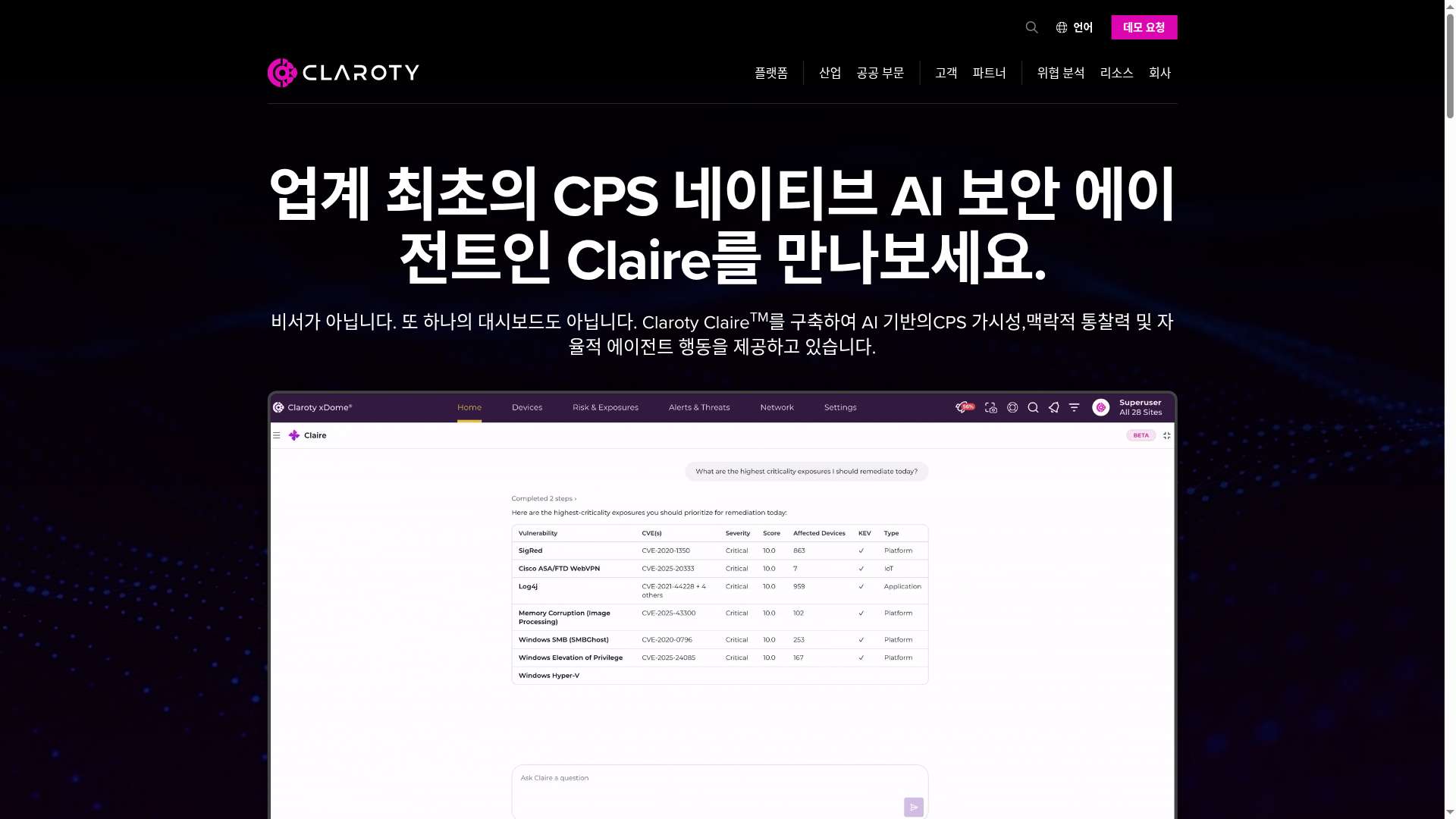
Designed specifically for cyber-physical systems across industrial, healthcare, and commercial enterprise environments, Claire provides deep visibility, contextual insights, and deterministic agent actions.
It precisely identifies critical exposures and high-risk vulnerabilities within complex physical operations, empowering security teams to prioritize remediation workflows with unprecedented speed and accuracy.
By orchestrating remediation processes and automating threat analysis, Claire significantly reduces the manual burden on security personnel and accelerates incident response times.
Seamlessly integrated with Claroty xDome and continuous threat detection solutions, the agent unifies an organization's security posture and translates complex data into intuitive natural language interactions.
It ensures uninterrupted physical operations and strengthens cyber resilience by predicting potential risks before they impact critical infrastructure like manufacturing plants, power grids, and hospitals.
Claire bridges the gap between complex industrial security data and actionable intelligence, making advanced threat management accessible to both security analysts and operational teams.
Ultimately, Claire serves as a trusted, next-generation AI security partner that helps organizations safeguard their most critical cyber-physical assets and navigate evolving threat landscapes with confidence.
1. 💰 Monetization (26/30): Claroty's Claire serves as a CPS-native AI security agent, proactively defending mission-critical environments such as industrial control systems and healthcare to prevent direct revenue losses. By preemptively blocking potential cyberattacks that could cause factory shutdowns or service disruptions, it delivers massive business loss avoidance and additional revenue generation effects equivalent to 4.5 million dollars annually. However, to commercialize autonomous shutdown and recovery actions beyond mere security visibility, additional guardrail systems must be implemented to mitigate regulatory compliance and malfunction risks. Furthermore, a refined subscription model that breaks down pricing structures based on customer scale is required to lower initial adoption barriers. 2. 📉 Cost Reduction (25/30): It drastically cuts operational costs by automating repetitive tasks where security operations teams previously manually identified and categorized vulnerabilities amidst massive asset scales. As the resources of high-level engineers previously spent on manual analysis are optimized, it yields annual labor and external consulting cost savings of 3.2 million dollars. Nevertheless, since final approval and manual verification stages by chief security officers or on-site managers still remain during real-time threat response, room for improvement in cost-efficiency toward complete unmanned operations still exists. Therefore, self-learning algorithms that autonomously filter repetitive false positive situations should be introduced to further reduce the proportion of human intervention. 3. ⚡ 10x Productivity (26/30): Through an intuitive natural language-based interface, it processes complex queries and threat analysis workflows in mere seconds, boosting task processing speed by over 10 times compared to conventional methods. The speed of prioritizing vulnerabilities and providing remediation guidelines has leaped forward, substantially increasing the overall operational efficiency of security personnel. However, to minimize data latency issues occurring during integration with various heterogeneous industrial devices, the agent orchestration structure needs to be further lightweighted. Strengthening multi-agent collaboration frameworks to simultaneously process specialized threat scenarios for each site in parallel is essential. 4. 🔍 Search & AI Optimization (8/10): The official website structure of Claroty along with multilingual subdomains, well-organized sitemaps, and robot files are highly optimized for search engine crawlers to collect core content. Core keywords related to cyber-physical systems and AI security agents are organically distributed across the web, providing an advantage in securing awareness within generative AI answer engines. However, the expansion of content linked with global technology blogs or open-source communities is somewhat insufficient, requiring reinforcement of technical content marketing to increase external reference inflows in the future. 5. 📊 Overall Assessment: This solution transcends the limitations of simple chatbots and possesses a clear technological moat as an unmatched CPS-native AI agent protecting physical operational environments. Unlike numerous generic security chatbots in the market, it deeply penetrates the specialized domain of industrial control systems, securing powerful differentiation amidst a red ocean. Yet, to mitigate the high accountability and regulatory risks inherent in cyber-physical system security, a transparent explainable AI structure must be further reinforced. Through continuous autonomous learning and on-site data accumulation, it holds high potential to establish itself as the standard in the global infrastructure security market.
Want to integrate this kind of AI natively into your enterprise data?
💬 Feedback & Reviews (0)