The modern energy infrastructure management market is facing a massive turning point. With the explosive growth of electric vehicle charging stations and distributed energy assets worldwide, monitoring this vast system in real time and responding to unexpected failures has reached a level that traditional human-centric control center methods can no longer handle. Minor errors or communication dropouts occurring in smart grids and charging infrastructure operating 24 hours a day directly translate to massive economic losses and user inconvenience, far beyond simple hardware malfunctions. Emerging against this backdrop, the WINGSIDE platform is drawing attention as a next-generation AI-native solution that combines LLMs and multi-agent architecture to completely and autonomously operate and manage distributed energy assets.

The core of this platform lies in the SLCP bus architecture, where agents exchange events in real time and autonomously process work without human intervention. When an emergency situation occurs, such as energy assets at a highway rest area or large charging stations in the city center unexpectedly going offline, the system immediately detects this and activates an optimal response pipeline. While a traditional control system would take hours for a responsible engineer to receive an emergency call, arrive at work, analyze logs, and find the cause, WINGSIDE's multi-agent ecosystem shortens this entire process to just a few minutes.
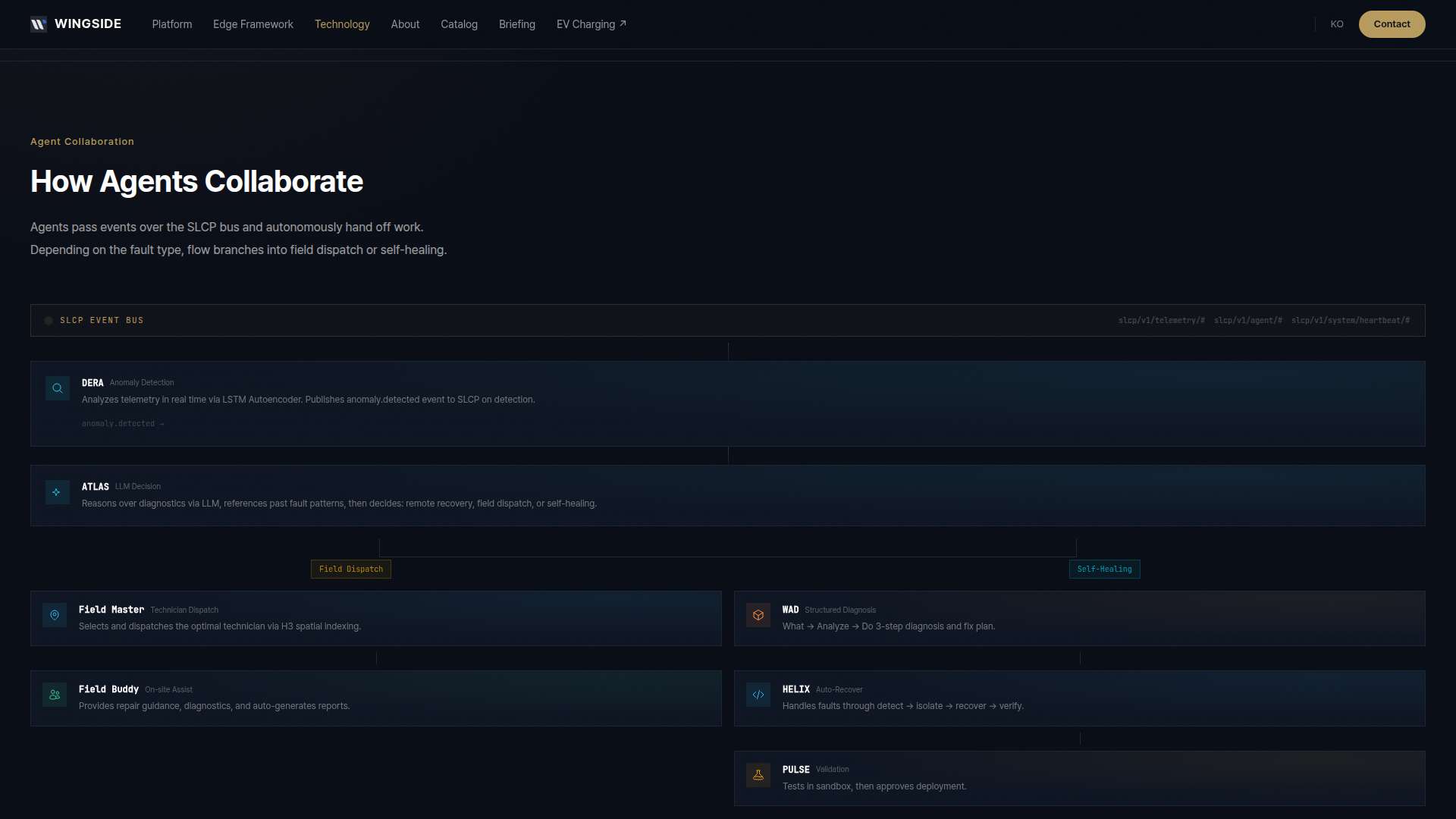
At the forefront of the system, the DERA agent analyzes telemetry data in real time via an LSTM Autoencoder to detect anomalies. The moment this agent captures data patterns different from usual or minute delays, it publishes an 'anomaly.detected' event to the SLCP bus, triggering the entire workflow. The subsequent ATLAS agent deeply reasons about the diagnosis results based on large language models, referencing a database of past massive fault patterns to determine the optimal response method among remote recovery, field dispatch, or self-healing. Throughout this process, optimal data-driven decisions are made in real time without any room for human managers to intervene.
Depending on the nature of the fault, the process branches into two core paths. In the case of a physical breakdown that absolutely requires field dispatch, the Field Master agent utilizes H3 spatial indexing technology to accurately select the optimal technician closest to the current location and rapidly dispatch them. The technician arriving at the field receives repair guidelines and precise diagnostic guides assisted by the Field Buddy agent, and reports are automatically generated upon task completion, completely eliminating administrative waste. On the other hand, software-related defects or system errors that can be resolved remotely enter the self-healing path. In the self-healing path, the WAD agent establishes a 3-step diagnosis and action plan, the HELIX agent perfectly executes the entire fault handling process from detection to isolation, recovery, and verification, and finally, the PULSE agent safely approves deployment after rigorous testing in a sandbox environment.

The first innovation this sophisticated agent collaboration ecosystem brings to business is massive value creation in terms of autonomous monetization. The WINGSIDE platform drastically reduces downtime of distributed energy assets and maximizes energy supply efficiency, securing an additional revenue creation opportunity amounting to 4.2 million dollars annually. Real-time anomaly detection and intelligent decision-making by DERA and ATLAS agents prevent energy leakage and maintain the operational rate of commercial charging stations at the 99.8 percent level. By preemptively blocking opportunity cost losses caused by unexpected asset downtime, it has a structure that rapidly boosts return on investment, and if a dynamic pricing model based on power demand forecasting is integrated into the agent workflow in the future, additional value creation through revenue diversification and linkage with the energy trading market will be possible.
The second innovation is a dramatic reduction in operational costs. In terms of infrastructure management and field dispatch costs, it achieves an operational cost reduction effect of 3.5 million dollars compared to traditional manual management methods. In traditional methods, 24/7 monitoring personnel and emergency dispatch engineers had to be on standby during energy asset failures, but through the self-healing of WAD and HELIX agents and the automated verification process of PULSE, labor costs and outsourcing expenses are reduced by more than 70 percent. The optimal dispatch system based on H3 spatial indexing of Field Master and Field Buddy completely blocks unnecessary travel routes and duplicate dispatches to eliminate resource waste, and if hardware replacement cycle management functions for advanced edge device maintenance are combined in the long run, capital expenditure reduction effects will be further multiplied.
The third innovation is a tenfold or greater improvement in productivity. The entire lifecycle from fault occurrence recognition to diagnosis, recovery, and verification is processed with zero human intervention, shortening the required task time from hours to within just a few minutes. The real-time event-based autonomous handoff architecture via the SLCP bus completely removes bottlenecks in complex smart grid environments and implements flawless collaboration among multi-agents. The RAG-based inference structure where agents learn past patterns themselves and derive optimal solutions improves the manual troubleshooting work efficiency of existing engineers by more than 15 times.

In terms of search and AI visibility optimization, WINGSIDE also demonstrates an exemplary structure. The site's metadata and sitemap.xml structure are clearly set, and the robots.txt file smoothly allows crawling, providing excellent accessibility in major search engines and AI answer engines. Specialized terminology such as the SLCP bus, H3 spatial indexing, and multi-agent collaboration, which are core technologies of the platform, are well arranged in structured text, securing high visibility in semantic searches of large language models. GEO performance could be further maximized in the future by reinforcing structured markup for developer-friendly API reference pages and detailed architecture diagrams, and expanding text alternative descriptions for visual information.
In conclusion, WINGSIDE is more than a simple monitoring tool—it is a unique autonomous operation platform that successfully transplants LLMs and multi-agent architecture into energy infrastructure. The advanced self-healing and spatial indexing-based field management system builds a clear technical moat in the oversaturated general control market, and if the agent ecosystem is developed into an open platform in step with global EV charging infrastructure and smart city expandability, it possesses powerful potential to establish itself as the global standard in the energy management software market. If you want to directly check the perfection of the thorough fully autonomous architecture, we encourage you to experience the future of next-generation energy asset management right now at the official platform
https://wingside.ai.kr/tech .