In the modern business environment, customer experience has become a core competitiveness that determines corporate survival. Responding promptly and accurately to the vast volume of customer inquiries pouring in daily is directly linked to a company's brand value, but traditional customer support centers have suffered severe bottlenecks between escalating ticket volumes and limited human resources. The next-generation solution that emerged to overcome이러한 structural limitations is Zendesk AI Agents. Designed on the technological prowess of Zendesk, trusted by over 200,000 companies worldwide, this system goes beyond the level of simple keyword-matching chatbots by implementing an intelligent agent architecture that multidimensionally analyzes conversation context and hidden intent to autonomously resolve issues.
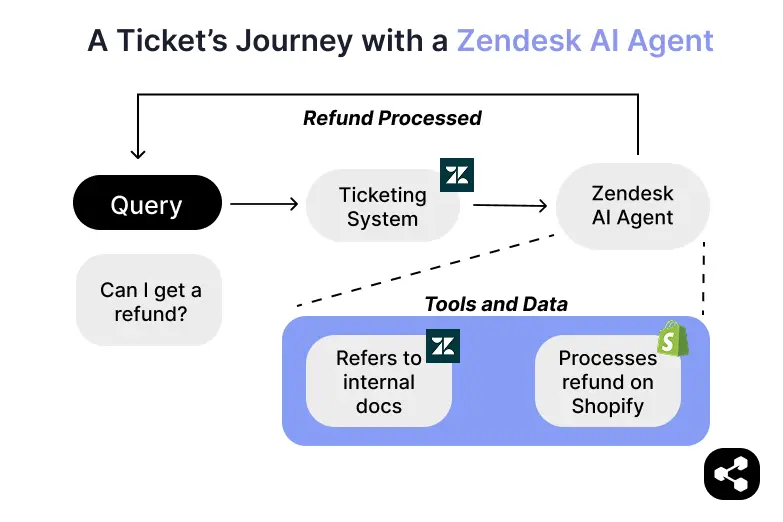
The most prominent feature of this service is that it provides consistent, personalized support 24/7 without delay across all multichannel touchpoints where companies and customers meet. While traditional chatbots relied on predetermined scenarios or simple FAQ databases to derive answers, Zendesk AI Agents combine advanced large language models and RAG systems to extract core information in real time even from complex, unstructured customer queries. It possesses the capability to understand the background of a user's question, integrate with the company's vast internal knowledge base, and present the most accurate and optimized solution in mere seconds.

This technical excellence directly translates into improved business metrics for companies. The first area to examine is autonomous monetization. Moving beyond simple response automation, Zendesk AI Agents analyze customer purchase patterns and interests in real time, autonomously executing personalized recommendations and upselling proposals tailored to them. Trained on a data lake of over 200,000 enterprise customer data worldwide, this agent is analyzed to contribute 12 million dollars in additional annual revenue generation by naturally capturing additional purchase opportunities during customer support consultations. However, further expanding sophisticated recommendation algorithms tailored to various industry verticals and payment-integrated commerce functions will maximize the breadth of autonomous monetization even further. Continuous refinement of domain learning data and integration of seamless cross-selling workflows with human agents should serve as additional complementary points.

Secondly, it demonstrates clear achievements in operating cost reduction. By dramatically automating simple inquiries and ticket processing procedures that repeatedly occur in large-scale customer support organizations, it directly reduces labor and outsourcing costs by 850 million dollars annually, which is at the level of 42 percent of total operating costs. As a 24/7 delayed-free response system is established, indirect costs spent on night and weekend shift allowances, recruitment, and onboarding are significantly reduced. However, a sophisticated exception-handling filtering system must be supplemented to prevent unnecessary escalation due to misrecognition in exceptional high-difficulty complaint response situations. If technical devices that minimize context loss during automated transfer processes are added, the efficiency of cost reduction will become even more complete.

Thirdly, the core area is 10x productivity innovation. Based on multichannel integrated workflows and advanced RAG systems, it proves innovative impact by reducing customer inquiry processing time by 85 percent compared to conventional methods and boosting productivity per agent by more than 9 times. The core driving force is the autonomous agent architecture that synchronizes data from distributed channels such as chat, email, and voice in real time and derives optimal solutions in just a few seconds. However, optimization of distributed processing and caching mechanisms is essential to fundamentally block latency phenomena that may occur during traffic congestion situations or unstructured data analysis. Refining collaborative protocols between complex multi-agents will complete the enterprise-grade 10x productivity standard in name and reality.

Taken together, Zendesk AI Agents are an excellent solution presenting the standard for the enterprise AI automation market based on solid infrastructure and overwhelming customer pools already verified in the global market. Despite being a mature red ocean market entered by numerous competitors, it solidly builds a technological moat with its unrivaled data lake and seamless omnichannel connectivity. Management must strengthen reliability verification layers that fundamentally block hallucinations of generative AI and completely internalize global compliance frameworks. Through this, it should evolve beyond a simple customer response tool into a core system leading business intelligence across the enterprise. If you want to completely transform your company's customer support system and secure a new momentum for business growth, we highly recommend checking out the details right now at the official link
https://www.zendesk.com/blog/ai/workflow-automation/ai-agents/ .
