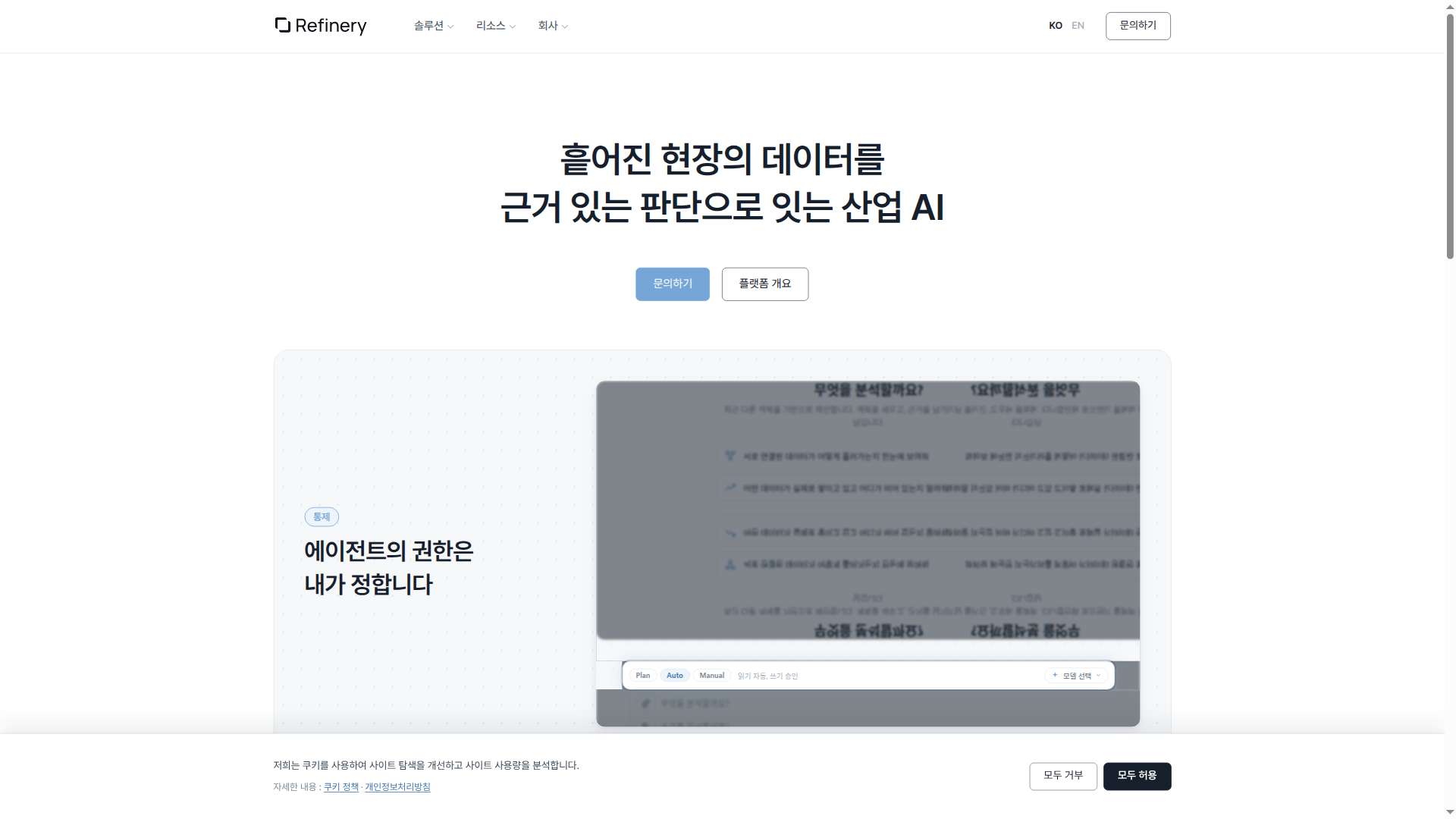
The digital transformation in manufacturing and energy plants, drawing attention from global tech magazines, goes far beyond simply introducing new software. Amidst the flood of massive data emanating from legacy systems maintained over decades and hundreds of sensors, enterprises have eagerly craved an innovative operating system capable of extracting truly meaningful insights. Emerging in response to this generational demand, Refinery is an industrial AI operating system designed to seamlessly integrate fragmented field data based on ontologies, enabling humans and AI to grasp situations in the exact same context and execute immediate actions.
Manufacturing and energy plant environments possess a high degree of complexity entirely distinct from general IT businesses. The field is a hybrid of diverse heterogeneous systems such as SCADA, MES, and ERP, where numerous sensor logs and technical documents are stored distributively. Conventional generic chatbots or fragmented automation tools have shown limitations in failing to understand the unique context of these industrial domains, frequently causing false alarms or remaining at the level of simple summarization. However, Refinery is engineered based on over 30 years of field experience and accumulated know-how, presenting answers and actionable guides strictly grounded in field data and domain knowledge.

The architecture of this platform is elaborately structured into four core layers: connection, ontology, apps, and AI agents. Gateways and connectors seamlessly link field facilities and legacy systems, granting consistency by defining all collected data into a single ontology model. Various applications such as dashboards, analysis tools, and workflows operate organically upon this common model, while AI agents perform 24/7 round-the-clock monitoring and precise analysis within the authority and control limits set by the user.
The autonomous monetization impact provided by Refinery from a business perspective is quite overwhelming. By directly executing predictive maintenance, quality prediction, and energy optimization through integrating manufacturing and energy plant field data into an ontology model, enterprises can proactively defend against downtime losses and generate new added value amounting to 18 million dollars annually. While preemptively blocking equipment failures and drastically defending against massive opportunity costs resulting from production line interruptions, it maximizes efficiency in the energy optimization sector, significantly raising financial performance.

Clear innovations are also proven in terms of operational cost reduction. By completely automating the traditional exhausting methods where field engineers manually analyzed logs and individually monitored hundreds of sensor abnormalities, human resources and outsourcing inspection costs required for data exploration and fault diagnosis can be reduced by more than 12 million dollars annually. Since AI agents constantly monitor and provide clear, evidence-based action guides, unnecessary field dispatches and malfunction costs due to human error are minimized, while simultaneously securing infrastructure deployment flexibility by supporting both cloud and on-premise hybrid environments.
Productivity 10x innovation indicators are also noteworthy. The time required from anomaly detection of field facilities to root cause analysis and action guide presentation is dramatically shortened from hours to within seconds, improving overall plant operational efficiency by more than 10 times. The four-step structure ranging from connection to AI agents effectively refines the complexity of large-scale industrial data, converging the effort of human direct analysis close to zero, and driving safe and reliable decision-making amidst complex processes.
In conclusion, Refinery is establishing itself as a core infrastructure fundamentally transforming the paradigms of the manufacturing and energy industries beyond mere software. It presents a powerful digital transformation answer to all enterprises seeking to lower the barriers of complex industrial data and realize clear data-driven decision-making, sufficiently proving its potential to leap forward as a global standard plant solution. Visit the official live service right now at
https://refinery.kr/industrial-ai to directly experience the pinnacle of next-generation industrial AI where field data connects to reasoned decisions.