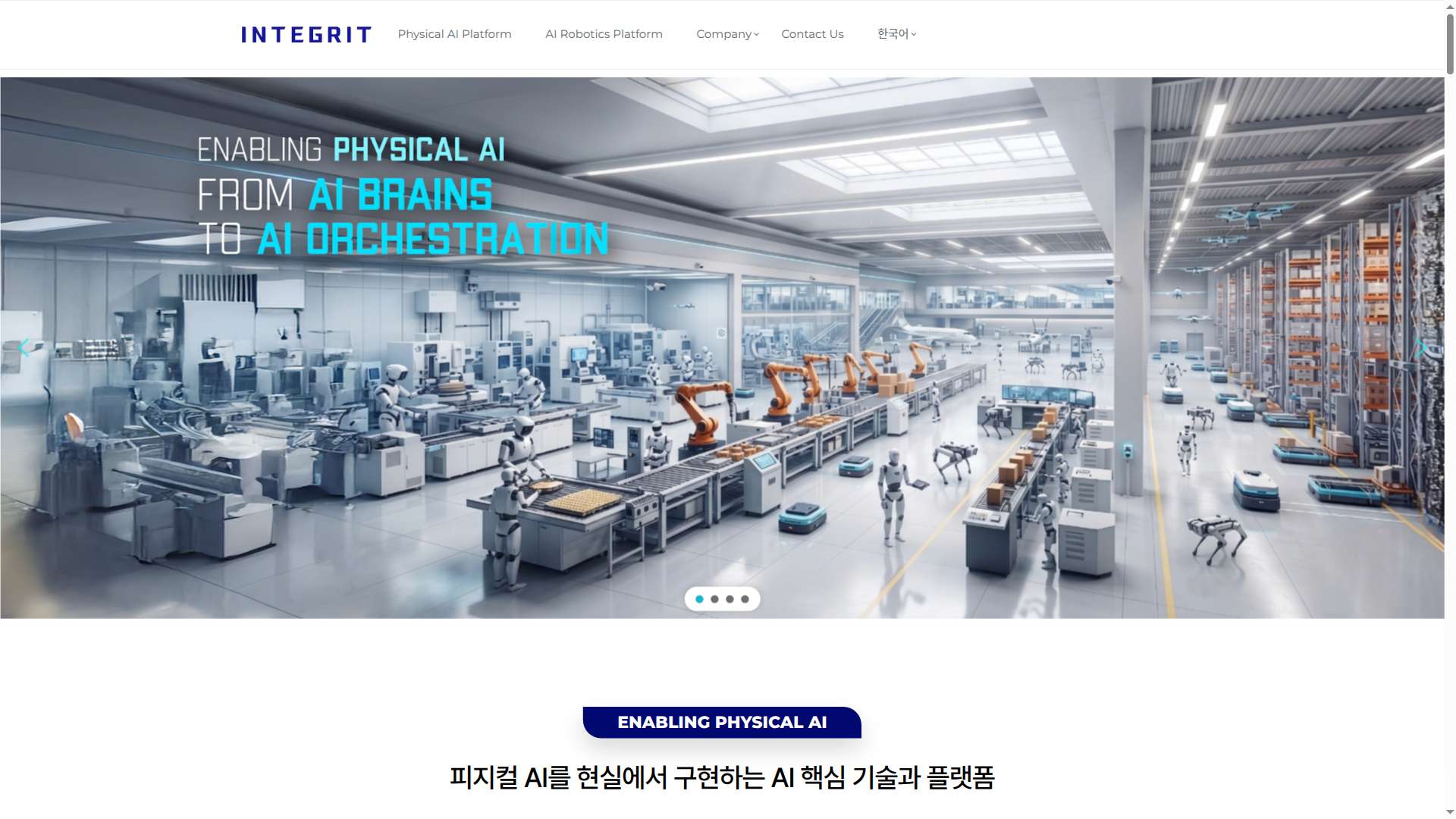
We are witnessing a monumental transition where artificial intelligence extends beyond virtual worlds into the physical real economy. While past AI remained confined to virtual spaces generating text or images, we have now entered an era of physical AI where intelligence moves factory manufacturing lines, controls autonomous mobile robots in logistics centers, and regulates smart home environments. However, amidst this massive trend, the vast majority of manufacturing enterprises and robot developers are running into severe technical barriers. Integrating high-performance AI models into physical hardware semiconductors and unifying heterogeneous robots with different protocols into a single system are highly complex tasks requiring immense time and investment.

To solve these industrial challenges, Integrit provides an integrated physical AI solution that organically combines AI semiconductors, system software, on-device AI execution environments, and robot orchestration platforms. The service goes beyond offering a single algorithm; it establishes an end-to-end technology pipeline ranging from initial hardware device bring-up, operating system porting, deep learning model lightweighting and optimization, to real-time control orchestration of all field robot data. This empowers developers and enterprises to minimize resources spent on complex embedded system engineering and migrate toward an environment focused on the practical physical implementation of artificial intelligence.
The core competitiveness of the Integrit platform begins in the domain of AI SoC and computing architecture design. It executes hardware integration for various AI semiconductors and NPUs while optimizing CPU, memory, and power resources to lay the groundwork for stably running AI even in low-power environments. Alongside this, it directly performs operating system porting such as Linux and Android, alongside BSP, kernel, device driver, hardware abstraction layer, and firmware development, ensuring that sensors, communication modules, and physical hardware resources are perfectly synchronized with the AI execution environment. The stability of such low-level system software plays a decisive role in securing malfunction-free safety in physical environments.
Building upon the foundation of system software, Integrit powerfully delivers on-device AI execution environments and model optimization capabilities. It converts and quantizes high-performance giant artificial intelligence models such as large language models, vision-language models, and vision-language-action models to fit target NPU environments, maximizing inference performance while minimizing memory usage. By organically integrating diverse frameworks such as ONNX and QNN, it perfectly implements on-device intelligence where edge devices perceive and infer in real-time without communication latency with cloud servers.

Furthermore, Integrit accelerates the commercialization of physical artificial intelligence through its robotics orchestration platform, which supports mission management for heterogeneous robots, AI model deployment, and real-time field data collection and integration. From collaborative robots on manufacturing floors to autonomous mobile robots in logistics centers and consumer appliance agents in smart homes, it provides centralized and distributed control environments allowing diverse devices to cooperate like a single organism to perform complex tasks. This acts as a core driving force maximizing efficiency in large-scale field deployment while inducing standardization across the robotics industry.
These technological innovations directly drive changes in corporate business structures and financial performance. First, in terms of autonomous monetization, Integrit is successfully transitioning traditional hardware-centric business models into high-value software and platform license models. By supplying comprehensive solutions ranging from AI semiconductors to system software, on-device AI execution environments, and robot orchestration, it induces direct productivity improvements in smart factories and logistics automation sites while creating new derivative revenue opportunities valued at 48 million dollars annually. However, ongoing supplementary development of open API ecosystem expansion and diversified subscription SaaS business models remains necessary to further enhance customized AI model optimization and compatibility with third-party hardware across various industrial sectors.
Second, regarding operating cost reduction, the platform automates and standardizes complex development processes ranging from initial AI SoC bring-up, deep learning model conversion and quantization, to embedded system software construction, drastically lowering R&D and engineering input costs for enterprises. By substantially reducing external outsourcing service costs and expert engineer resources previously consumed for manual hardware optimization and heterogeneous robot control, companies can achieve operating cost savings amounting to 32 million dollars annually. Nonetheless, advanced modular diagnostic and automated migration tools are additionally required to minimize custom engineering costs incurred during physical integration with legacy hardware infrastructures and sensors during initial deployment.
Third, concerning productivity innovation, the pipeline that automatically converts giant AI models such as LLM, VLM, and VLA to match target NPU environments and maximizes real-time on-device inference performance delivers overwhelming capabilities that shorten robot intelligence development cycles from several months to mere days. Through multi-agent environments and real-time data orchestration, the cognitive, reasoning, and behavioral response speeds of field robots are enhanced tenfold, driving a quantum leap in development productivity. However, technological enhancements must continue to stabilize NPU compiler optimization and real-time error handling mechanisms in pace with the rapidly changing update cycles of edge AI algorithms.
From the perspective of search engine optimization and AI discoverability, Integrit is optimally structured through structured metadata and clear technical keyword placement, enabling search engine crawlers and generative AI answer engines to accurately recognize and ingest the core value of the physical AI platform. The structural separation of English and Korean content alongside high utilization of concrete technical terminology ensures outstanding visibility in global markets. Continuously expanding reference case study content linked with global developer communities and tech blogs will further maximize authority and traffic acquisition in AI-driven search results.
Integrit establishes an undeniable technical moat as an exceptional physical AI platform leader that breaks down the boundaries between hardware and AI to implement artificial intelligence in the physical economy beyond mere robot control software. Unlike the increasingly saturated general chatbot market, the domain combining advanced embedded system software and robotics orchestration features extremely high barriers to entry, enabling differentiated competitive advantages in the global market. Management must further solidify market dominance by strengthening strategic partnerships with global semiconductor manufacturers and robot makers while leading platform standardization. You are encouraged to directly experience the future of physical AI where hardware and software are perfectly integrated and prepare for a new leap in your business. Detailed features and implementation plans for this innovative physical AI platform can be directly verified at the official website
https://integrit.ai/